|
Home • Research • Publication • Glossary • Contacts ______________________________________________
|
|
Thermo-Mechanical Stress in Cryopreservation
Cryopreservation
success revolves around controlling ice formation—the cornerstone of
cryoinjury. The current line of research focuses on suppressing
crystallization in the presence of highly viscous materials, known as
cryoprotective agents (CPAs), in a process known as vitrification (vitreous
in Latin means glassy). While vitrification is a well-understood
phenomenon, its application to biological systems comes with the potentially
harmful effects of toxicity of the CPA and structural damage due to
thermo-mechanical stresses. The
objective of this line of research is to reduce thermo-mechanical stress in
large-size specimens and thereby prevent structural damage. This line of
research integrates: (i) visualization of physical
events associated with cryopreservation using cryomacroscopy,
(ii) measurements of physical properties in cryogenic temperatures, (iii) modeling
for thermo-mechanical stress in vitrification, and (iv) simulations of
thermo-mechanical stress formation in cryopreservation protocols. While current
research efforts target the blood vessel as an investigation model, the
observed phenomena and analyses are applicable to a wide variety of
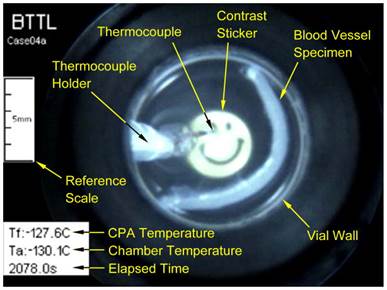
biomaterials and cryopreservation conditions. For example, a cryopreserved
blood vessel where both crystallization and fractures are
avoided—observed with a cryomacroscope [PubMed]:
Recent
research efforts at the BTTL focus on further suppressing ice growth by means
of synthetic
ice modulators (SIMs), and on decreasing thermo-mechanical stress during
the rewarming phase of the cryogenic protocol by means of volumetric heating
using magnetic nanoparticles in an AC magnetic field. Selected
publications: • Joshi, P., Ehrlich, L.E., Gao, Z., Bischof, J.C., Rabin, Y.
(2021): Thermal Analyses of Nanowarming-Assisted Recovery of the Heart from
Cryopreservation by Vitrification. 144(3):031202 (11 pages), ASME Journal of
Heat Transfer HT-21-1544 ASME • Joshi, P., Rabin, Y. (2021): Analysis of crystallization during
rewarming in suboptimal vitrification conditions: a semi-empirical approach.
Cryobiology, 103:70-80 Elsevier, PubMed • Rabin, Y. (2021): Mathematical modeling of surface deformation
during vitrification. Cryobiology, 102:34-41 Elsevier, PubMed • Solanki, P.K., Rabin, Y. (2021): Thermomechanical stress
analysis of rabbit kidney and human kidney during cryopreservation by
vitrification using radiofrequency heating. Cryobiology, 100:180-192 Elsevier, PubMed •
Solanki,
P.K., Rabin, Y. (2020): Scaling effects on the residual thermomechanical
stress during ice-free cooling to storage temperature, J. Appl. Mech. Oct
2020, 87(10): 101003 (8 pages) Paper
No: JAM-20-1203 https://doi.org/10.1115/1.4047420
•
Solanki,
P.K., Rabin, Y. (2018): Analysis of polarized-light effects in glass-promoting
solutions with applications to cryopreservation and organ banking, 13(6):
e0199155, PubMed,
HHS
Public Access, Plos ONE • Solanki, P.K., Bischof, J.C., Rabin, Y. (2017):
Thermo-mechanical stress analysis of cryopreservation in cryobags
and the potential benefit of nanowarming. Cryobiology, 76:129-139 PubMed, HHS Public
Access, ScienceDirect • Solanki, P.K., Rabin, Y. (2017): Thermal expansion of the
cryoprotective agent cocktail DP6 in combination with various synthetic ice
modulators, ASME Bioengineering and Biotransport Conference, Tucson, AZ, USA
(June 21-24) BTTL
Depository • Solanki, P.K., Bischof, J.C., Rabin, Y. (2017):
Thermo-mechanical stress analysis of cryopreservation in cryobags and the
potential benefit of nanowarming, Cryobiology, 76:129-139 PubMed, HHS Public
Access, ScienceDirect • Feig, J.S.G., Solanki, P.K., Eisenberg, D.P., Rabin, Y. (2016):
Polarized light scanning cryomacroscopy, Part II: thermal modeling and
analysis of experimental observations, Cryobiology, 73(2):272-281 PubMed, HHS Public
Access, ScienceDirect • Feig, J.S.G., Eisenberg, D.P., Rabin, Y. (2016): Polarized light
scanning cryomacroscopy, Part I: Experimental apparatus and observations of
vitrification, Crystallization, and Photoelasticity Effects, Cryobiology,
73(2):261-71 PubMed,
HHS Public
Access, ScienceDirect • Eisenberg, D.P., Bischof, J.C., Rabin, Y. (2015):
Thermo-mechanical stress in cryopreservation via vitrification with
nanoparticle heating as a stress-moderating effect, ASME Journal of
Biomechanical Engineering, 138(1), doi:
10.1115/1.4032053 PubMed,
ASME
Digital Collection • Eisenberg, D.P., Rabin, Y. (2015): Stress-strain measurements in
vitrified arteries permeated with synthetic ice modulators, ASME Journal of
Biomechanical Engineering, 137(8):0810071-0810077, doi:10.1115/1.4030294. PubMed, HHS Public
Access, ASME
Digital Collection • Eisenberg, D.P., Steif, P.S., Rabin, Y. (2014): On the effects
of thermal history on the development and relaxation of thermo-mechanical
stress in cryopreservation, Cryogenics, 64:86–94 PubMed, HHS Public
Access • Feig, J.S.G., Rabin, Y. (2014): The scanning cryomacroscope with
applications to cryopreservation – a device prototype, Cryogenics,
62:118–128 HHS
Public Access, ScienceDirect • Eisenberg, D.P., Taylor, M.J., Jorge L. Jimenez-Rios, Rabin, Y.
(2014): Thermal expansion of vitrified blood vessels permeated with DP6 and
synthetic ice modulators, Cryobiology, 68(3):318-26 PubMed, HHS Public
Access, ScienceDirect • Rabin, Y., Taylor, M.J., Feig, J.S.G., Baicu, S., Chen, Z.
(2013): A new cryomacroscope device (Type III) for visualization of physical
events in cryopreservation with applications to vitrification and synthetic
ice modulators, Cryobiology 67(3):264-73 PubMed, HHS Public
Access, ScienceDirect • Rabin, Y., Feig, J.S.G., Williams, A.C., Lin, C.C., Thaokar, C.
(2012): Cryomacroscopy in 3D: a device prototype for the study of
cryopreservation. ASME 2012 Summer Bioengineering Conference - SBC 2012,
Fajardo, Puerto Rico, USA (June 20-23) ASME
Digital Collection, BTTL
Depository • Eisenberg, D.P., Taylor, M.J., Rabin, Y. (2012): Thermal expansion
of DP6 combined with synthetic ice blockers in presence and absence of
biological tissues. Cryobiology, 65(2):117-125 PubMed, HHS Public
Access, ScienceDirect • Eisenberg, D.P., Rabin, Y. (2011): The effect of synthetic ice
blockers on thermal expansion of the cryoprotective cocktail DP6. ASME 2011
Summer Bioengineering Conference - SBC 2011, Farmington, PA, USA (June 22-25)
ASME
Digital Collection • Noday, D.A., Steif, P.S., Rabin, Y. (2009): Viscosity of
cryoprotective agents near glass transition: a new device, technique, and
data on DMSO, DP6, and VS55. Journal of Experimental Mechanics, 49(5):663-672
PubMed, HHS Public
Access, BTTL
Depository • Steif, P.S., Noday, D.A., Rabin, Y. (2009): Can thermal
expansion differences between cryopreserved tissue and cryoprotective agents
alone cause cracking? CryoLetters 30(6):414-421 PubMed, HHS Public
Access, BTTL
Depository • Baicu, S., Taylor, M.J., Chen, Z., Rabin, Y. (2008): Cryopreservation
of carotid artery segments via vitrification subject to marginal thermal
conditions: Correlation of freezing visualization with functional recovery.
Cryobiology, 57(1):1-8 PubMed,
HHS Public
Access, ScienceDirect,
BTTL
Depository • Steif, P.S., Palastro, M.C, Rabin, Y. (2008): Continuum mechanics
analysis of fracture progression in the vitrified cryoprotective agent DP6.
ASME Biomechanical Engineering, 130(2):021006 PubMed, HHS Public
Access, ASME
Digital Collection • Jimenez Rios, J.L., and Rabin, Y. (2007): A new device for
mechanical testing of blood vessels at cryogenic temperatures. Journal of
Experimental Mechanics 47:337–346 (Special issue on: Mechanics of
Organic, Implant, and Bioinspired Materials) PubMed, HHS Public
Access, BTTL
Depository • Steif, P.S., Palastro, M.C, Rabin, Y. (2007): The effect of
temperature gradients on stress development during cryopreservation via
vitrification. Cell Preservation Technology 5(2):104-115 PubMed, HHS Public Access,
BTTL
Depository • Jimenez Rios, J.L., Paul S. Steif, and Rabin, Y. (2007):
Stress-strain measurements and viscoelastic response of blood vessels
cryopreserved by vitrification. Annals of Biomedical Engineering
35(12):2077-2086 PubMed,
HHS Public
Access, Springer
Link, BTTL
Depository • Jimenez Rios, J.L., Rabin, Y. (2006): Thermal expansion of blood
vessels in low cryogenic temperatures, Part I: A new experimental device.
Cryobiology, 52(2):269-283 PubMed, HHS Public
Access, ScienceDirect,
BTTL
Depository • Jimenez Rios, J.L., and Rabin, Y. (2006): Thermal expansion of
blood vessels in low cryogenic temperatures, Part II: Measurements of blood
vessels vitrified with VS55, DP6, and 7.05M DMSO. Cryobiology, 52(2):284-294 PubMed, HHS Public
Access, ScienceDirect,
BTTL
Depository • Rabin, Y., Steif, P.S., Hess, K.C., Jimenez-Rios, J.L.,
Palastro, M.C. (2006): Fracture formation in vitrified thin films of cryoprotectants.
Cryobiology, 53:75-95 PubMed, HHS Public
Access, ScienceDirect,
BTTL
Depository • Baicu, S., Taylor, M.J., Chen, Z., Rabin, Y. (2006):
Vitrification of carotid artery segments: An integrated study of
thermophysical events and functional recovery towards scale-up for clinical
applications. Cell Preservation Technology, 4(4):236-244 PubMed, HHS Public
Access, BTTL
Depository • Steif, P.S., Palastro, M.C, Rabin, Y. (2006): Analysis of the
effect of partial vitrification on stress development in cryopreserved blood
vessels. Medical Engineering & Physics, 29(6):661-670 PubMed, HHS Public
Access, ScienceDirect,
BTTL
Depository • Rabin, Y., Steif, P.S. (2006): Solid mechanics aspect of
cryobiology, In: Advances in Biopreservation (Baust, J.G., and Baust J.M.,
Eds.), CRC Taylor & Francis, Chap. 13, pp. 359-382 • Rabin, Y., Plitz, J. (2005): Thermal expansion of blood vessels
and muscle specimens permeated with DMSO, DP6, and VS55 in cryogenic
temperatures. Annals of Biomedical Engineering, 33(9):1213 – 1228 PubMed, Springer
Link, BTTL
Depository • Rabin, Y., Taylor, M.J., Walsh, J.R., Baicu, S., Steif, P.S.
(2005): Cryomacroscopy of vitrification, Part I: A prototype and experimental
observations on the cocktails VS55 and DP6. Cell Preservation Technology,
3(3):169-183 PubMed,
HHS Public
Access, BTTL
Depository • Steif, P.S., Palastro, M., Wen, C.R., Baicu, S., Taylor, M.J.,
Rabin, Y. (2005): Cryomacroscopy of vitrification, Part II: Experimental
observations and analysis of fracture formation in vitrified VS55 and DP6.
Cell Preservation Technology, 3(3):184-200 PubMed, HHS Public
Access, BTTL
Depository • Rabin, Y., Steif, P.S. (2005): Letter-to-the-Editor: Analysis of
thermo-mechanical stress in cryopreservation. CryoLetters, 26(6):409-411 PubMed, HHS Public
Access, BTTL
Depository • Plitz, J., Rabin, Y., Walsh, J., (2004): The effect of thermal expansion
of ingredients on the cocktails VS55 and DP6. Cell Preservation Technology,
2(3):215-226 Mary Ann
Liebert, BTTL
Depository • Rabin, Y., Bell, E. (2003): Thermal expansion measurements of
cryoprotective agents. Part I: A new experimental apparatus. Cryobiology,
46(3):254-263 PubMed,
ScienceDirect,
BTTL
Depository • Rabin, Y., Bell, E., (2003): Thermal expansion measurements of
cryoprotective agents. Part II: Measurements of DP6 and VS55, and comparison
with DMSO. Cryobiology, 46(3):264-270 PubMed, ScienceDirect,
BTTL
Depository • Rabin, Y., Steif, P.S. (2000): Thermal stress modeling in
cryosurgery. International Journal of Solids and Structures 37:2363-2375 ScienceDirect,
BTTL
Depository • Rabin, Y., Rittel, D. (2000): Infrared temperature sensing of
mechanically loaded specimens: thermal analysis. Experimental Mechanics,
40(2):197-202 Springer
Link, BTTL
Depository • Dennis, B.H., Dulikravich, G.S., Rabin, Y. (2000): Optimization of
organ freezing protocols with specified allowable thermal stress levels.
International Mechanical Engineering Congress and Exposition 2000, Orlando,
FL, November 5-10, HTD-Vol. 368/BED-Vol. 47, pp. 33-48 BTTL
Depository • Rabin, Y., Steif, P.S. (1999): Thermal stress modeling of
freezing biological tissues. In: Advances in Heat and Mass Transfer in
Biotechnology, International Mechanical Engineering Congress and Exposition
1999, Nashville, Tennessee. HTD-Vol. 363, BED-Vol. 44, pp. 183-188 BTTL
Depository • Rabin, Y., Taylor, M.J., Wolmark, N. (1998): Thermal expansion
measurements of frozen biological tissues at cryogenic temperatures. ASME
Journal of Biomechanical Engineering, 120(2):259-266 PubMed, ASME
Digital Collection, BTTL
Depository • Rabin, Y., Steif, P.S. (1998): Thermal stresses in a freezing
sphere and its application to cryobiology. ASME Journal of Applied Mechanics,
65(2):328-333 ASME
Digital Collection, BTTL
Depository • Rabin, Y., Olson, P., Taylor, M.J., Steif, P.S., Julian, T.B.,
Wolmark, N. (1997): Gross damage accumulation in frozen rabbit liver due to
mechanical stress at cryogenic temperatures. Cryobiology, 34:394-405 PubMed, ScienceDirect,
BTTL
Depository • Rabin, Y., Steif, P.S. (1996): Analysis of thermal stresses
around a cryosurgical probe. Cryobiology, 33:276-290 PubMed, ScienceDirect,
BTTL
Depository • Rabin, Y., Steif, P.S., Taylor, M.J., Julian, T.B., Wolmark, N.
(1996): An experimental study of the mechanical response of frozen biological
tissues at cryogenic temperatures. Cryobiology, 33:472-482 PubMed, ScienceDirect,
BTTL
Depository Acknowledgements:
This research has
been supported, in part, by the • National Science Foundation (NSF), grant no. EEC 1941543 • National Heart Lung and Blood Institute (NHLBI) Grant
R01HL127618 • National Heart Lung and Blood Institute (NHLBI) Grant R01HL135046 •
National Heart Lung and Blood
Institute (NHLBI) Grant R01HL069944 •
National Institute of Biomedical
Imaging and Bioengineering (NIBIB) Grant R21EB011751 •
National Center for Research
Resources (NCRR) Grant R21RR026210 •
National Institute of General
Medical Sciences (NIGMS) Grant R21GM103407 •
National Heart Lung and Blood
Institute (NHLBI) Grant R01HL127618 • US Army – Defense Health Program Contract H151-013-0162 |
|
______________________________________________ |