

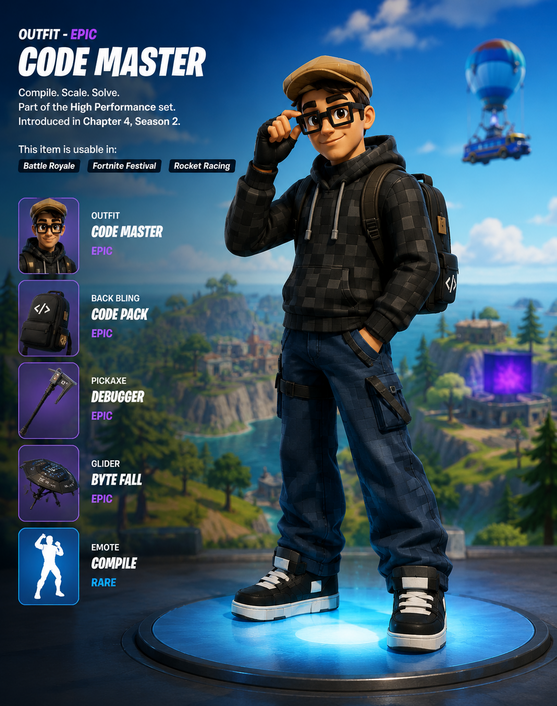
What is Fortnite?
Fortnite is a free-to-play online battle royale game developed by Epic Games, first released in 2017. In its most popular mode, 100 players are dropped onto an island, scavenge for weapons and resources, and fight until only one player (or squad) remains standing. The playable area shrinks over time through a closing storm circle, forcing players into increasingly intense encounters.
The game runs on PC, consoles (PlayStation, Xbox, Nintendo Switch), and mobile. It has consistently ranked among the most-played games in the world, with tens of millions of active players and peak concurrent counts in the hundreds of millions during major events.
Key characteristics that matter for our discussion:
- Real-time multiplayer: every player sees the same world state updated many times per second
- Persistent accounts: cosmetics, V-Bucks, battle pass progress, and stats persist across sessions
- Massive concurrency: thousands of simultaneous matches happening at any moment
- Global reach: players connect from every continent, expecting low latency
What is a Distributed System?
A distributed system is a collection of independent computers that communicate over a network and appear to users as a single coherent system. Three properties define it:
- No shared memory — components cannot read each other’s RAM directly; they exchange messages over the network
- Partial failure — some components can crash while others keep running
- Concurrency — components execute in parallel with no global clock to coordinate them
A single server talking to a single client is not a distributed system. It is a client-server architecture. The distinction matters: in a client-server setup, if the server goes down, everything stops. In a distributed system, work is spread across many machines so that no single failure brings the whole thing down.
Why Fortnite at Scale Is a Distributed System
The single-server ceiling
A single powerful server can handle perhaps a few hundred concurrent players before CPU, memory, and network bandwidth become bottlenecks. Fortnite runs hundreds of thousands of concurrent matches. No single machine on Earth can simulate all of those simultaneously, maintain all player accounts, handle all authentication requests, and serve assets globally — all at once.
The only solution is to split the work across many machines.
The services that make up Fortnite’s backend
What looks like “the Fortnite server” to a player is actually a collection of specialized services, each running on its own cluster of machines:
| Service | Responsibility |
|---|---|
| Game servers | Simulate individual matches — physics, player state, zone shrinkage |
| Matchmaking service | Group players by skill, region, and ping before a match starts |
| Authentication service | Verify player identity; integrate with Epic account, PlayStation Network, Xbox Live |
| Inventory/progression service | Store skins, V-Bucks, battle pass tier, and stats per account |
| Social/party service | Friend lists, party formation, voice chat coordination |
| Store service | Serve the rotating item shop; handle V-Buck purchases |
| CDN (Content Delivery Network) | Distribute game patches and assets from servers geographically close to each player |
| Telemetry/analytics | Collect gameplay events for anti-cheat, balancing, and monitoring |
Each of these runs independently. They communicate with each other over the network using APIs and message queues.
The four properties that make it distributed
1. No shared memory
A game server running your match in one data center cannot directly read the inventory database running in another. When your match ends and your stats need to be updated, the game server sends a network message to the progression service. That service writes to its own database. This message-passing model is fundamental to distributed systems.
2. Partial failure
You have almost certainly seen a Fortnite in-game notice like “The item shop is currently unavailable.” This is partial failure in action. The store service went down, but your match kept running. Authentication still worked. Your friends list still loaded. In a non-distributed system, one failure would cascade and take everything with it. In a distributed system, each service fails independently.
3. No global clock
When two events happen on different servers — say, two players eliminate each other at the same millisecond — there is no single authoritative clock to say which happened first. The game server running that match must resolve the conflict using its own local state. Meanwhile, the progression service records both eliminations based on the messages it receives, potentially out of order. Distributed systems use techniques like vector clocks, logical timestamps, and consensus protocols (e.g., Raft, Paxos) to manage ordering without a global clock.
4. Data partitioning (sharding)
Fortnite has hundreds of millions of registered accounts. No single database server can store all of that. Player data is sharded — split across many database instances based on some partition key (often a hash of the player ID). A query for player A’s inventory goes to shard 3; a query for player B’s inventory goes to shard 17. The sharding layer is invisible to the application code, but it is a core distributed systems technique.
Regional distribution and latency
Fortnite runs data centers in multiple geographic regions — North America, Europe, Asia-Pacific, South America, and others. When you connect, matchmaking routes you to the region with the lowest ping. This geographic distribution is itself a distributed systems concern: it introduces questions about data consistency (is your account data the same in every region?), replication lag, and failover (what happens when a whole regional data center goes offline?).
The Key Insight
The individual game server running your specific match is not a distributed system — it is one process on one machine. But that machine is one node in a much larger distributed system that spans hundreds of servers, multiple regions, and dozens of independent services.
From your perspective as a player, it all looks like “Fortnite.” That seamless appearance — hiding the complexity of thousands of coordinated machines — is exactly what a distributed system is designed to achieve.