|
| BIOGRAPHY | WORKS | PERFORMANCE | RECORDINGS | MEDIA |
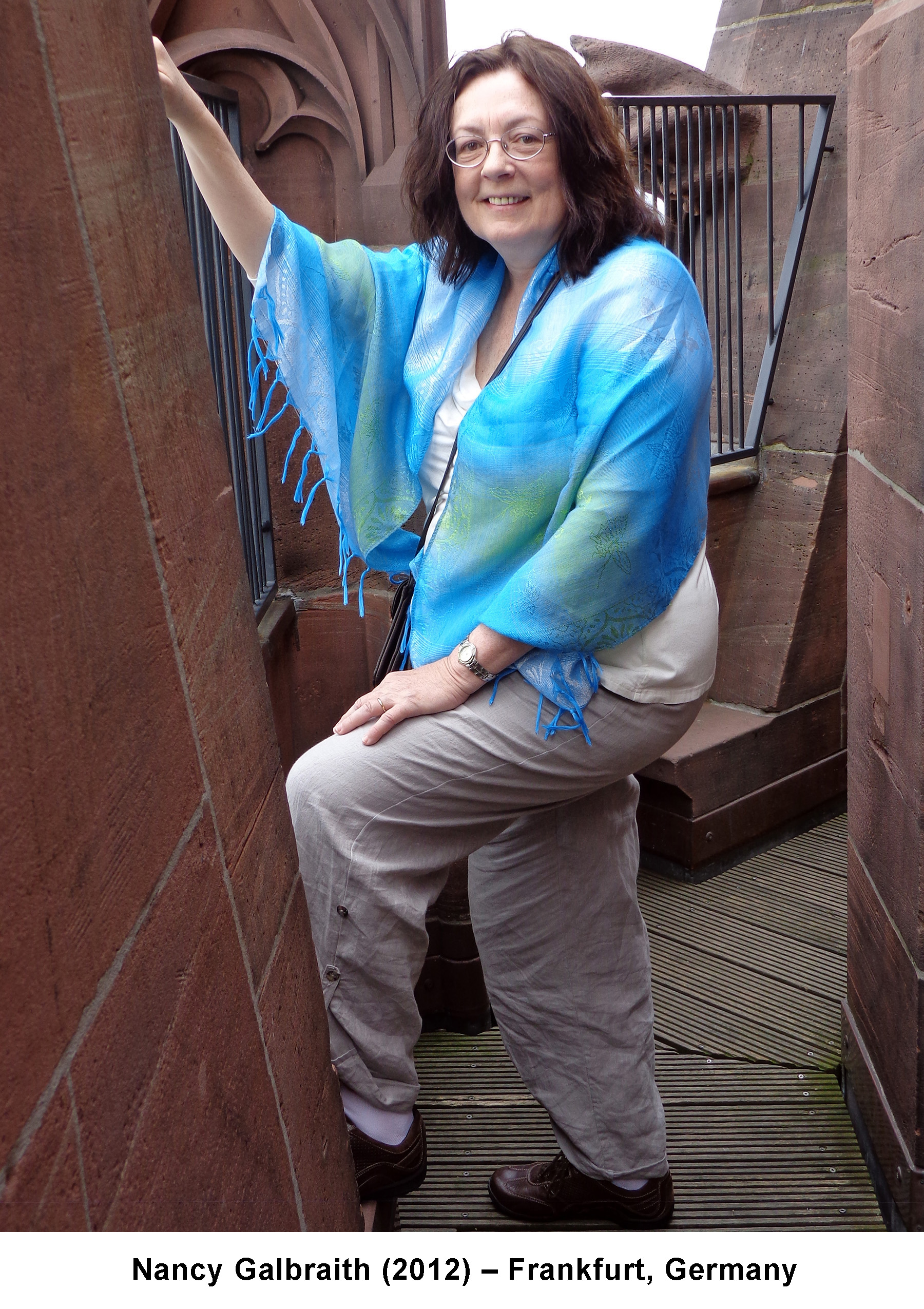
Nancy Galbraith (b.1951) resides in Pittsburgh, Pennsylvania, USA, where she is Chair of Composition at the Carnegie Mellon University School of Music, and holds the Vira I Heinz Professorship of Music endowed chair at the College of Fine Arts. In a career that spans four decades, her music has earned praise for its rich harmonic texture, rhythmic vitality, emotional and spiritual depth, and wide range of expression. Her works have been directed by some of the world's finest conductors, including Gennady Rozhdestvensky, Mariss Jansons, Keith Lockhart, Donald Runnicles, Robert Page, and Manfred Honeck. Her compositions are featured on numerous recordings, including eleven anthologies. With major contributions to the repertoires of symphony orchestras, concert choirs, wind ensembles, chamber ensembles, electroacoustic ensembles, and soloists, Galbraith plays a leading role in defining the sound of contemporary classical music. |
 |
|||
CAREER HIGHLIGHTS | ||||
SYMPHONY ORCHESTRA |
|
Galbraith has enjoyed numerous performances by the Pittsburgh Symphony Orchestra, beginning in 1988 with Morning Litany conducted by Gennady Roshdetsvensky. Most recently, the orchestra performed Tormenta del Sur with conductor Manfred Honeck. In 2014, the PSO performed Euphonic Blues in four subscription concerts. Two reviews of those concerts in Pittsburgh newspapers offer a fair summation of all the composer's orchestral works: Euphonic Blues...is impressive in its emotional range, rewarding for the course of its musical ideas and masterly in its orchestral palette...it was a joy to discover and received a standing ovation. —Pittsburgh Tribune-Review Euphonic Blues...navigates a rich orchestration and varied tonal landscape, at once poignant then triumphant...Her harmonic language has a moving familiarity to it; those comforting flavors contrasting with an exotic-sounding 7/8 section. —Pittsburgh Post-Gazette 1988: The Pittsburgh Symphony Orchestra premiered Morning Litany in four subscription series concerts directed by the eminent Russian conductor Gennady Rozhdetsvensky. 1992: The Orquesta Sinfónica de Tucumán premiered Danza de los Duendes in San Miguel de Tucumán, Argentina, with conductor Eduardo Alonso Crespo. Later that year the Pittsburgh Symphony Orchestra performed the work in its new outreach concert series titled "Concert of the Future." 1994: The Cincinnati Chamber Orchestra, conducted by Keith Lockhart (Boston Pops, Utah Symphony), recorded Piano Concerto Nº 1, with pianist Ralph Zitterbart, at the Emory Theater in Cincinnati, Ohio. The recording was released two years later on Ocean Records' album titled New Energy From the Americas. The concerto was aired on radio stations across North America, and received praise from Fanfare Magazine, American Record Guide, and the Cincinnati Inquirer who wrote, A formidable work for piano in three movements, this is an equally virtuoso piece for orchestra, and a welcome addition to the concerto literature of this century.In 1997 USAirways featured the third movement of the concerto on its classical music station, in a program titled "Great Piano Music". 1995: The Orquesta Sinfónica de Tucumán premiered Tormenta del Sur in San Miguel de Tucumán, Argentina, with conductor Eduardo Alonso Crespo. The city's newspaper, La Gazeta, hailed Galbraith as ...one of the most outstanding composers of her generation along with Philip Glass and John Adams.The work has been performed by a number of other orchestras, notably the Pittsburgh Symphony Orchestra and the Orquesta Sinfónica de Veracruz. 1998: The Pittsburgh Symphony Orchestra commissioned and premiered A Festive Violet Pulse for a celebration welcoming its new music director Mariss Jansons. This compact and high-energy 3-minute work has become a popular concert opener for orchestras all across the US. 2002: The Pittsburgh Symphony Orchestra premiered De profundis ad lucem at California University of Pennsylvania, who commissioned the work to celebrate the school's 150th anniversary. In 2011, the work receive its European premiere with the Limburgs Symfonie Orkest in the Netherlands. 2003: The Johnstown Symphony Orchestra (Pennsylvania) commissioned and premiered Fantasy for Orchestra to celebrate its 75th concert season. 2005: Requiem was premiered by the Mendelssohn Choir of Pittsburgh with the Academy Chamber Orchestra at Carnegie Music Hall in Pittsburgh. Commissioned by music director Robert Page, the work concluded the celebrated conductor's 26th and final year with the Mendelssohn Choir. Requiem is a landmark display of the composer's creative and technical mastery crafted into a work of profound inspiration and spiritual power. Galbraith's "Requiem" is a masterpiece that had the audience members on their feet at the end, cheering with tears in their eyes. —Pittsburgh Tribune-Review 2012: Euphonic Blues was commissioned and premiered by the Carnegie Mellon Philharmonic Orchestra, led by Belgian conductor Ronald Zollman, for the 100th anniversary celebration of the Carnegie Mellon University School of Music. The work was later included in the program of Galbraith's Centaur Records CD titled Nancy Galbraith: Strange Travels. 2014: The Pittsburgh Symphony Orchestra presented Euphonic Blues with famed Scottish conductor Donald Runnicles in three subscription series concerts. 2017: The Westminster Choir and Orchestra of Montview, with conductor Adam Waite, presented the premiere of the symphony orchestra version of Missa Mysteriorum, which was adapted by Galbraith from her original 1999 work, scored for chorus and wind ensemble. 2018: Pianist Sung-Im Kim premiered Galbraith's Piano Concerto Nº 3 with the Chamber Orchestra of Pittsburgh, conducted by Edward Leonard. 2019: For Behold From Henceforth was premiered with the Westmoreland Symphony Orchestra, featuring soprano Meghan DeWald. It was presented at a Christmas concert at the Palace Theater in Greensburg, Pennsylvania led by Maria Sensi Sellner. 2022: The Carnegie Mellon Philharmonic Orchestra premiered the orchestra version of Strange Travels, conducted by Lawrence Loh at Carnegie Music Hall in Pittsburgh. 2023: Piano Concerto No. 4 was premiered by NAT 28 Contemporary Music Ensemble with conductor Daniel Nesta Curtis at the Kelly-Strahorn Theater in Pittsburgh. 2024: The Pittsburgh Symphony Orchestra presented Tormenta del Sur in four subscription concerts under the direction of Maestro Manfred Honeck. The piece set up a groove in low strings and low brass and built to a succession of dramatic climaxes in waves. This was a lovely 10-minute work. —Pittsburgh Post-Gazette 2024: The Carnegie Mellon Philharmonic Orchestra, led by Daniel Nesta Curtis, premiered Galbraith's Ominous Seasons, a one-movement work for orchestra. |
CONCERTOS |
|
1994: The Cincinnati Chamber Orchestra, conducted by Keith Lockhart (Boston Pops, Utah Symphony), recorded Piano Concerto Nº 1, with pianist Ralph Zitterbart, at the Emory Theater in Cincinnati, Ohio. The recording was released two years later on Ocean Records' album titled New Energy From the Americas. The concerto was aired on radio stations across North America, and received praise from Fanfare Magazine, American Record Guide, and the Cincinnati Inquirer who wrote, A formidable work for piano in three movements, this is an equally virtuoso piece for orchestra, and a welcome addition to the concerto literature of this century.In 1997 USAirways featured the third movement of the concerto on its classical music station, in a program titled "Great Piano Music". 2000: Galbraith's unique and spirited Concerto for Piano and Wind Ensemble (Piano Concerto Nº 2) debuted with the Slippery Rock Wind Ensemble and pianist Nanette Solomon. The concerto has since found its way into the concert band repertoire, with notable performances in Chicago, Virginia, Germany, and Cornell University. 2006: The premiere of Traverso Mistico by the Carnegie Mellon Contemporary Ensemble marked the beginning of Galbraith's series of electro-acoustic works for Baroque flutist Stephen Schultz. The performance also featured a solo electric cello, played by Barney Culver. A live recording of the premiere is featured on Centaur Records' Nancy Galbraith: Other Sun (2012).
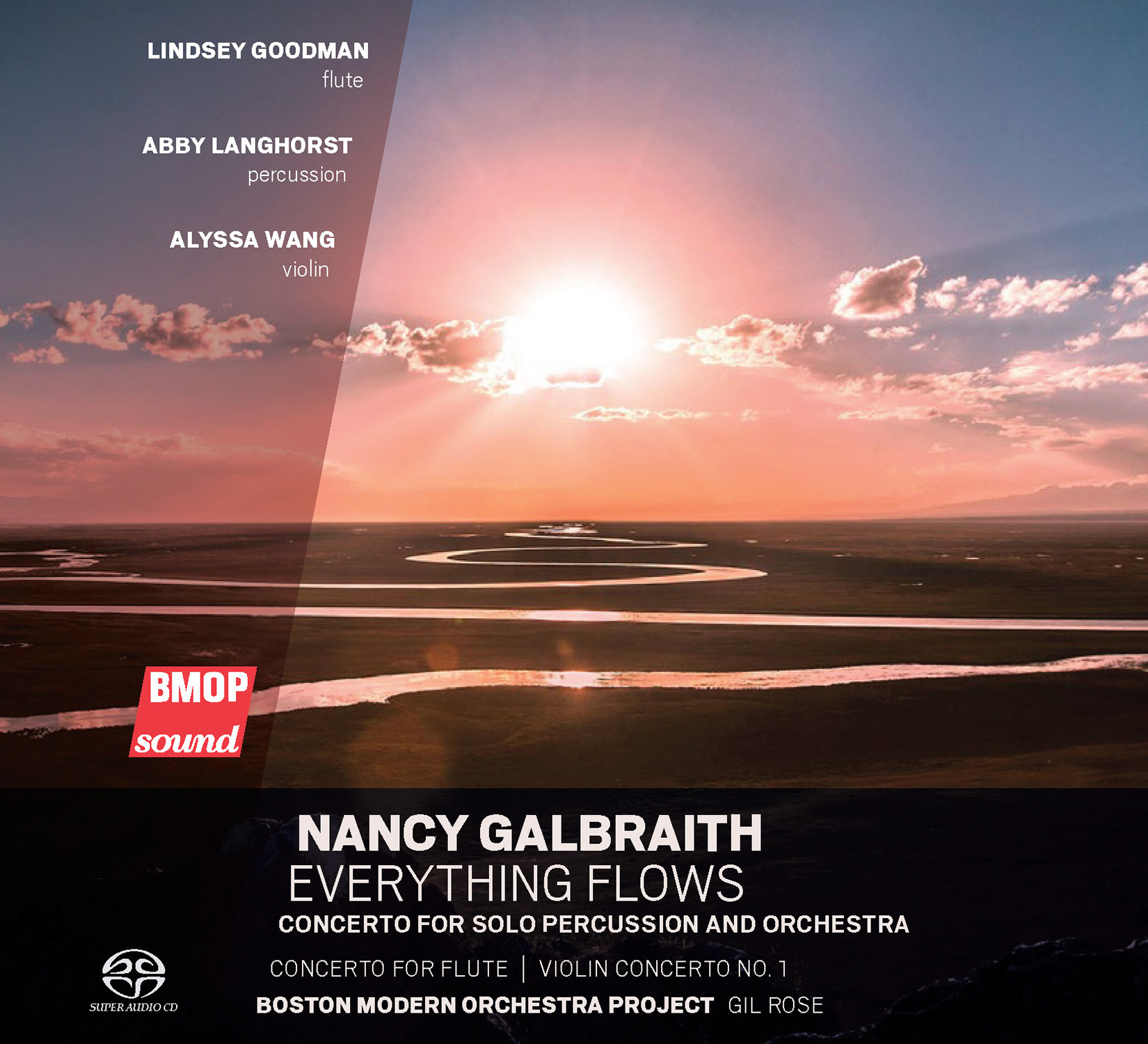
2012: Effervescent Air was premiered by the Carnegie Mellon Baroque Ensemble, with featured performances by Stephen Schultz (electric Baroque flute) and Luz Manriquez (piano). This was the fourth electro-acoustic work composed for Schultz, which also featured amplified piano with delay and reverb pedals. The work was recorded for Centaur Records' Nancy Galbraith: Strange Travels released in 2014. Daniel Nesta Curtis conducted the ensemble for both the premiere and the recording. 2016: Dancing Through Time was premiered by the Carnegie Mellon Contemporary Ensemble, featuring electro-acoustic performances by faculty stars Stephen Schultz (Baroque flute) and David Harding (viola). Artistic director Daniel Nesta Curtis led the performance and directed the studio recording for the indie CD Nancy Galbraith: Dancing Through Time, released on CD Baby later that year. 2016: The Hoodlebug Brass joined the Pittsburgh Youth Philharmonic Orchestra to perform the world premiere of Galbraith's Concerto for Brass Quintet. 2017: Alyssa Wang premiered Galbraith's Violin Concerto Nº 1 with the Carnegie Mellon Contemporary Ensemble, conducted by Daniel Nesta Curtis. 2018: Sung-Im Kim premiered Galbraith's Piano Concerto Nº 3 with the Chamber Orchestra of Pittsburgh, conducted by Edward Leonard. 2019: Percussionist Abby Langhorst premiered Galbraith's Everything Flows (Percussion Concerto Nº 1) with the Carnegie Mellon Contemporary Ensemble, conducted by Daniel Nesta Curtis. 2019: Lindsey Goodman premiered Galbraith's Flute Concerto Nº 2 with Pittsburgh's Resonance Works, conducted by Daniel Nesta Curtis. 2023: After two cancellations due to the pandemic, Transcendental Shifts, an electro-acoustic double concerto for flute and viola, was premiered by the Carnegie Mellon Contemporary Ensemble, featuring performances by faculty stars Stephen Schultz (Baroque flute) and David Harding (viola). Artistic director Daniel Nesta Curtis directed the concert, which included the premiere of Nocturne for Flute played by Schultz with the Contemporary Ensemble.
Galbraith's recent concertos are expert creations. This release is highly recommended. —Sequenza [Galbraith] writes in a tonal post-minimalist style recognizable by its rhythmic groove, highly saturated instrumental color, and genial, laid-back tone. —American Record Guide |
WIND ENSEMBLES |
|
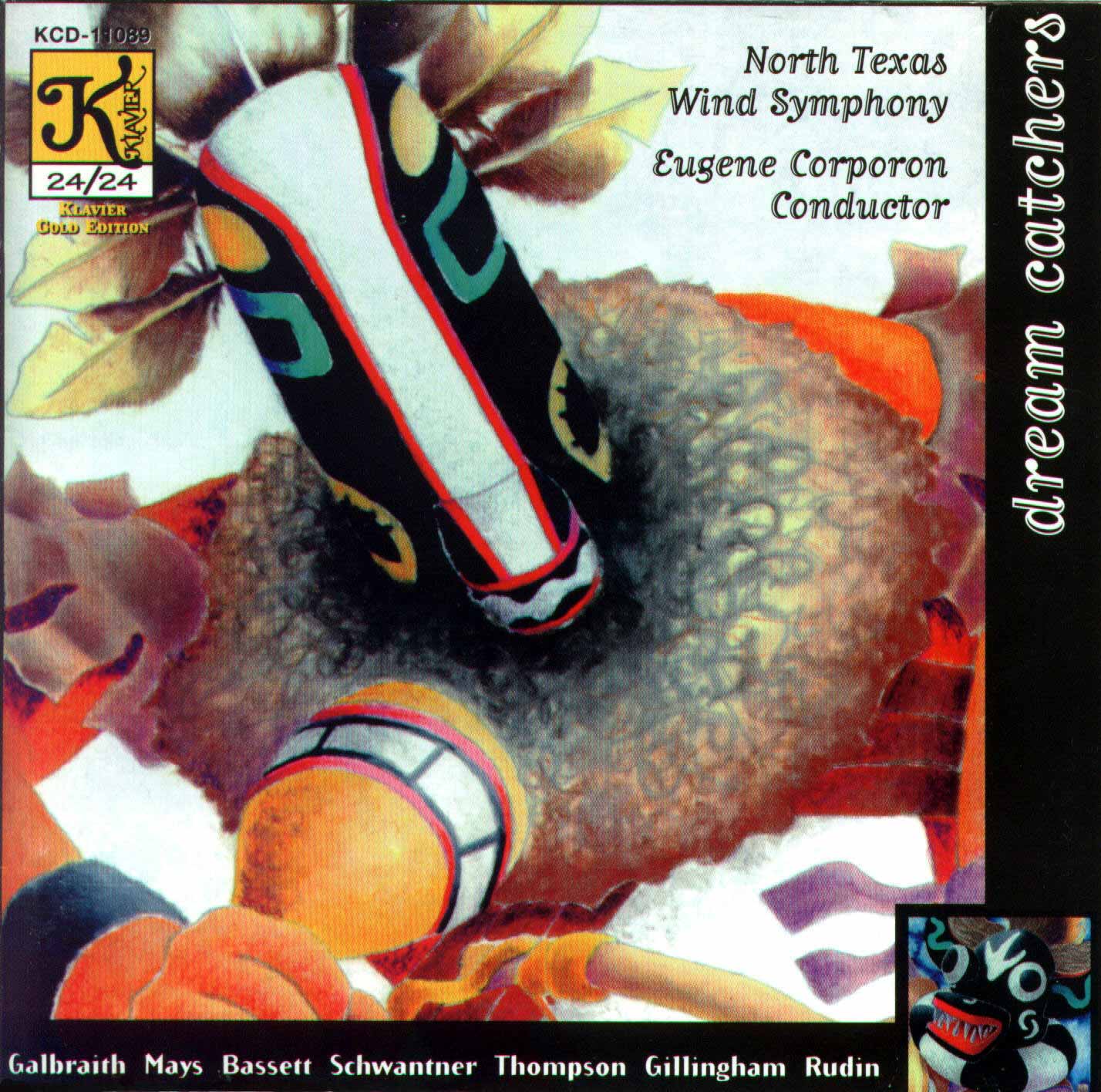
Nancy Galbraith has attained international recognition as a composer of wind ensemble music. Her works have become standard repertoire for concert bands, brass bands, and flute choirs around the world, and are regularly performed and recorded by some of the world's finest ensembles. The immediate success of Galbraith's earliest works for wind ensembles—with brightness round about it and Danza de los Duendes—may be attributed to the fact that they were among the first post-minimalist works by a prominant composor written specifically for concert bands, for which band directors's had been eagerly awaiting in the later part of the 20th century. 1993: Galbraith's popularity in the concert band domain began with the premiere and recording of with brightness round about it by the Carnegie Mellon Wind Ensemble under the direction of Denis Colwell. Numerous performances quickly followed by both professional and college bands, notably the University of North Texas, Cincinnati University College Conservatory of Music, several California State University bands, the World Youth Symphony, Riverside Winds (CA), Banda Sinfônica de Cubatão (Brazil), and many others. It appeared on additional recordings by Drake University and the Waukesha Area Symphonic Band. 1996: The Waukesha Area Symphonic Band commissioned and premiered Wind Symphony Nº 1 to celebrate the 20th anniversary of the Women's Center in Waukesha, Wisconsin. In 2003, the work was included on the program of the Albany Records disc titled Nancy Galbraith: Atacama. Galbraith's wind symphony has been presented in concerts by several American college bands and by professional bands in the Netherlands, including the Rotterdam Symphony Orchestra.
1998: Galbraith rescored with brightness round about it for the River City Brass Band in Pittsburgh, Pennsylvania, where it was performed in seven subscription series concerts led by music director Denis Colwell. 1998: Elfin Thunderbolt was premiered by the Indiana University of Pennsylvania Wind Ensemble with music director (and noted composer) Jack Stamp. "Elfin" has also been played by bands at Lehigh University, New Jersey City University, two California State Universities, and by festival bands assembled for conferences held by the Pennsylvania Music Educators Association and the California Music Educators Association. 2000: Galbraith's unique and spirited Concerto for Piano and Wind Ensemble debuted with the Slippery Rock Wind Ensemble and pianist Nanette Solomon. The concerto has since found its way into the concert band repertoire, with notable performances in Chicago, Germany, and Cornell University. A recording of the concerto will be released early in 2017 along with the re-release of the composer's Piano Concerto Nº 1 2006: Pittsburgh's River City Brass Band commissioned and premiered Washington's Landing for it's 25th anniversary celebration. The next year (2007), Galbraith rescored the work for it's premiere by the Carnegie Mellon Wind Ensemble. Both premieres were conducted by Denis Colwell, music director of both RCBB and the CMU Winds. 2008: Luminosity was commissioned and premiered by Pittsburgh's River City Brass Band for a special concert presented in honor of the city's 250th birthday. In 2010, Altena Brass of the Netherlands performed Luminosity on its annual Easter concert. 2009: Streaming Green became an instant hit for American flute choirs after its premiere at the National Flute Association Convention in New York City. It was also performed at the 2010 and 2011 conventions in California and North Carolina, and in numerous concerts across the United States, including a Christmas recital in the White House East Room. Alaska's Arctic Wind Flute Choir featured Streaming Green on its concert tour of New Zealand in 2011. In 2014, Streaming Green appeared as the opening work on an album titled Streaming Dreams, released by the popular Uptown Flutes. 2012: Febris Ver ("Spring Fever") was premiered by the IUP Wind Ensemble, with conductor Jason Worzbyt, at the College Band Directors National Association (CBDNA) Eastern Division Conference at Indiana University of Pennsylvania. The work has received a number of subsequent performances by college bands across the country. 2013: Euphonic Blues for Brass was commissioned and premiered by Altena Brass of the Netherlands for its annual Easter concert, led by music director Jan Gerrit Adema. The work was adapted directly from the composer's Euphonic Blues for symphony orchestra that premiered a year earlier.
2014: Audible Images was commissioned and premiered by the North Hills High School Wind Symphony, one of the nation's most celebrated youth ensembles. 2015: The Columbia Flute Choir, conducted by Sharyn Byer, premiered Festival Overture for Flutes at the National Flute Association Convention in Orlando, Florida. 2018: The Columbia Flute Choir, conducted by Sharyn Byer, premiered Festival Overture for Flutes at the National Flute Association Convention in Orlando, Florida. 2019: The Chesapeake Bay Wind Ensemble, conducted by Bill Garlette, premiered the wind ensemble version of Galbraith's orchestral work Euphonic Blues, in Newport News, Virginia. In 2020 the ensemble presented the work at the Association of Concert Bands National Convention in Virginia Beach. 2022: The Imani Winds (woodwind quintet) were featured in a performance of Concerto for Woodwind Quintet and Wind Ensemble with the University of Maryland Wind Orchestra, conducted by Michael Votta. The concerto, in three movements, was premiered earlier in the year by the Indiana University of Pennsylvania Wind Ensemble with the Faculty Woodwind Quintet, conducted by Timothy Paul. 2023: In August, the PANdemonium4 flute quartet premiered Blue Capriccio in West Virginia; and on the same day the Desert Echoes Flute Ensemble premiered Rhapsodic Groove at the National Flute Association Convention in Arizona. 2024: After two cancellations due to the pandemic, the Carnegie Mellon Wind Ensemble premiered Galbraith's Epiphany and Meditation for wind ensemble and organ. The performance was conducted by Stephen Story and featured Edward Alan Moore on organ. 2024: Pittsburgh's Brass Roots premiered East Liberty Overture for brass band and organ, concucted by Daniel Nesta Curtis with organist Edward Alan Moore. |
CHAMBER MUSIC |
|
Through the years, Galbraith has enjoyed a great sense of creative freedom afforded to her by the availablity of so many virtuostic musicians living in the Pittsburgh area, along with the world-class faculty and student musicians at Carnegie Mellon University, who offer an endless store of versitility and enthusiasm. 1983: Galbraith's first publically performed chamber works—Dance, Nonet, and Time Cycle—appeared in premieres by the Carnegie Mellon Contemporary Ensemble and by Pittsburgh's Renaissance City Winds, who later commissioned and premiered Suite for Woodwind Quintet in 1985. The Pittsburgh New Music Ensemble premiered Fantasia in 1987 and Into Light in 1989. 1994: Aeolian Muses was commissioned and premiered by Mexico's Trío Neos for their concert tour through the US and Mexico. The group later recorded the work for its Quindecem Recordings album, Mujeres de las Américas (2000). 1995: Pittsburgh Symphony Orchestra pianist Patricia Prattis Jennings premiered Rhythms and Rituals with Pittsburgh's Renaissance City Winds, who commissioned the work for their 20th Birthday Celebration concert series. In 1999, Jennings and the Renaissance City Winds recorded "Rhythms" for ÉLAN's CD titled Nancy Galbraith: Four Chamber Works. The work soon found its way into the standard repertoire and in 2000 was hailed by Chamber Music magazine: Not the least bit 'listener unfriendly' but it couldn't have been written at any other time but now. An example of the kind of piece that should be the 'sound of classical music' on today's radio stations. 1995: Gloria Te Deum was premiered by the River City Brass octet, conducted by Denis Colwell, and accompanied by the composer on organ. The work was commissioned by the Pittsburgh Synod of the Evangelical Lutheran Church of America for its 150th Anniversary Celebration at Pittsburgh's newly constructed David L. Lawrence Convention Center. 1995: Pittsburgh Symphony Orchestra principals Cynthia DeAlmeida (oboe) and Nancy Goeres (bassoon), along with Chilean pianist Luz Manriquez, premiered Galbraith's trio Incancantation and Allegro at the Shadyside Concert Series in Pittsburgh. The trio later recorded the work for ÉLAN's album Nancy Galbraith: Four Chamber Works mentioned above. 1996: Mexico City's Cuarteto Latinoamericano premiered String Quartet Nº 1 at Mellon Institute in Pittsburgh. This was the first of three quartets the ensemble has premiered and recorded for the composer; Inquiet Spirits premiered in 2000 and String Quartet Nº 3 in 2006. All three quartets appear on the indie release Nancy Galbraith: Cuarteto Latino Americano, which also features a performance of Introduction and Allegro for Violin and Piano by the Cuarteto's Saul Bitran and pianist Luz Manriquez. 2001: Chilean artists Alberto Almarza and Luz Manriquez presented the premiere of Atacama Sonata for flute and piano at the International Masterclass at the Juilliard School headed by Jeanne Baxtresser. The duet recorded the sonata for the Albany Records CD Nancy Galbraith: Atacama, released in 2003. 2002: Sinfonietta Ventus commissioned and premiered Galbraith's woodwind octet, Dos Danzas Latinas, for a concert at the Centro National de las Artes in Mexico City. This was followed by a repeat performance at the "XXX Festival Internacionao Cervantino" in Guanajuato, Mexico. They recorded the two dances, Habanera and Samba, for the Albany Records CD Nancy Galbraith: Atacama, released in 2003. Other performances followed with the Lake Superior Chamber Orchestra, Renaissance City Winds, the Cornell University Winds, et alii. 2003: Of Nature—a double reed quartet—was commissioned by the University of Texas at Austin for faculty principles Rebecca Henderson (oboe) and Kristin Wolfe Jensen (bassoon), who premiered the work—along with Susan Tomkiewicz (oboe) and Rebekah Heller (bassoon)—at the International Double Reed Society conference at the University of North Carolina. The quartet was later featured on Henderson's Longhorn Music album Gobo: Commissions and Premieres for Oboe in 2012. 2004: Island Echoes was performed by the IUP percussion trio at the 7th Festival of Women Composers International, where Galbraith was the featured composer-in-residence. The trio was recorded for the Centaur Records CD Nancy Galbraith: Other Sun released in 2010. 2006: The premiere of Traverso Mistico by the Carnegie Mellon Contemporary Ensemble marked the beginning of Galbraith's series of electro-acoustic works for Baroque flutist Stephen Schultz. The performance also featured a solo electric cello, played by Barney Culver. A live recording of the premiere is featured on Centaur Records' Nancy Galbraith: Other Sun (2012).
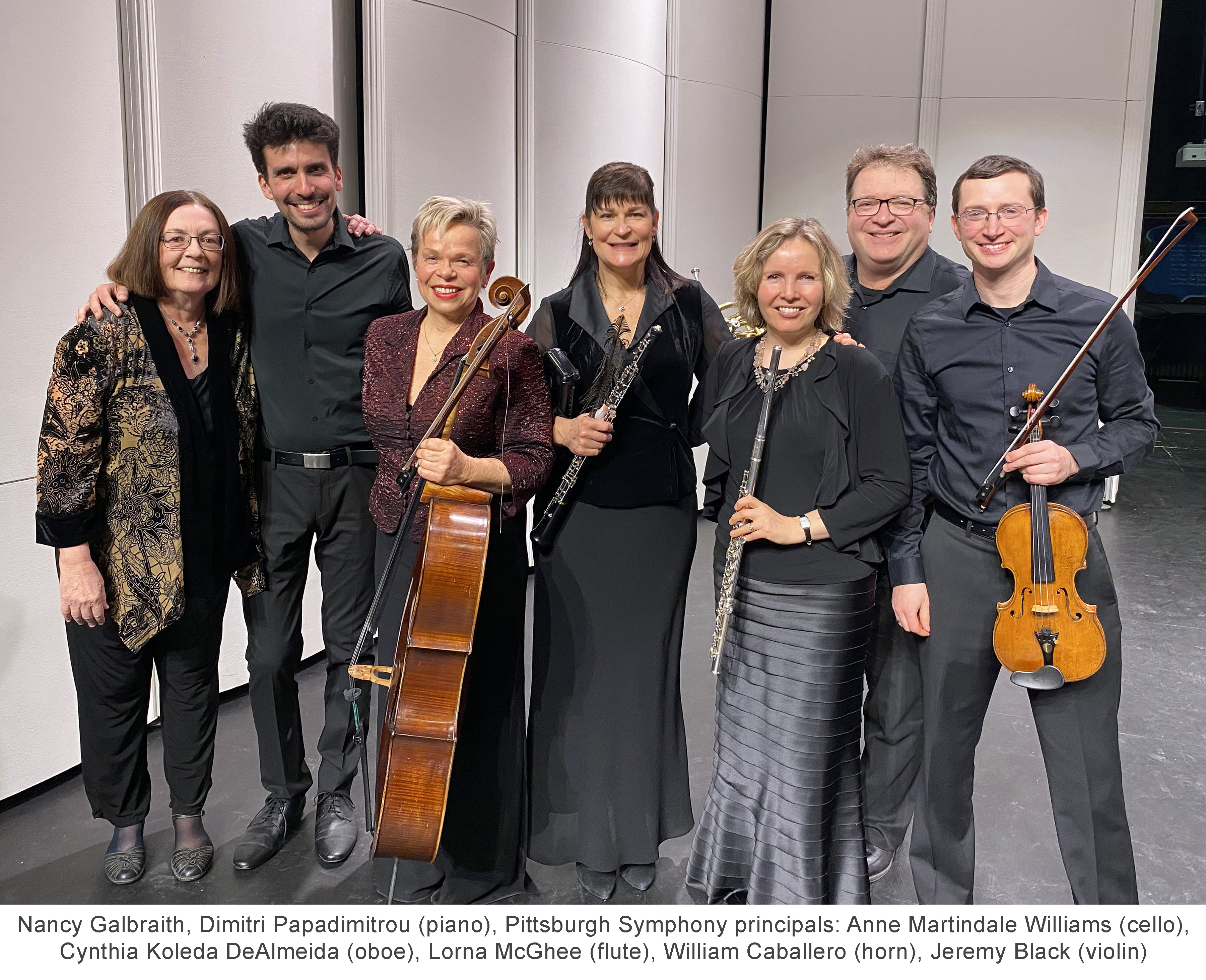
2006: Pittsburgh Symphony Orchestra principal harpist Gretchen Van Hoesen comissioned and premiered Two Moods for Harp for her recital at Carnegie Mellon University. 2006 & 2009: New York Philharmonic players Pascual Marinez Forteza (clarinet) and Kim Laskowski (bassoon) performed Aeolian Muses with pianist David Oei at the Harmonie Club in New York City. 2007: Sonata for Bassoon and Piano was the featured new work for the Meg Quigley Vivaldi Competition in Ithaca, New York, where it was performed by all the contestants. The finalists followed with performances at the International Double Reed Convention in Ithaca. Galbraith's sonata appears on recordings by two prominent bassoonists, Nicolasa Kuster and Christin Schillinger, who both presented the work in recital tours across the US. Other noted bassoonists have concertize with the sonata, including Wendy Holdaway's performance at the XXIX Foro de Música Nueva in Mexico City. 2007: Voices That Beautify the Earth, for solo flute, was released on Capstone Records' Points of Entry: The Laurels Project that featured numerous works by contemporary women composers. 2008: Night Train was premiered at Carnegie Mellon University with Stephen Schultz (electric Baroque flute) and Pittsburgh's popular rock cello quartet, Cellofourte (later re-formed as Cello Fury). This was the second in the series of elecro-acoustic works featuring flutist Schultz. The concert was broadcast live on WQED-FM. Night Train is the program closer on Centaur Records' Nancy Galbraith: Other Sun (2010). 2008: Pittsburgh Symphony Orcherstra concertmaster Andrés Cárdenas played the premiere of Galbraith's duet Idyll—with the composer at the piano—for the wedding of Adam and Leena Waite in Chatham County, New Jersey. 2008: Galbraith composed Reflections—a woodwind sextet featuring solo oboe and English horn—for her daughter, Amy Galbraith Ogburn, for her doctoral recital at West Virginia University. She performed it again with the Mahidol University Contemporary Enclave at the Asian Double Reed Association's 2011 Inaugural Conference in Thailand. 2009: Other Sun was premiered at Carnegie Mellon University with Stephen Schultz (electric Baroque flute) and Pittsburgh's popular rock cello trio, Cello Fury (formerly Cellofourte). This was the third in the series of elecro-acoustic works featuring flutist Schultz and the second featuring Cello Fury. The concert was broadcast live on WQED-FM. Other Sun is the title track on Centaur Records' Nancy Galbraith: Other Sun (2010). 2012: Effervescent Air was premiered by the Carnegie Mellon Baroque Ensemble, with featured performances by Stephen Schultz (electric Baroque flute) and Luz Manriquez (piano). This was the fourth electro-acoustic work composed for Schultz, which also featured amplified piano with delay and reverb pedals. The work was recorded for Centaur Records' Nancy Galbraith: Strange Travels released in 2014. Daniel Nesta Curtis conducted the ensemble for both the premiere and the recording. 2014: The Arianna String Quartet premiered Nocturno with Chilean flutist Alberto Almarza in Santa Catarina, Brazil. Galbraith adapted the work from the second movement of Atacama Sonata, which was premiered by Almarza at the Juilliard School in 2001. 2014: Strange Travels was premiered by the Carnegie Mellon Contemporary Ensemble, led by artistic director Daniel Nesta Curtis. The work is the title track for Centaur Records' Nancy Galbraith: Strange Travels released in 2014. The Peabody Modern Orchestra performed the work in 2015. 2015: Galbraith adapted Midnight Stirring for chamber orchestra from her composition for flute choir [see previous section] for the premiere by the newly formed Chamber Orchestra of Pittsburgh. 2016: Dancing Through Time was premiered by the Carnegie Mellon Contemporary Ensemble, featuring electro-acoustic performances by faculty stars Stephen Schultz (Baroque flute) and David Harding (viola). Artistic director Daniel Nesta Curtis led the performance and directed the studio recording for the indie CD Nancy Galbraith: Dancing Through Time, released on CD Baby later that year. 2018: Ruby's Ascent, scored for flute, oboe, clarinet, violin and cello, was premiered at the by Kamratōn at the Glitterbox Theater in Pittsburgh. 2018: Festival Overture for Cellos was premiered at the Pittsburgh Cello Fest at Carnegie Mellon University. 2018: Rustic Breezes was premiered by the Galax Quartet (Baroque strings) with Baroque flutist Stephen Schultz, at the Berkeley Baroque Festival & Exhibition at UC Berkeley, California. 2020: Five principal players from the Pittsburgh Symphony Orchestra presented the world premiere of Galbraith's Interrupted Atmosphere at Carnegie Mellon University. Concert pianist Dmitri Papadimitriou joined forces with Lorna McGhee (flute), Cynthia Koleda DeAlmeida (oboe), William Caballero (horn), Jeremy Black (violin), and Anne Martindale Williams (cello) in a thrilling, virtuostic performance of the composer's new work. 2020: With numerous projects and performances on hold due to the pandemic, Galbraith spent her summer months exploring the world of Digital Audio Workstations (DAW's) and produced a work for electronic sounds, plus two solo artists. With masks and social distancing protocols in place, soprano Anna Elder and flutist Sarah Steranka recorded their parts for Behind the Eyes against an electronic background created by the composer. The music was then paired with a video created by her husband, Matthew Galbraith, who also wrote the poem from which the text was adapted. The finished product was premiered on YouTube on May 30th, 2021. 2020–21: From October through June, several pandemic-era virtual performances were presented by various ensembles and soloists, including Three Piano Preludes by Nanette Kaplan Solomon, Audible Images by the PSU Wind Ensemble in Pittsburg, Kansas, Strange Travels by the University of Iowa Symphony Orchestra, Febris Ver by the bands at the University of Miami, Rustic Breezes by artists from the Local 5 Music Fund in Cleveland, Ohio, and a re-broadcast of the Smoke and Steel premiere by the Bach Choir of Pittsburgh. 2022: Settings of two poems, Behind the Eyes and Behind the Veil by poet Matthew Galbraith, were premiered by Anna Elder (soprano) and Sarah Steranka (flute) with the Carnegie Mellon Contemporary Ensemble conducted by Daniel Nesta Curtis, at Pittsburgh's Kelly-Strahorn Theater. 2022: The chamber orchestra version of Galbraith's string quartet with flute, Rustic Breezes, was premiered by the Carnegie Mellon Baroque Ensemble with Stephen Schultz on amplified Baroque flute and conductor Daniel Nesta Curtis. 2023: The Kassia Ensemble premiered Summer of 2020 for clarinet, harp, and strings. |
CHORAL MUSIC |
|
Galbraith first attained distinction as a choral composer near the turn of the century with the support and patronage of one of America's most celebrated conductors, Robert Page. Maestro Page commissioned two monumental works by the composer and conducted several others. In his liner notes for Galbraith's Requeim (2005) Page wrote: The magic of Nancy's work is in its incredible layers of sound, texture superimposed on texture, yet suprisingly clear and understandable. Also important is her uncanny ability to deliver with equal impact passages of high, high energy and passages of awesome quietude. (read full text) In 2008, Page presented a lecture titled "The Music of Nancy Galbraith" at the National Collegiate Choral Organization (NCCO) conference at the University of Cincinnati. Galbraith's catalog of music for concert choirs includes a number of works that set traditional Latin Christian texts; most notably Missa Mysteriorum (1999), Requiem (2004), and Lumen Christi (2009). She has also composed several major works with inter-faith themes: God of Justice (2002), Sacred Songs and Interludes (2006), and Novena (2007). Her catalog also included several prominent secular suites, including Four River Songs (2002), Four Nature Canticles (2011), and Smoke and Steel (2016).
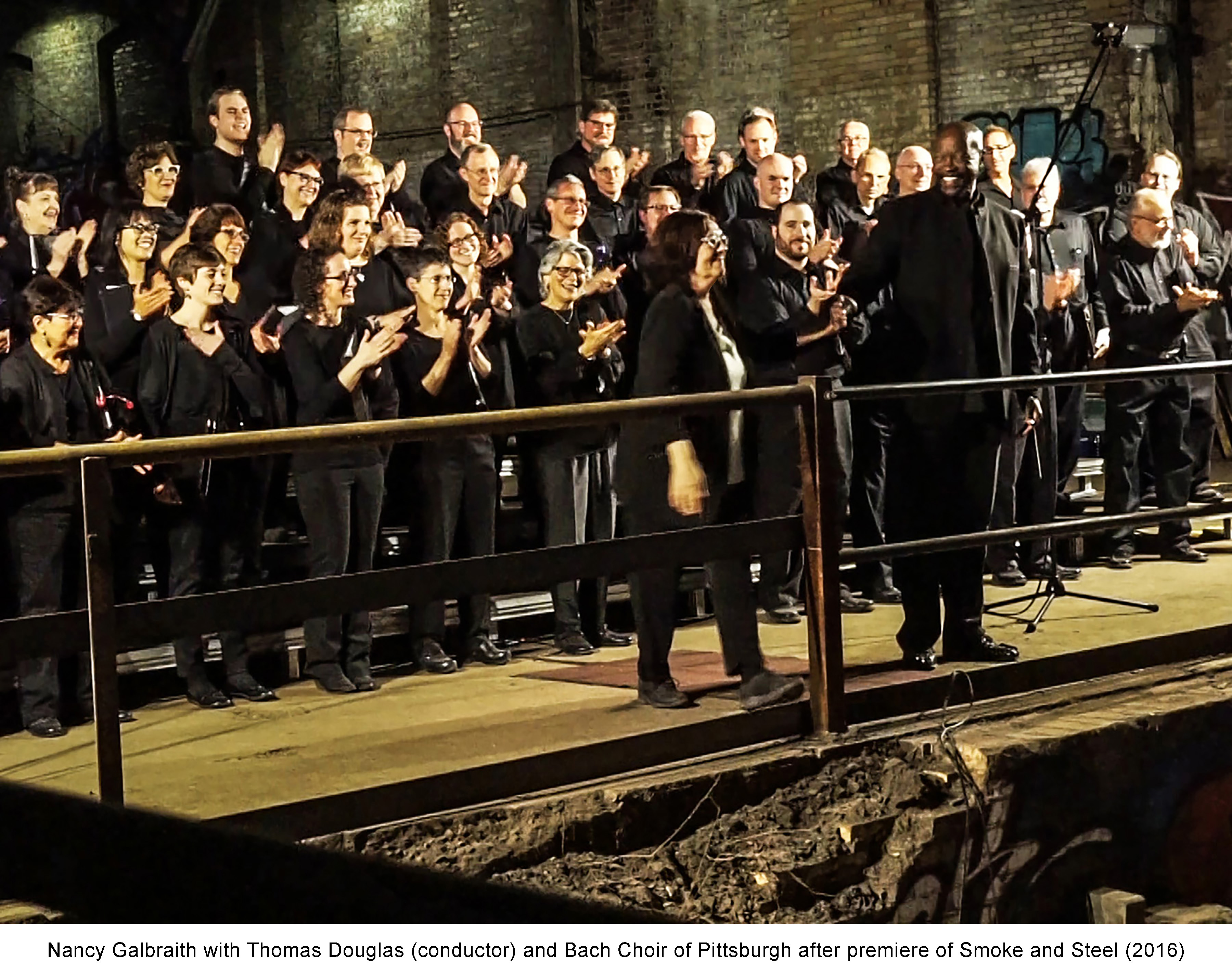
1999: Missa Mysteriorum was premiered by the Mendelssohn Choir of Pittsburgh, conducted by Robert Page. Scored for choir and wind ensemble, the composer's glorious Mass merged her sacred music and contemporary classical music styles into a work described by the Pittsburgh Post-Gazette as 2002: Magnificat was premiered at The Lutheran Theological Seminary at Gettysburg by Bel Voce and the Music Gettysburg! Festival Choir. The premiere was followed with performances by Seraphin at St. Paul's Chapel at Columbia University, Ars Musica Chorale in New Jersey, St. George's Chorale Society in New York, and was the closing work for the 7th Festival of Women Composers International in Pittsburgh. 2003: The Pittsburgh Camerata commissioned and premiered Four River Songs, featuring poems by Pablo Neruda, Langston Hughes, and E. E. Cummings. 2005: Requiem was premiered by the Mendelssohn Choir of Pittsburgh with the Academy Chamber Orchestra at Carnegie Music Hall in Pittsburgh. Commissioned by music director Robert Page, the work concluded the celebrated conductor's 26th and final year with the Mendelssohn Choir. Requiem is a landmark display of the composer's creative and technical mastery crafted into a work of profound inspiration and spiritual power. Galbraith's "Requiem" is a masterpiece that had the audience members on their feet at the end, cheering with tears in their eyes. —Pittsburgh Tribune-Review 2006: Beit Benedict United States commissioned Novena, an oratorio for four vocal solists, chamber orchestra, and pre-recorded audio tracks. The libretto includes sacred texts and prayers from Judaism, Christianty, and Islam. The premiere at St. Procopius Abbey in Lisle, Illinois was presented to raise funds and awareness for the future construction of the Beit Benedict Interfaith Peace Academy in Jerusalem. 2006: The Pittsburgh Camerata commissioned and premiered Sacred Songs and Interludes. The work celebrates texts from the world's seven major religions: Hinduism, Buddhism, Tao, Confucianism, Judaism, Christianity, and Islam. The Camerata later recorded the work for their album titled Nancy Galbraith: Sacred Songs and Interludes. 2007: The Connecticut Choral Artists (CONCORA) premiered Two Emily Dickinson Songs, commissioned for the American Masterpieces Choral Festival in Providence, Rhode Island. The Providence Singers hosted the event with a grant from the National Endowment for the Arts. 2008: Galbraith's oratorio God of Justice was featured in a benefit concert at St Procopius Abbey in Lisle, Illinois with the Benet Academy Honors Chorus & Children's Choir. As with a previous concert in 2006 at St Procopius, the event was held to raise funds for the Beit Benedict Interfaith Peace Academy in Jerusalem. God of Justice combines texts from the Gospel of St. Matthew, the US Conference of Catholic Bishops' Economic Justice for All, and the Jewish hymnal The Gates of Prayer. The work was premiered in 2004 for two concerts benefiting the Providence Family Center in Pittsburgh. 2011: The composer's works were celebrated by the Providence Singers (Rhode Island) in a concert titled "The Music of Nancy Galbraith." The program included the premiere of her commissioned work Sonnet 116 (Shakespeare), which was the subject of a feature article in Chorus America's Singer Network advocating the benefits and rewards of choral commissioning. Galbraith's works were led by music director Andrew Clark and by guest conductor Robert Page. 2012: Lumen Christi was commissioned by the Order of St Benedict at St Procopius Abbey in Lisle, Illinois to celebrate the order's 125th anniversary. The work was premiered at the abbey by the Benet Academy Madrigal Singers. 2012: Four Nature Canticles—featuring poems by Dickinson, Browning, Joyce and Frost— was commissioned and premiered by the Kent Place Chamber Singers and Lyrica Chamber Music in Chatham, New Jersey. The Kent Place singers and Lyrica recorded the work in 2014. 2013: The Harvard Glee Club and Radcliffe Choral Society commissioned and premiered Three Poems of Miguel de Unamuno for their annual Christmas concert. The singers, led by music director Andrew Clark, performed the work for their US west coast tour the following year. 2013: Carnegie Mellon University commissioned The Oak for the Inauguration Ceremony of Dr Subra Suresh as 9th President of Carnegie Mellon University. The work features the poem by Alfred Lord Tennyson. 2014: The Akron Symphony Chorus commissioned and premiered Psalm 42 in memory of their recently departed singer and benefactor, Claire Hawkins. The premiere was conducted by music director Maria Sensi Sellner. 2015: The Passion According to St Matthew was featured in a performance at the historic Manchester Cathedral in the United Kingdom by singers from the University of Salford (Manchester) and St Vincent College in the US. The work was premiered earlier in the year in Pittsburgh. Both concerts were directed by Thomas Octave. 2016: The Bach Choir of Pittsburgh commissioned Galbraith to compose Smoke and Steel, which was premiered at the Carrie Furnace Historic Site in Braddock, Pennsylvania near Pittsburgh. In two concerts performed in the rugged setting of a reclaimed steel mill, this epic choral narrative features the poem of the same name by Carl Sandburg. The concerts were presented to commemorate the once thriving steel industry of Pittsburgh and surrounding towns in the 20th century. 2017: A stirring rememberance in honor of Maestro Robert Page—award winning American conductor of choruses and orchestras—was presented at Temple University in Philadelphia. The combined forces of the Temple Concert Choir and the Remembering Robert Page Singers—a collection of Page's former Temple students from across the United States—sang through a soulful program of choral music that featured the world premiere of Galbraith's In paridisum, commissioned for the event. 2017: The Westminster Choir and Orchestra of Montview, with conductor Adam Waite, presented the premiere of the symphony orchestra version of Missa Mysteriorum, which was adapted by Galbraith from her original 1999 work, scored for chorus and wind ensemble. 2019: The innovative Pittsburgh-area performing arts organization, Resonance Works, led by founding director Maria Sensi Sellner, performed the premiere of the chorus/orchestra version of Galbraith's popular O Magnum Mysterium in two Christmas season concerts. 2022: Choral music returned to the concert halls in April when the Radcliff Choral Society performed Four Nature Canticles at Harvard University. The following day, Galbraith's epic Passion According to Saint Matthew was presented in a pre-Easter celebration at the St. Vincent Archabbey Basilica in Greensburg, Pennsylvania. 2022: Galbraith's setting of the poem Rededication by Sara Stock Mayo was premiered by the Resonance Works Chorus and Orchestra, conducted by Maria Sensi Sellner at the New Hazlett Theater in Pittsburgh. |
PIANO AND ORGAN |
|
She has concertized on some of the finest organs in the Pittsburgh area, and on the chapel organ at the Lutheran Theological Seminary at Gettysburg. In 1985, she took over as organist at Christ Lutheran Church in Millvale near Pittsburgh, where her mother, Alverta Hoffman Riddle, had played for 62 years. She has served a number of times as the organist for the annual assemblies of the Southwestern Pennsylvania Synod of the Evangelical Lutheran Church of America (ELCA). 1979: Galbraith performed the premiere of Haunted Fantasy in a concert with the Pittsburgh New Music Ensemble. This marked the first public performance of one of her compositions in a non-academic setting. 1986: Galbraith performed the premiere of Prelude for Piano at Pittsburgh's Three Rivers Arts Festival. A short time later she performed the premiere of Noel for Organ in a recital in Pittsburgh 1990: Litany and Cortege were premiered in organ recitals in Florida and Pittsburgh. 1995: Galbraith performed the premiere of Gloria Te Deum with the River City Brass octet, conducted by Denis Colwell. The work was commissioned by the Pittsburgh Synod of the Evangelical Lutheran Church of America for its 150th Anniversary Celebration at Pittsburgh's newly constructed David L. Lawrence Convention Center. 1997: Galbraith performed her own organ works, Gloria Te Deum (with a brass sextet) and Cortege, along with Religioso (piano) at the Martin Luther Colloquium at the Lutheran Theological Seminary at Gettysburg. 1999: Galbraith performed the premiere of the solo organ version of Gloria Te Deum at Heinz Chapel in Pittsburgh. 1997: Piano Sonata Nº 1 was premiered by Jocelyn Chapman at Mellon Institute in Pittsburgh. The composer's virtuosic and inspired sonata is now a familiar fixture in contemporary piano music literature. 2000: Nanette Solomon performed Piano Sonata Nº 1 for the Music Teachers National Association (MTNA) national convention in Minneapolis. 2001: Galbraith performed the premiere her organ adaptation of Agnus Dei—the final movement of Missa Mysteriorum—at Heinz Chapel in Pittsburgh. 2002: Pittsburgh Symphony Orchestra pianist Patricia Prattis Jennings recorded Piano Sonata Nº 1 for the Albany Records CD, Nancy Galbraith: Atacama. 2004: Organist/composer Carson Cooman featured four works by Galbraith in his "Organists Workshop on Contemporary Women Composers" in Penfield, New York. 2006: Pianist Nancy Boston performed Piano Sonata Nº 1 on her concert tour through Virginia, West Virginia, Pennsylvania, New Hampshire, Texas, Wisconsin, and New York. She recorded the sonata for her CD, Modern Voices in Piano Music. 2006-2007: Pianist Leslie Spotz performed Piano Sonata Nº 2 on her concert tour through Germany, Italy, Texas, New York, Pennsylvania, and Washington DC. 2013: Three Preludes for Piano was premiered by Sanjung Lee at Kumho Art Hall in Seoul, Korea. In 2014 Rishi Merchandani recorded the sonatas for Centaur Records' album Nancy Galbraith: Strange Travels. 2016: Effervescent Air for Piano Four-Hands was premiered by Luz Manriquez and Sung-Im Kim at Yonsei University in Seoul, Korea. 2017: Piano Sonata No.2, commissioned by the Pennsylvania Music Teachers Association, was premiered by Eric Fung at the PMTA state conference at Lebanon Valley College. 2019: Distinguished organist and scholar Anne Labounsky—a former student of Jean Langlais— teamed with Nancy Galbraith to present a concert and lecture for the composers's organ and piano works for the Carnegie Mellon Osher Lifelong Learning Institute in Pittsburgh, Pennsylvania. The program included the premieres of Galbraith's Meditation and Prelude & Estampie, both for organ. 2019: In a recital at Carnegie Mellon University, pianist Nanette Kaplan Solomon presented a program titled A Celebration of Two CMU Icons: Piano Music by Nikolai Lopatnikoff and Nancy Galbraith. Pianist Luz Manriquez joined Solomon for Galbraith's Effervescent Air for Piano Two Hands. |
BALLET |
|
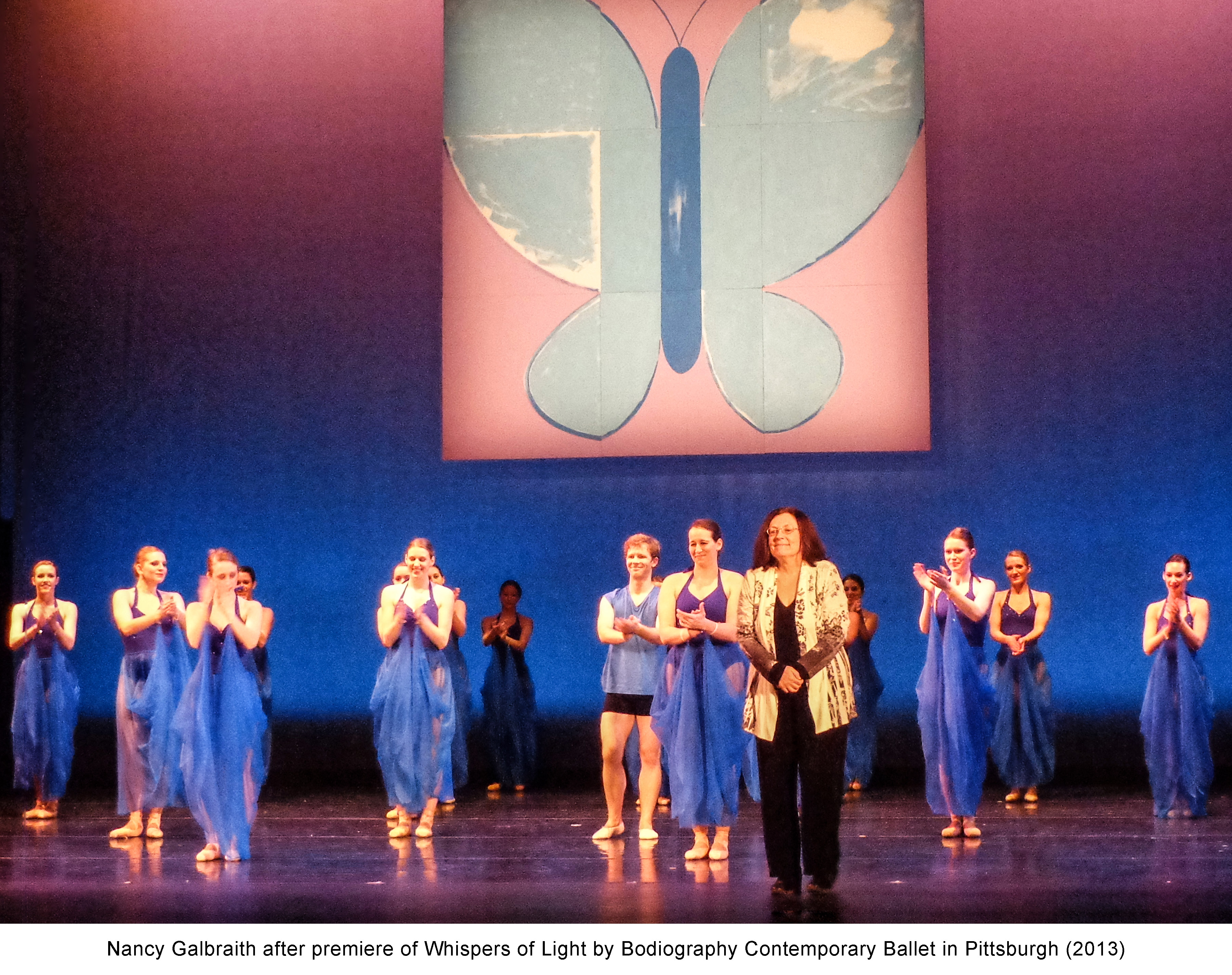
Galbraith composed her first ballet suite in 2013 for a commission awarded by the Bodiography Contemporary Ballet Company in Pittsburgh, PA. Whispers of Light, choreographed by founding director Maria Caruso, was premiered in two concerts that celebrated the Highmark Caring Place—an organization, with four facilities in western Pennsylvania, that champions the cause of grieving children and provides programs in support of children and their families who have suffered tragic losses.
|
SACRED SATB ANTHEMS |
|
Concurrent with her concert music career, Galbraith has enjoyed great success as a composer of SATB anthems for church choirs. Drawing upon her experience as music director and organist at Christ Lutheran Church in Millvale, near Pittsburgh, Pennsylvania, she has produced a sizeable collection of anthems, canons, liturgical settings, and organ works. In addition to those listed below, her catalog of sacred anthems also includes several movments adapted from several concert choral suites including Magnificat (2002) and Lumen Christi (2009). 1982-88: Galbraith composed over a dozen sacred anthems for her choir at Christ Lutheran Church in Millvale, Pennsylvania. These are listed in her catalog under Early Works. 2000: Christ By Whose Death the Church on Earth Was Born was commissioned by the composer's own church, Christ Lutheran, for its 100th anniversary celebration. The work features a text composed by the noted sacred lyricist, Herman Stuempfle, Jr. In 2010, it was sung by an 800-voice choir at the 56th Annual Ocean Grove Choir Festival in New Jersey. 2007: O Magnum Mysterium—Premiered by the Beit Benedict Festival Choir at St. Procopius Abbey in Lisle, Illinois at a benefit concert for the Beit Benedict Peace Academy in Jerusalem. 2017: In Paradisum was premiered by the Temple University Concert Choir along with the Remembering Robert Page Singers (Temple Alumni) at the Temple Performing Arts Center in Philadelphia, Pennsylvania. In paradisum was the featured premiere in a concert titled "Remembering Robert Page" produced at Temple University where Maestro Page was the director of choral arts for a number of years. 2017: Ubi Caritas was premiered by the Maestri Singers with music director Thomas Octave in a special ceremonial service at St Joseph Church of St Maria Goretti Parish in Pittsburgh, Pennsylvania. 2018: Nancy Galbraith led her own Christ Lutheran Church Choir, along with the Palmer Brass Quartet and organist Ann Labounsky, in the premiere of Out of the Depths, adapted from the Martin Luther hymn. The performance was presented at the Martin Luther Hymn Festival at Heinz Memorial Chapel in Pittsburgh, Pennsylvania. |
ACADEMIC CAREER |
|
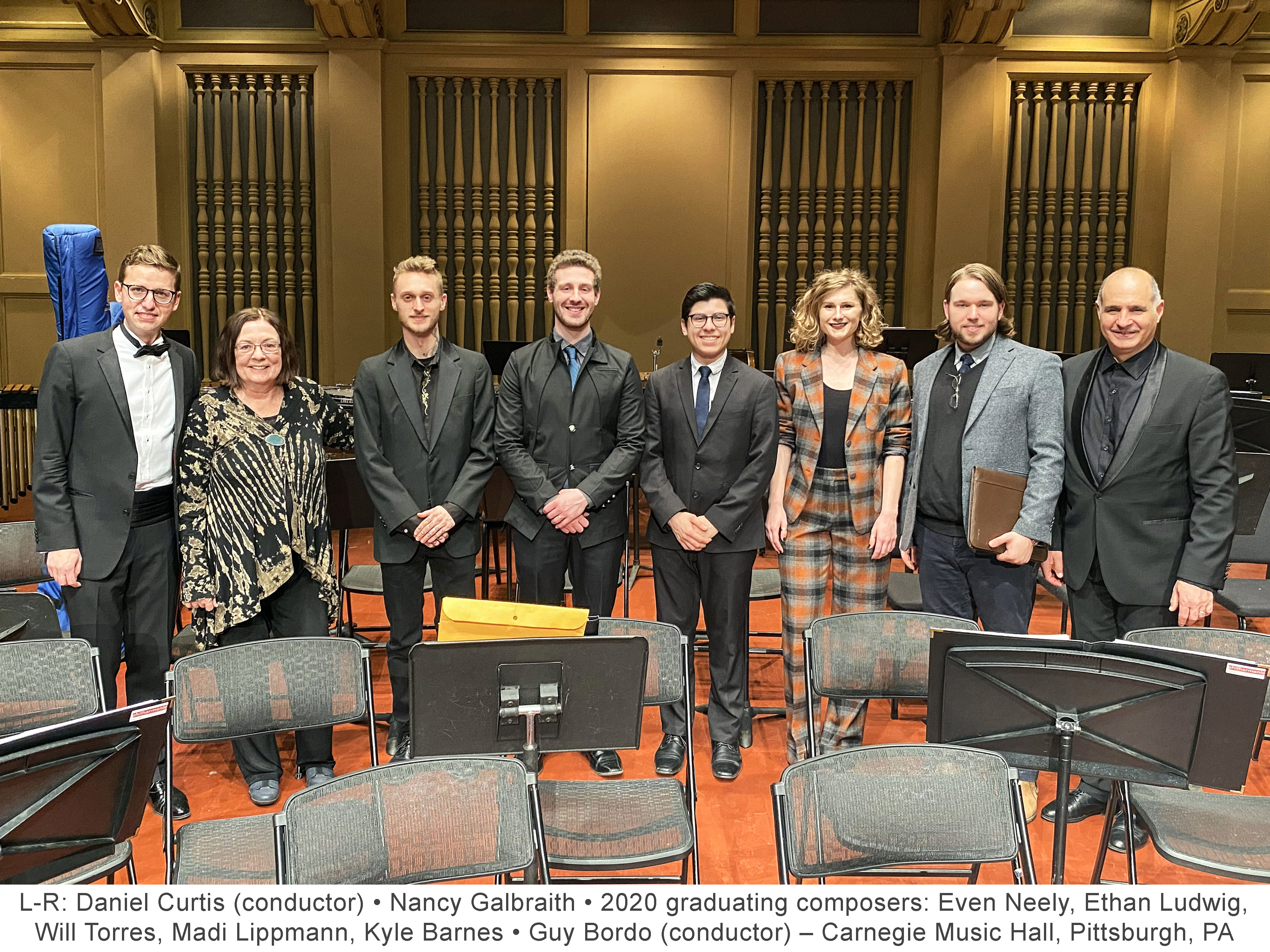
A prolific and obsessive composer, Nancy Galbraith devotes the same amount of time and energy to her students at Carnegie Mellon University, where she is Professor and Chair of Composition and a highly respected teacher and mentor. One of her greatest achievements at the School of Music is the creation and oversight of the annual Student Orchestra Concert at Carnegie Music Hall in Pittsburgh's Oakland district, where the Carnegie Mellon Philharmonic presents a concert of orchestral works by CMU's graduating student composers. The concert is the culmination of the academic year at the School of Music, when students and faculty join together to celebrate the future of concert music in America and on the world stage. She is also the founder and Faculty Advisor of the annual Freshman Showcase, where the school's instrumentalists, singers, and composers gain real-world experience by serving as producers, conductors and performers of their own concert of music.
2002: Galbraith is promoted to the position of Full Professor of Composition and the Carnegie Mellon University School of Music. 2014: The Carnegie Mellon University College of Fine Arts honored Galbraith with the Henry Hornbostel Teaching Award for excellence in teaching and for her 30+ years of distinguished service to the students at the CMU School of Music. 2018: Nancy Galbraith was awarded the distinguished Vira I. Heinz Professorship of Music endowed chair in a ceremony at the College of Fine Arts at Carnegie Mellon University. 2020–21: During the Spring and Fall semesters, Carnegie Mellon University was in nearly total lockdown due to the pandemic. In lieu of the various composer concerts that normally take place at the School of Music, Professor Galbraith encouraged her students to write and produce music and video for virtual concerts. The students responded with three highly successful and popular streamed events that included some very creative multi-media presentations. |
ET CETERA |
|
Galbraith has worked as a recording producer on many of her own albums, and was engaged to help produce the Mendelssohn Choir of Pittsburgh/River City Brass album, Christmas!, under the direction of Maestro Robert Page. The CD was the declared favorite of astronaut John Glenn on his 1998 Space Shuttle mission. 1997: Galbraith was the featured artist and composer-in-residence for the "Festival of Reformation & Reconciliation" colloquium at the Lutheran Theological Seminary at Gettysburg, where she performed her own works on the chapel organ, conducted the Seminary Motet Choir, and led the congregation of pastors and scholars in singing her Lutheran Liturgy. Her sacred anthem, In Unity and Love, based on a text by Philip Melanchthan, was commissioned for the event, and has been the featured anthem at numerous ordination ceremonies at the seminary. 2000: The University of Northwestern in St. Paul, Minnesota engaged Galbraith as composer-in-residence for a week of lectures and workshops, concluding with a full concert of her works by various student/faculty musicians from the Music Department. 2001: The Lutheran Theological Seminary at Gettysburg celebrated its 175th anniversary by presenting a concert of works by Galbraith that concluded with Missa Mysteriorum performed by the combined forces of the Schola Cantorum, the Seminary Motet Choir, and Music Gettysburg Wind Band. 2001: The town of Thief River Falls in northern Minnesota engaged Galbraith as composer-in-residence for its annual week-long festival of choral music, featuring two commissioned works, Clown in the Moon and Triolet, and a performance of Missa Mysteriorum by the Masterworks Chorale and the Northland Community Band. 2002: The University of Chicago Department of Music invited Galbraith for master classes and performances of her music. The Rockefeller Chapel Choir sang several choral works along with performances of her organ works by chapel organist Thomas Weisflog. The University Chorus, Motet Choir, and University Wind Ensemble performed Missa Mysteriorum in UC's Mandel Hall. 2004: Galbraith was engaged as the featured Artist-in-Residence for the 7th Festival of Women Composers International sponsored by Indiana University of Pennsylvania. The event included numerous performances of her works along with those of other prominent writers, including Libby Larson and Katherine Hoover. She also delivered the keynote address and participated in several preconcert lectures. 2004: Following heavy flooding in Pittsburgh due to Hurricane Ivan, several choral works by the composer were featured in a benefit concert by the North Hills Chorale with former New York City Opera star Mimi Lerner. 2009: Galbraith was engaged as composer-in-residence for the 9th Annual Women Composers Festival in Hartford, Connecticut. 2011: The Benedictine monks of St. Procopius Abbey in Lisle, Illinois hosted a benefit concert for the Beit Benedict Peace Academy in Jerusalem. The concert featured two world premieres by Galbraith—Novena and O Magnum Mysterium—along with other works by the composer. 2011: The composer's works were celebrated by the Providence Singers (Rhode Island) in a concert titled "The Music of Nancy Galbraith." The program included the premiere of her commissioned work, Sonnet 116 (Shakespeare), which was the subject of a feature article in Chorus America's Singer Network advocating the benefits and rewards of choral commissioning. The concert was let by music director Andrew Clark and by guest conductor Robert Page. [Repeated from above.] 2013: The Shaler Area School District near Pittsburgh, Pennsylvania honored Galbraith with the Distinguished Alumna Award "for her contributions to society both professionally and personally." 2013: Ohio University honored Galbraith with the Distinguished Alumna Award and a composer residency featuring performances of her works by various ensembles from the OU School of Music. |
PERSONAL LIFE |
|
Nancy Galbraith was born into a musical family on January 27, 1951 in Pittsburgh, Pennsylvania. She began piano studies at the age of four with her mother, pianist/organist Alverta Hoffman Riddle, who passed her along to pianist Fredrick Schiefelbein. She also enjoyed the encouragement and support of her uncle, Pittsburgh Symphony violinist Freeman Hoffman. During her teen years she studied piano with Father Ignatius Purda at St. Vincent's College in Pennsylvania, and music theory and piano at the Carnegie Mellon Preparatory School of Music. She also studied clarinet with the Pittsburgh Symphony's Jerry Levine, and was first chair clarinet of the Allegheny Valley Honors Band for four years. Galbraith earned degrees in composition from Ohio University (BM, 1972) and West Virginia University (MM, 1978), and continued studies in composition, piano, and organ at Carnegie Mellon University. Galbraith lives with her husband, Matthew Galbraith, in Millvale, a suburb of Pittsburgh, Pennsylvania. The couple was married in 1975 in Morgantown, West Virginia where they met while attending West Virginia University. They have two daughters, Amy Ogburn (DMA, Oboe Performance) and Sarah Bond (PhD, Biology), and four grandchildren. Matthew is a retired engineering technician and now works as Nancy's producer and manager. He has published three collections of poetry. |
| All content in nancygalbraith.com: Copyright © by Matthew Galbraith (Unless Noted). All Rights Reserved. International Copyright Secured.
All Music Represented in Audio Samples: Copyright © by Subito Music Inc (ASCAP). All Rights Reserved. International Copyright Secured. |
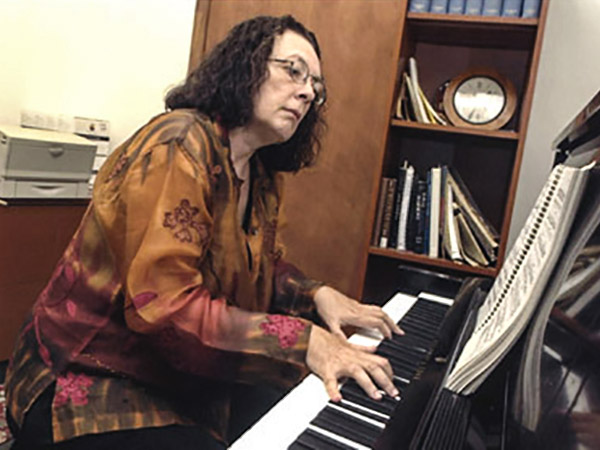 Composer Galbraith is also an accomplished pianist and organist, and has written and performed a number of works for both instruments. In her earlier years at Carnegie Mellon University she performed in numerous recitals as an accompanist and soloist, and in other venues in the northeastern US as well.