| |
Graduate
and Undergraduate Courses Self-Paced
Web Tutorial
Course Evaluation
Students
|
|
| |
●
●
●
Graduate
and Undergraduate Courses |
|
| |
At CMU Professor Shimada developed and taught two new graduate level
courses related to the computational aspects of engineering,
“24-786: Geometric Modeling” and “24-700:
Computational Geometry.”
The core technologies in geometric modeling and computational
geometry are the foundation of modern CAD and CAE software tools.
One goal of developing these two courses was to strengthen the
department’s recent “computational need” thrust.
The department has recognized the importance of exposing our
students to various computational tools and has been utilizing
Pro/ENGINEER, ANSYS and other packages in core courses.
The early exposure to these tools has been an advantage and
strength to our students, and it has been a driving force in attracting
more freshmen to the Department of Mechanical Engineering, particularly
more female students, who used to be deterred by the "nuts and
bolts" perception of the field.

Professor Shimada has also reformed the content and the method of
instruction of one the core undergraduate courses, "24-311:
Numerical Methods."
The new formats introduced include:
Two
types of computational assignments.
One of the
goals that were set for this course was to teach
two sets of computational skills: efficient use of commercially
available software packages, and programming numerical methods using a
common computer language. The
first set of skills was taught through five problem sets that required
the use of Mathcad. In
these problems, understanding the limitations of each numerical method
was emphasized. The second set of skills was taught through six programming
assignments in C++.
Use
of VRML for visualizing results.
Most
engineering students do not enjoy writing codes for numerical methods
because all they see as results are numbers.
To overcome their reluctance, Professor Shimada
successfully implemented the usage of Virtual Reality Modeling Language
(VRML) to display visually the final results of the numerical
calculations. In this way
the students could visualize: the convergence process of the Newton-Raphson
method, forces in a three-dimensional truss structure, the process of
two-dimensional optimization, a three-dimensional view of a quadratic
regression surface, animation of the trajectory of a spring-mass
pendulum, and other examples. Using
VRML increased the students' interest in writing codes and also helped
them to reason if their numerical results were correct or not.
|
 |
|
 |
|
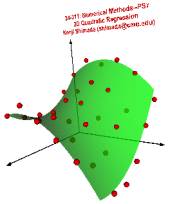
Two-dimensional
quadratic regression. Students
write a code for regression, and the resultant surface is
visualized in 3D along with the input data points using VRML. |
|
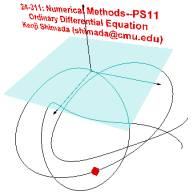
Numerical
integration of ODE. Students
write a code for the numerical
integration of the equation of motion for a spring-mass pendulum.
The 3D trajectory of the mass is visualized and animated
using VRML. |
|
|
| |
●
●
●
Self-Paced
Web Tutorials |
|
| |
|
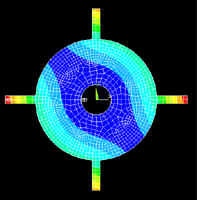 |
Professor Shimada and his graduate students, Chandan Aladahalli
(co-advised with Professor Cagan) and Tian
Zhou, have developed a self-paced
web tutorial on FEM and ANSYS.
The tutorial is designed to teach students: (1) what Finite
Element Method (FEM) is, (2) how to model engineering analysis problems
using FEM, and (3) how to use a commercial FEM package, ANSYS.
This provides an easy and effective way for students to learn an
essential computational skill not directly covered in the regular
required courses, but useful in their future career.
Another project with his undergraduate student, Amy Solana, is a
self-paced web
tutorial on Mathcad. |
|
|
| |
●
●
●
Course Evaluations |
|
| |
|
|
| |
●
●
●
Students |
|
| |
Ph.D. Students
 | Venkat
Ayyadevara, “Automated Planning for Stacking Polyhedral Sheet Metal
Parts,” Spring 2000. Present Position: Senior Program Manager at
Microsoft Corporation |
| Ko-Hsiu Hou,
“A Computational Method for Mesh-Based Free-Form Functional Surface
Design,” Spring 2002, Present Position: Researcher, GE Corporate
Research and Development, Niskayuna, NY. |
| Soji Yamakawa,
“Unstructured Three-Dimensional Mesh Generation with Controlled
Anisotropy and Directionality,” Summer 2002, Present Position:
Research Associate, Carnegie Mellon University, Pittsburgh, PA. |
| Murat Gunay,
“Three-Dimensional Bone Shape Reconstruction from X-Ray Images Using
Hierarchical Free-Form Deformation and Sequential Quadratic
Programming,” Spring 2003, Present Position: Assistant Professor,
Pamukkale University, Turkey. |
| Chandan
Alladahali, “Three-Dimensional Layout Design,” Fall 2004 (co-advised
with Professor J. Cagan), Present Position: GE, India. |
| Roshan
Quadros, “A Computational Framework for Automating Generation of
Finite Element Mesh Sizing Function,” Summer 2005, Present Position:
Software Engineer, Algor, Pittsburgh, PA. |
| Miguel
Vieira, “Geometric Data Processing for 3D Laser Scanner,” Fall 2006,
Present Position: Senior Researcher, Leica Geosystems, CA.
|
| Daigo Tanaka,
“Optimal Layout of Cryoprobes for Cryosurgery,” (co-advised with
Professor Y. Rabin, BME), Spring 2007, Present Position: Software
Engineer at Research & Engineering, WesternGeco / Schlumberger. |
| Arbtip
Dheeravongkit, “Mesh Pre-Adaptation for Large-Deformation Non-linear
Finite Element Analysis,” Spring 2007, Present Position: Assistant
Professor, King Mongkut's Institute of Technology. |
| Emily
Monahan, “Computer-Aided Navigation System for Arthroscopic Hip
Surgery,” Fall 2007, Present Position: Assistant Professor, Bucknell
University. |
| Matthew
Staten, “Sheet-Based Generation and Modification of Unstructured
Conforming All-Hexahedral Finite Element Meshes,” Spring 2010, CEE,
Present Position: Sandia National Labs. |
| Frank
Hammond, “Task-Specific Morphological Design Optimization of
Kinematically Redundant Manipulators,” Spring 2010, Present
Position: Post-Doc Researcher, Harvard University. |
| Erick
Johnson, “Improving Analysis of Patient-Specific Aneurysms by
Determining the Wall Thickness through Mesh Deformation,” Co-Advised
with Prof. Y. Zhang, August 2010, Present Position: Researcher,
Sandia National Labs. |
| Tsung-Hsien
Wang, “Customizing Pattern-Based Panelization for NURBS Surface
Reconstruction with Irregular Boundary Conditions,” Co-Advised with
Ramesh Krishnamurti, Spring 2012. |
| Iacopo
Gentilini, “Path Optimization for Kinematically Redundant Robotic
System,” Summer 2012. |
| Ved Vyas,
“Tensor-Guided High Aspect Ratio Mesh Generation,” Fall 2013 (Ph.D.
expected). |
| SooHo Park,
“Minimizing Energy Consumption of Kinematically Redundant Robot,”
Fall 2013 (Ph.D. expected). |
| Hsiang-Chun
(Jean) Lu, “Sketch-Based Geometric Feature Decomposition,” Spring
2013 (Ph.D. expected). |
| Chun-Fan Goh,
“Robotic Motion Control,” Co-Advised with Gerald Seet, Spring 2014
(Ph.D. expected) |
| Rob Keelan,
“Computer-Assisted Cryosurgical Training,” Co-Advised with Yoed
Rabin, Spring 2014 (Ph.D. expected) |
| Anjali
Sehrawat, “Computer-Assisted Cryosurgical Training,” Co-Advised with
Yoed Rabin, Spring 2014 (Ph.D. expected) |
| Mabaran
Rajaraman, “Sensor-based Robotic Motion Control,” Spring 2015 (Ph.D.
expected) |
| Ying Ying Wu,
“Path Optimization for Bone Distraction Ontogenesis,” Spring 2015
(Ph.D. expected) |
| Diego
Andrade, “Generative Pattern Generation for Industrial Design,”
Spring 2016 (Ph.D. expected) |
| Meghan
Chandarana, “3D Gesture-based Robotic Motion Teaching,” Spring 2016
(Ph.D. expected) |
| Jin Wei,
“Robotic Motion Teaching by Demonstration,” Spring 2017 (Ph.D. expected)
|
Master’s Students
| Jia-Huei
Liao, “Quadrilateral Meshing via Close Packing of Square Cells,”
Spring 1998 (MS-P). |
| Megan Hazen,
“Local Feature Recognition in Three-Dimensional Data Using Invariant
Hashing,” Spring 1999 (MS-P). Present Position: University of
Washington. |
| Naveen
Viswanath, “Adaptive Anisotropic Quadrilateral Mesh Generation
Applied to Surface Approximation,” Spring 2000 (MS-P). Present
Position: Seagate Technology. |
| Karthick
Chilaka, “Surface Topology and Geometry Reconstruction of Wireframe
CAD Models,” Spring 2000 (MS-P). Present Position: Spatial
Corporation. |
| Ben Cheng,
“Geometric Feature Recognition via Discrete Curvature Estimation,”
Spring 2000 (MS). |
| Tian Zhou,
“An Angle-Based Approach to Two-Dimensional Mesh Smoothing,” Spring
2001 (MS-P). Present Position: Engineer, Siemens Westinghouse Power
Corporation. |
| Chandan
Alladahali, “Using Geometric Sensitivity Analysis to Infer Timing
Schedule of Move Sets for a Pattern Search Based 3D Layout
Algorithm,” Spring 2001 (MS-P, co-advised with Professor J. Cagan). |
| Ho-Kook Lee,
“Solution-Adaptive Finite Element Analysis of Sheet-Metal Forming,”
Fall 2001 (MS). Present Position: POSCO |
| Jonathan
Evans, “Shape and Topology Optimization for Hybrid Structural
Parts,” Spring 2002 (MS) (a part-time student from Bayer AG) |
| Miguel
Vieira, “Geometric Data Processing for 3D Laser Scanner,” Spring
2003 (MS-P). |
| Leslie
Gennari, “Pen-Based User Interface for Electrical Circuit Design,”
Spring 2004 (MS-P). |
| Arbtip
Dheeravongkit, “Meshing with Pre-Distortion for Large Deformation
Finite Element Analysis,” Spring 2004 (MS-P). |
| Nissan
Shoykhet, “Computational Modeling of Abdominal Aortic Aneurysm,”
Spring 2005 (MS-P) |
| Emily
Monahan, “Computer-Assisted Arthroscopy for Hip Surgery,” Spring
2005 (MS-P). |
| Robert
Oberreuter, “Computer and Robot Assisted Orthopedic Surgery,” Spring
2006. |
| Michael
Ballinger, “Prostate Shape Reconstruction from CT Images,” (co-advidsed
with Professor Y. Rabin), Spring 2007 (MS-P) |
| Ravichandra
Varma Buddharaju, “Finite Element Mesh Independency Study,” Spring
2007. |
| Max von der
Heydt, “Image-guided Biopsy System,” Spring 2007 (MS-P) |
| Andrew W.
Heutchy, “Dynamics Simulation of FSEA Car,” Spring 2007 (MS-C). |
| Mark Roberts,
“Image-guided Biopsy System,” Spring 2008 (MS-P). |
| SooHo Park,
“7DOF Hyper Redundant Robotic Manipulator,” Spring 2008 (MS-P). |
| Michael
DeSpenza, “Teaching System for Hyper-Redundant Robotic Manipulator,”
Spring 2008 (MS-P). |
| Jacqueline
Libby, Spring 2008 (MS-C). |
| Abhinav
Singhal, Fall 2008 (MS-C). |
| Namjung Kim,
“Image-Based Human Body Modeling,” Spring 2009 (MS-P) |
| Hsiang-Chun
(Jean) Lu, “Sketch CAD,” Spring 2009 (MS-P) |
| Alan Teets,
“Physically Based Beautification of Free-Hand Strokes,” Co-Advised
with Burak Kara, Spring 2009 (MS-C) |
| Pearce Stanek-Johnson,
“Robot-Assisted Motor Skill Learning,” Spring 2010 (MS-P) |
| Jung H. Park,
“Ergonomic Laryngoscopic Intubation with Headup Display, Wireless
Camera and Fiberoptics with Resistance to Fouling,” Spring 2010
(MS-P) |
| Vinay Krishna
Tharigopula, “Intubation Device with Laser Digitizing Capability,”
Spring 2010 (MS-C) |
| Prashin
Sharma, “Shortest Path Generation for Kinematically Redundant
Robots,” Spring 2010 (MS-C) |
| Arnontpas
Ruangsri, “Mesh Independence Study for Non-Linear Structural FEM
Analyses,” Spring 2010 (MS-C) |
| Siddharth
Vijayaraghavan, “Mesh Independence Study for Non-linear FEM
Analyses,” Fall 2009 (MS-C) |
| Madhur
Kaushik, “Finite Element Analyses of the Effectiveness of a Shipping
Package,” Spring 2010 (MS-C) |
| Robert Keelan,
“Measuring the Impact Force in a Shipping Package Drop Test,” Spring
2010 (MS-C) |
| Ajay Hari,
“Mapping the Physical Property of a Ruptured Abdominal Aortic
Aneurysm to FEM Analysis Results,” Spring 2010 (MSCDM) |
| Jong Eun Kim,
“Survey of Robotic Motion Simulators,” Spring 2010 (MSCDM) |
| Younduk Nam,
“Optimal Path Generation for a Car Navigation System,” Spring 2010 (MSCDM) |
| Saikumar
Yeratapally, “Mesh Independency Study for Crash Analysis,” Fall 2010
(MS-C) |
| Mathew A.
Chettupuzha, “Computational Simulation of Cerebral Aneurysm,” Spring
2011 (MS-C). |
| Cheongking
Ng, “Optimal Path Generation for a Product Quality Inspection,” Fall
2010 (MS-C) |
| Mabaran
Rajaraman, “Image-based 3D Shape Reconstruction of Human Foot,”
Spring 2011 (MS-P) |
| Karthik
Srinivasan, “3D Volume Decomposition for Hex Meshing,” Spring 2011
(MS-P) |
| Zachary
Barker, “Robot Motion Teaching via Model-based Gesture Recognition,”
Spring 2011 (MS-P) |
| Fangkai Zhu,
“Mesh Independence Study for Large Structural FEM Analyses,” Fall
2010 (MS-C) |
| Chen Zhang,
“Motion Control of a Four-Legged Robot,” Spring 2011 (MS-C) |
| Swati Sarraf,
“Robot Motion Control,” Spring 2012 (MS-C) |
| Yiting Guo,
“Physically based Surface Modeling,” Spring 2012 (MS-C) |
| Tian Wang,
“Shape and Topology Optimization of Shipping Package,” Spring 2012
(MS-C) |
| Mari
Gallegos, “Image-Based Custom Shoe Fitting,” Fall 2012 (MS-C) |
| Mohammed
Alqahta, “Optimal Nesting of Sheet Metal Parts,” Fall 2012 (MSCDM) |
| Steven
Christensen, “Novel Design of Trachea Measurement Device”, Spring
2012 (MSCDM) |
| Harsh Ghesani,
“Shape Optimization with CFD,” Spring 2012 (MSCDM) |
| Riddhit Mitra
“Novel Design of Trachea Measurement Device,” Spring 2012 (MSCDM) |
| Jing Xu,
“Trachea-Size Measurement using Computer Vision,” Fall 2012 (MS-P)
|
| Adarsh
Kathiresan, “TBA”, Spring 2013 (MSCDM) |
| Kaustubh
Deshpande, “Open Source CFD and its Application,” Spring 2013 (MSCDM
expected) |
| Christian
Segura-Rivera, TBA, Spring 2013 (MSCDM expected) |
| Thimal De
Alwis, TBA, Spring 2013 (MSCDM expected) |
| Krisda
Tapracharoen, TBA, Spring 2013 (MSCDM expected) |
| Sandeep
Yarabarla, TBA, Spring 2013 (MSCDM expected) |
| Prekumar
Natarajan, TBA, Spring 2013 (MSCDM expected) |
| Shiva
Ramalingam, TBA, Spring 2013 (MSCDM expected) |
| Qi Wang, TBA,
Spring 2013 (MS-P expected) |
| Andrew Klein,
“Machine Learning-based Adaptive Control of Wheeled Robot Motion,”
Spring 2014 (MS-P expected)
Fan Wang, TBA, Spring 2014 (MS-P expected) |
| Jorge Vasques,
“Travelling Salesman Problem with Neighborhood and its Application
to Unmanned Aerial Vehicle Path Planning,” Spring 2014 (MS-P
expected) |
| Anusha
Rangrajan, “Machine Learning-based Signal Processing for Continuous
Sleeping Disorder Monitoring,” Spring 2014 (BME MS-P expected) |
| Suyue Han,
“Geometric Processing for FSI Simulation of Cerebral Aneurysms,”
Co-Advised with J. Zhang, Spring 2014 (MS-P expected) |
| Tsung-Chun
Hsu, TBA, Spring 2014 (MS-P expected) |
| Vijay Raman,
TBA, Spring 2014 (MS-P expected) |
| Agniv
Banerjee, “Computational Modeling and Simulation for Head Injury
Analyses,” Spring 2014 (MS-P expected) |
| Difan Hong,
“Generative Generation of Geometric Features,” Spring 2014 (MS-P
expected) |
| Haichao Xu, “TBA,”
Spring 2014 (MS-P expected) |
Overseas Summer
Graduate Students
| Jun Mitani
(Visiting MS Student, the University of Tokyo, Japan, summer 1998). |
| Shingo
Takeuchi (Visiting MS Student, the University of Tokyo, Japan,
summer 1999). |
| Atsushi Izumi
(Visiting MS Student, the University of Tokyo, Japan, summer 2000). |
| Yasuhiro
Tamaki (Visiting MS Student, the University of Tokyo, Japan, summer
2002). |
| Barbara Motyl
(Visiting Ph.D. Student, the University of Udine, Italy, spring
2006). |
| Stefano
Guerra (Visiting Ph.D. Student, the University of Modena and Reggio
Emilia, Italy, fall 2010). |
| Nicola
Jacquot (Visiting MS Student, France, spring – summer 2011) |
| Takashi Maeno
(Visiting MS Student, Hokkaido University, Japan, spring 2011). |
| Hiroki
Maehama (Visiting MS Student, Hokkaido University, Japan, spring
2013). |
Undergraduate
Students
| Megan Hazen,
“Geometric Feature Search Engine for Internet,” Spring 1997. |
| Jonathan
Pompa, “Graphical User Interface for Surface Design,” Spring 1998. |
| Matthew
Carlson, “Two-Dimensional Curve Smoothing,” Spring 1999. |
| Susan
Swithenbank, “Three-Dimensional Bubble Mesh for FEM,” Spring 2000. |
| Bedirhan
Cinar, “Two-Dimensional Curve Smoothing,” Spring 2000. |
| #* Stehanie
Pollice, “Shape Reconstruction from a Limited Number of Images,”
Spring 2001. |
| #* Miguel
Vieira, “Three-Dimensional Curve Smoothing,” Spring 2001. |
| #* Arbtip
Dheeravongkit, “Angle-Based FEM Mesh Smoothing,” Spring 2002. |
| Fayette Shaw,
“Tagbots,” SURG, Spring 2002. |
| Daniel Vogel,
“Tagbots,” SURG, Spring 2002. |
| Chris Hynes,
“Surface Re-Parameterization for Finite Element Mesh Generation,”
Spring 2002. |
| #* Renata
Melamud, “Design Automation and Optimization of Hybrid Structures,”
Spring 2003. |
| * Nissan
Shoykhet, “Non-Invasive Risk Assessment of Rupture in Abdominal
Aortic Aneurysm Using FEM Analysis,” Summer 2003.
|
| #* John
Reifenberg, “Truss Structure Optimization,” Spring 2003. |
| #* Robert
Oberreuter, “Optimization of Bone Distraction Path for a 2DOF
Fixator,” Spring 2004. |
| #* Matt Rosa,
“Minimum-Degree-of-Freedom Bone Distractor,” Spring 2004. |
| * Serge
LiHoiFoo-Gregory, “Rapid Prototyping Machine for Automobile Interior
Design,” Spring 2004. |
| #* Shintaro
Kamishima, “Three-Dimensional Shape Generation from Cross-Sectional
Images,” Spring 2004. |
| Michael
North, “CFD for Automotive External Flow Analysis,” Spring 2005. |
| Shandor
Dektor, “CFD for Automotive External Flow Analysis,” Spring 2005. |
| Brent Selby,
“Pseudo Flow Simulation of Plastic Injection Molding,” Spring 2005. |
| Michael
Ballinger, “Image Processing for Cryosurgery,” co-advised with
Professor Y. Rabin, Spring 2005. |
| Michael
Steffa and Mike Ballinger, “Brain Imaging,” SURF Grant, Summer 2004. |
| Charlie Shaw,
“One-Layer Tetrahedral Mesh Generation for Plastic Injection Molding
FEM,” Spring 2005. |
| Christopher
D’Eramo, “Sketch-Based Automotive Styling CAD,” Fall 2005. |
| #* Michael
Norman, “Automotive Trunk Packing,” Spring 2006. |
| Erick
Johnson, “FEM Mesh Generation,” Spring 2006. |
| Galen
Mullins, “Finite Element Mesh Independence Study,” Spring 2007. |
| Susan
Frankiewicz, “CFD Meshing,” Spring 2007. |
| Alan Teets,
“Physically Based Generation of Curves and Surfaces,” Spring 2007. |
| #* Robert
Holop, “3D Layout Optimization,” Spring 2007. |
| Ikjun Cho,
“Accurate Merging of Laser-Digitized Polygonal Surface Patches,”
Fall 2006. |
| #* Billy
Burkey, “CFD Analysis of a Racing Car,” Spring 2007. |
| #*Andrew
Chang, “FEM Analysis of Spinal Implants,” Spring 2007. |
| #Stephen
Richard Kuhn, “Bridge Inspection Robot,” Spring 2008. |
| Tristan
Trutna, “Wheel-Leg Transformer,” Spring 2008. |
| #* Sarun
Soongsawang, “3D Laser Metrology of Large Flexible Parts,” Spring
2008. |
| #Sarah
Marmalefsky, “Sketch-Based Industrial Design,” Spring 2008. |
| Koji Ito,
“FEM Mesh Independence Study,” Spring 2008. |
| #Adam E.
Seibert, “3D CFD Meshing,” Spring 2008. |
#: CIT Research Honor Project
*: Mechanical Engineering Department Research Honor Project
School of Computer Science, independent
study advisee
| Brian Schuster, “Rigid Body Dynamics for Computer Graphics,” Spring
1999. |
|
|
|
