In predicate logic, as in sentential logic, there are more valid patterns of inference than those represented by the basic inference rules. Once again, we can break down these more sophisticated inferences into a series of applications of just the basic rules, thereby demonstrating their validity.
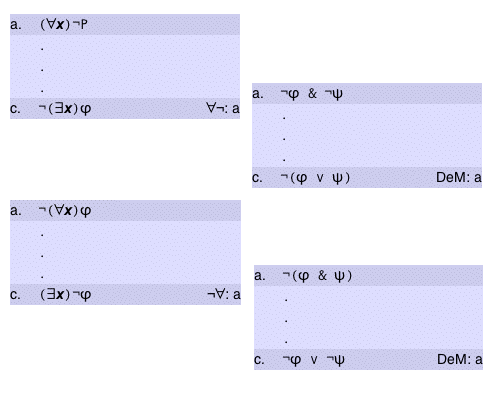
In this module, we look at a number of derived rules for predicate logic that are not only useful when it comes to constructing derivations, but that also highlight some of the properties of the quantifiers. As an example, we'll see a predicate analogue of DeMorgan's law in the rules concerning the interdefinability of the quantifiers.
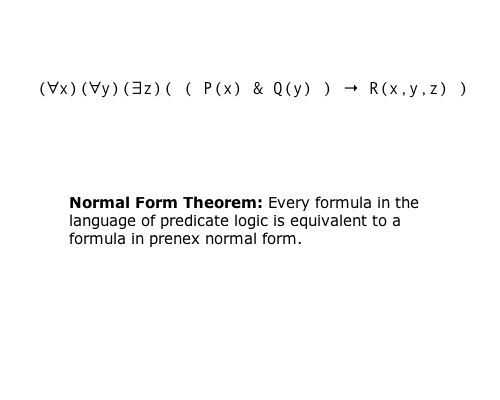
We also introduce the notion of prenex normal form, the predicate counterpart of disjunctive and conjunctive normal forms. A formula is in prenex normal form if it consists of a formula φ that is quantifier-free, preceeded by a sequence of quantifiers. The formula seen here is an example. We'll be able to prove a theorem stating that every formula in the language of predicate logic is equivalent to a formula in prenex normal form.
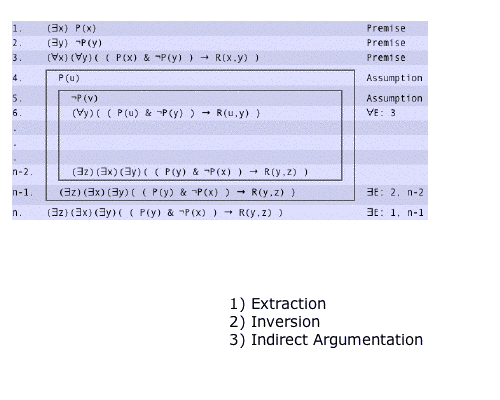
As a starting point, however, we begin by revisiting our strategies for completing derivations, with an eye to bringing them up-to-date for use in predicate derivations.
Let’Äôs summarize and formulate the learning objectives for this module. Studying this chapter will help you to extend the strategic considerations for the construction of proofs in sentential logic to those in predicate logic.
Using these strategies you’Äôll be able to establish a number of important derived rules.
In particular, you'll learn rules that underlie the conversion of an arbitrary formula into an equivalent formula in prenex normal form. Let’Äôs begin at the beginning and extend the strategies for proof construction.