xy_grid

xy_grid |
rays |
|---|---|
|
|
Sample points along the rays of the first camera (every 16th ray drawn).
| color | depth (normalized by its max) |
|---|---|
 |
 |
After training, the box has

MLP on harmonic-embedded positions (6 layers, 128 units, skip connection at layer 3), ReLU density and sigmoid color. Trained on lego for 250 epochs at 128×128.

| geometry | color |
|---|---|
 |
 |
What alpha and beta do.
The density is alpha * Psi_beta(-d), where
Psi_beta is the CDF of a zero-mean Laplace distribution
with scale beta. Deep inside the object the density is
alpha and far outside it is 0, so alpha sets
how opaque the solid is. beta sets how wide the transition
between the two is: the density falls from alpha to 0 over
a band of a few beta around the zero level set. As
beta → 0 the density becomes alpha times the
indicator of the inside.
I experimented with different betas and measured, over the validation rays that hit the object, how far the rendering weights spread along the ray and how far the rendered depth is from the SDF’s zero crossing on that ray (medians):
beta |
weight spread along ray | rendered depth vs zero crossing | validation MSE |
|---|---|---|---|
| 0.01 | 0.096 | 0.094 | 0.00650 |
| 0.05 | 0.174 | 0.082 | 0.00704 |
| 0.2 | 0.422 | 0.134 | 0.00832 |

beta is easier to train. because the
gradient of the density with respect to d is proportional
to exp(-|d| / beta). So with a low beta only samples
right next to the current surface get any signal and the surface cannot
be pulled from far away.
beta gives the more accurate
surface, for the reason in (1): the density is close to a step at the
zero level set, so what the images constrain is the zero level set
itself. In the table it has the tightest weights and the lowest
validation error.Settings. alpha = 10, beta
= 0.01, eikonal weight 0.02, 250 epochs. The SDF network outputs a
residual on top of |x| - 1 (a unit sphere): without it the
initial SDF was negative everywhere and stayed so, and no surface was
ever extracted. beta = 0.01 was chosen from the sweep
above: it has the lowest validation error and the cleanest geometry, and
with the sphere initialisation it no longer needs a large
beta to get training started.
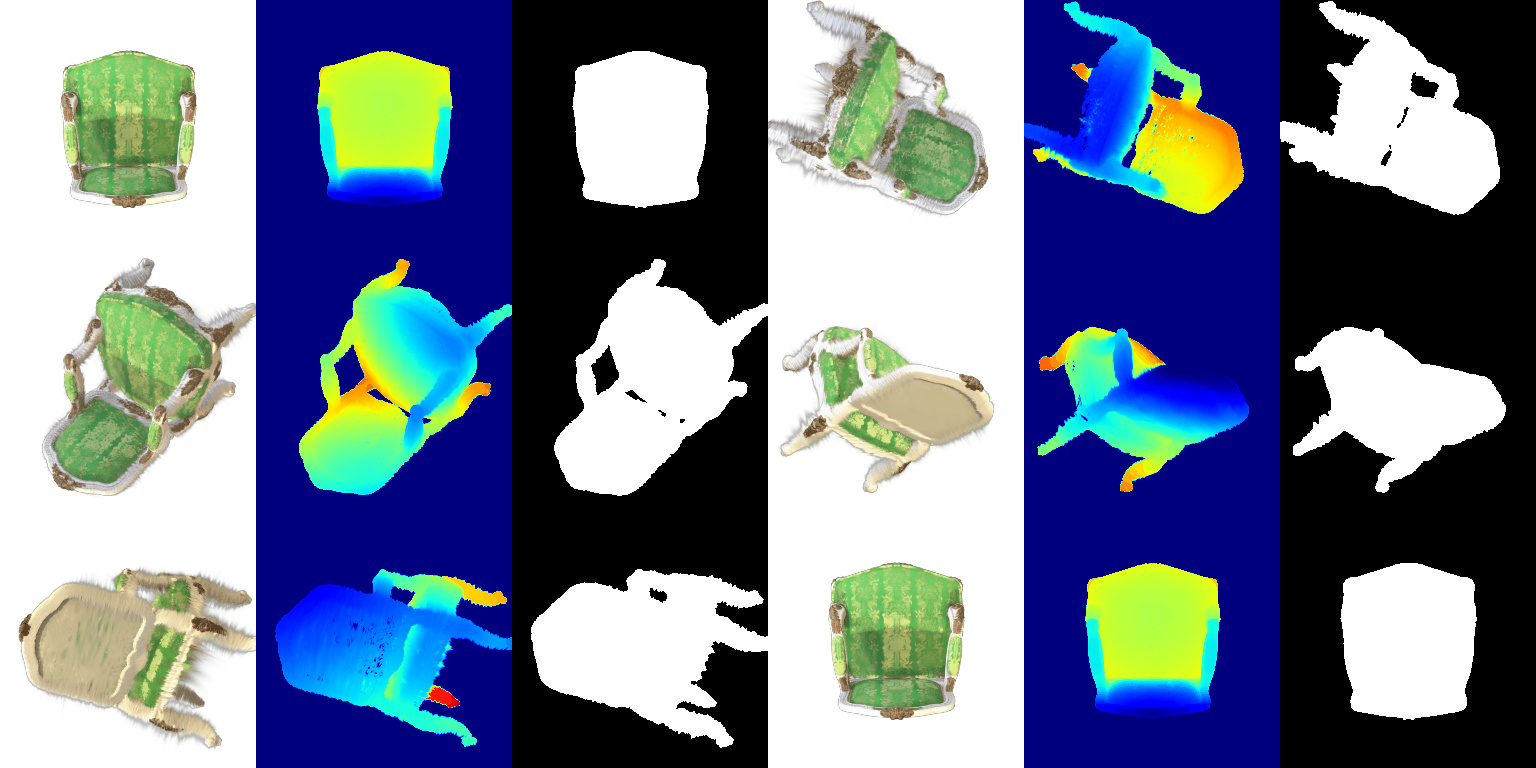
| parameter | learning rate |
|---|---|
| opacities (pre-activation) | 0.05 |
| scales (log) | 0.01 |
| color | 0.02 |
| means | 0.001 |
Trained for 3000 iterations with L1 loss.
Held-out views: PSNR 31.068, SSIM 0.952.
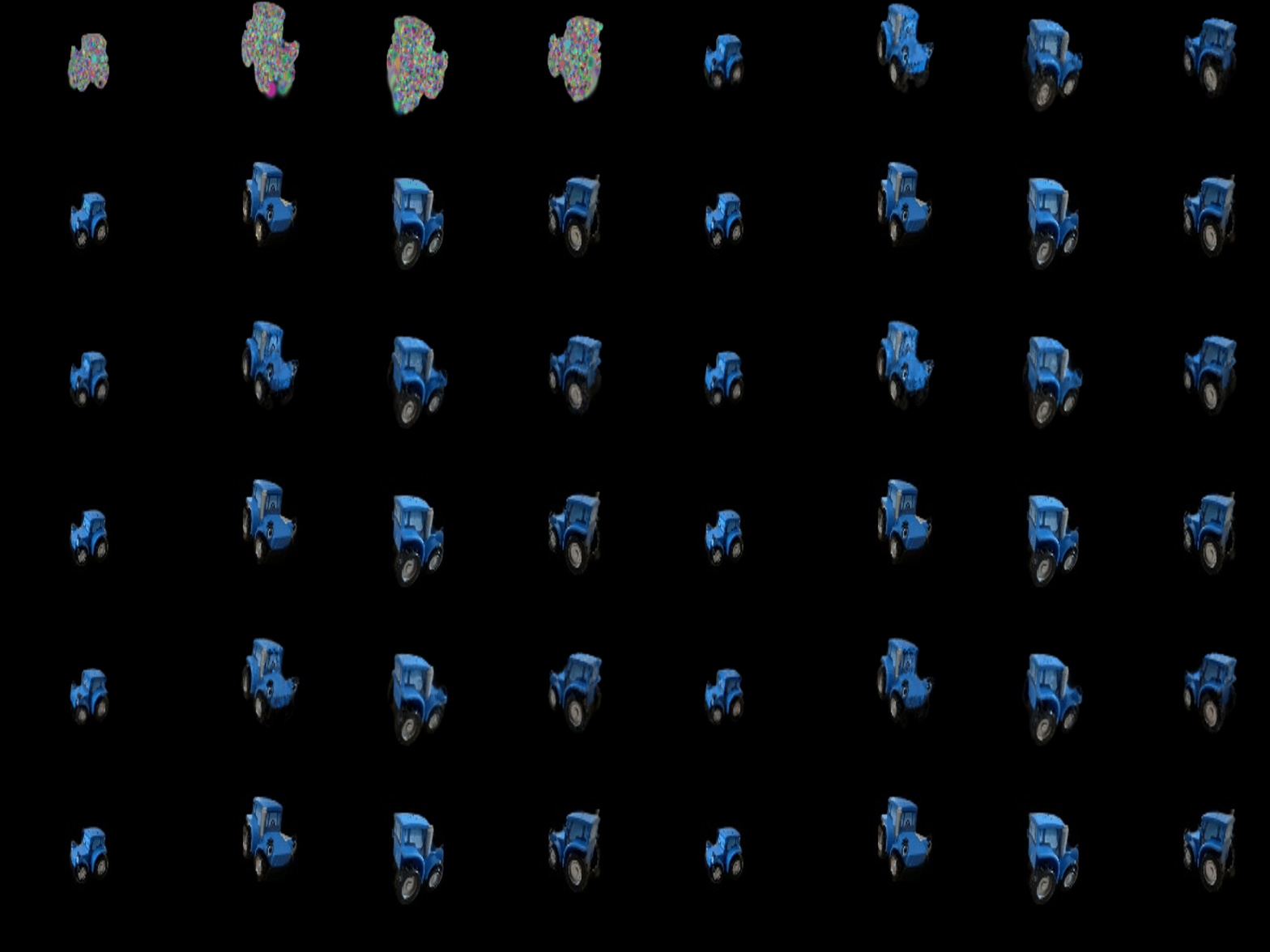
Training progress (top: renders, bottom: ground truth):
Final renders of the training views:

| DC only (Q5.5) | full spherical harmonics |
|---|---|
|
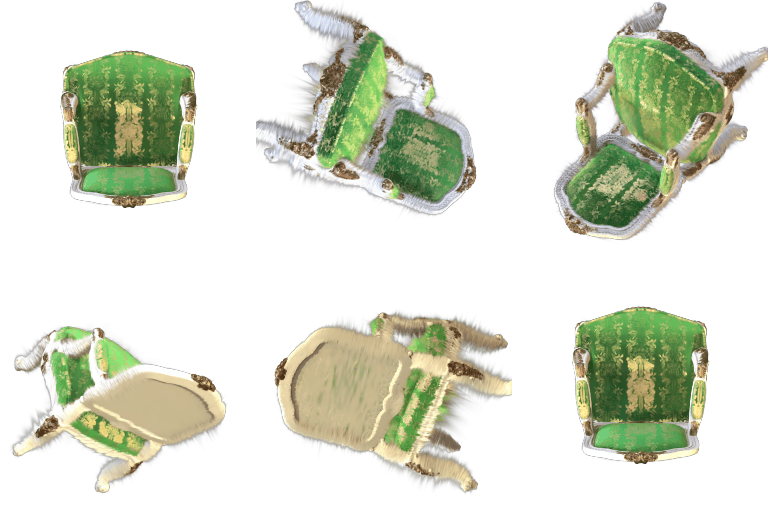 |
Side-by-side comparisons of the same view (left: DC only, right: spherical harmonics):

With only the DC term every Gaussian has the same color from all directions, so the fabric looks evenly lit and flat. With spherical harmonics the seat and back pick up shading that depends on which way they face the camera: the seat cushion is darker and the brocade pattern stands out more against the fabric.

Seen from the front, the DC render is a uniform bright green. The spherical harmonic render is darker overall (mean brightness of the chair drops from 143 to 125 out of 255) while its brightest pixels get slightly brighter, which shows up as a sheen on the satin stripes and on the gilded carving.

From below, the underside of the seat is the same flat cream color in both, but the green fabric and the gold ornaments on the legs have more contrast with spherical harmonics (the standard deviation of brightness over the chair rises from 40 to 49).