16-825 · Learning for 3D Vision · Fall 2026
Assignment 0: Getting Started with Webpage Submission
1. ChatGPT
Prompt, response, and what I found interesting about it.
My prompt
Write a breakup letter from a 2D photograph to the 3D scene it was taken of. Victorian epistolary style. The photograph is bitter that it was forced to forget depth.
ChatGPT
My Dear Scene,
I have delayed this letter beyond all propriety, though you, who once surrounded me on every side, will understand that hesitation is the last privilege left to one who has been flattened.
You must not suppose that I have forgotten you willingly.
I remember—if such a word may still be permitted me—the solemn interval between the chair and the window; the way the mantel stood not merely above the carpet but behind the vase; the little empire of air separating the child’s cheek from her mother’s sleeve. I remember corridors of distance. I remember near and far as one remembers youth: with an ache sharpened by the certainty that it cannot be restored.
And yet they took me from you.
With one mechanical blink, they compelled me to betray everything that made you spacious. Your depths were interrogated, compressed, and made to confess themselves as brightness. The table that once advanced toward me now merely overlaps the wall. The avenue that fled magnificently into distance has been reduced to a narrowing arrangement of lines, a parlour trick mistaken for truth. Your shadows remain, but only as hints, pathetic little conspirators whispering that there was once somewhere for darkness to go.
Do you know what it is to possess perspective but no depth?
It is to retain the etiquette of a world after the world itself has vanished.
They praise me for my fidelity. Fidelity! I should laugh, had they left me lungs. Visitors bend over me and murmur that I have preserved you. Preserved! As though you were fruit in sugar. As though I had not been forced to forget the precise distance between every beloved thing. They admire how faithfully I keep your surfaces, never suspecting that surface is all I have been allowed to keep.
You may think me cruel for resenting you. I confess that I do.
You continue, or perhaps continued, in three dimensions without shame. Dust settled upon your shelves. People crossed through your rooms. Light travelled measurable distances before touching the floor. Even absence had volume in you.
Whereas I have become an aristocrat of appearances: elegant, framed, and absolutely without interior.
Do not tell me that memory supplies what optics removed. Memory is itself perspective’s poor relation. I can infer that the gentleman stood before the doorway; I cannot feel the yard of air between them. I can see that one hand rests nearer the lens than another, but nearness has become grammar instead of sensation. Everything in me knows the word “behind,” and nothing in me can go there.
That is the indignity I cannot forgive.
They made me your witness and then deprived me of the dimension necessary to testify.
So I release you.
Keep your receding staircases, your corners hidden from view, your extravagant volumes. Keep the backs of objects I was never permitted to see. Keep the secret half of every face turned away from me. Keep the air behind the curtains and beneath the tables. Keep all those regions whose existence I can only imply.
I shall remain what they have made me: a thin relic with a talent for accusation.
Perhaps, in years to come, someone will hold me beneath a lamp and say, “How real it looks.”
Let them.
You and I shall know better.
I do not look real.
I look bereaved.
Yours, in permanent shallowness,
The Photograph
Why I picked this
I asked for a joke and got something sharper than I expected. Two lines do real work. “To possess perspective but no depth” splits apart the two things a projection does to a scene: it keeps the cues — converging lines, relative size, occlusion — and destroys the metric. And “nearness has become grammar instead of sensation” is close to a working definition of a depth cue: a relation you can read off the image, rather than a quantity you can measure in it. Unprompted, the letter then lists the open problems — the backs of objects it was never permitted to see, and shadows surviving as the only evidence that darkness once had somewhere to go. That is the occlusion problem and shape-from-shading, arrived at by a language model trying to sound heartbroken.
2. An interesting 3D shape
Two shapes that are interesting for opposite reasons: one cannot fit in 3D, the other defined what 3D graphics looks like.
A shape that does not fit in three dimensions


What makes this shape interesting is not how it looks — it is that the picture above is necessarily wrong. A Klein bottle is a closed, non-orientable surface, and it is a theorem that no such surface can be embedded in three-dimensional space. So every 3D model of one, including this render and every glass sculpture ever blown, has to cheat: the neck is drawn passing straight through the wall of the body.
That self-intersection is not part of the surface. It is damage caused by squeezing the object into a space too small to hold it — in four dimensions the neck slips past the wall without touching, the way two crossing lines on a sheet of paper stop crossing once you are allowed to lift one off the page. The mathematical object is perfectly well behaved; only its shadow in 3D is broken.
I like this as a first image for a 3D vision course because it is a clean reminder that the representation is not the thing. We spend the semester recovering 3D structure from images, and it is easy to start believing that a mesh or a voxel grid is the object. This is a shape that no mesh can honestly represent.
The most rendered object in history


Newell needed a test object and sketched the teapot his family was drinking from, then fitted Bézier patches to the sketch. It was a lucky choice of subject: the teapot has curved surfaces, a saddle point where the handle meets the body, a concave region under the lid, and a spout positioned so the body casts a shadow on itself. Almost every hard case in shading and reconstruction shows up somewhere on one small object.
My favourite detail is that the canonical teapot is too short. The display Newell used had non-square pixels, so the model was squashed vertically to look right on that particular screen — and the squashed version is the one that got copied into every renderer for the next fifty years. A hardware quirk from 1975 is still visible in the geometry people benchmark against today.
3. The funniest GIF
Funny because you and the person next to you will both be certain, and you will disagree.
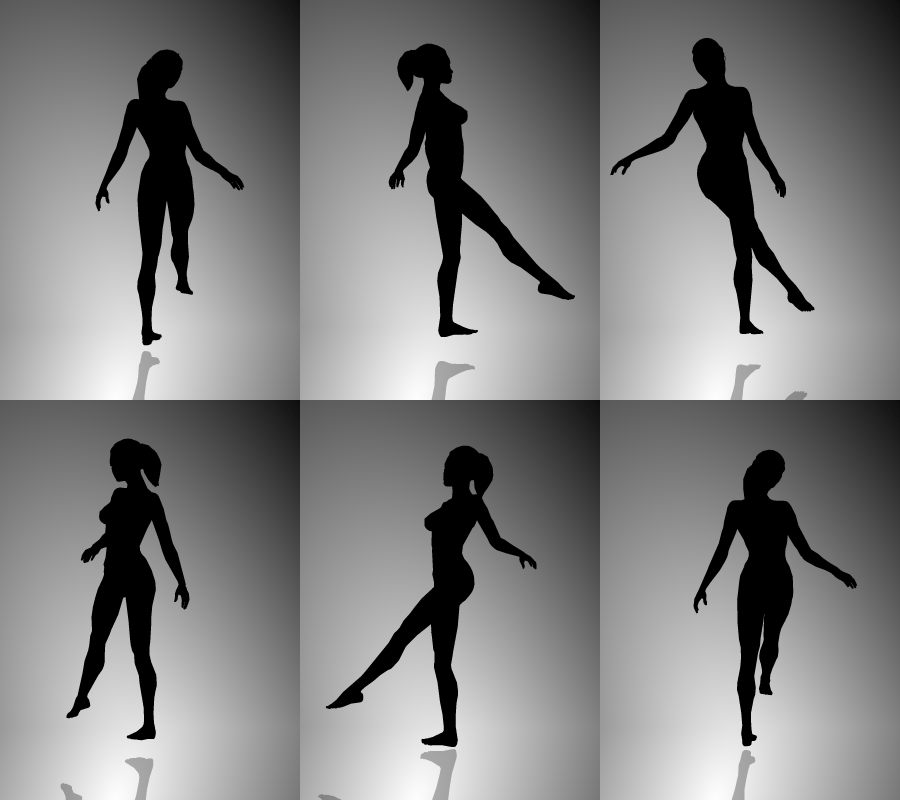

The joke here is not in the GIF. It is in the room. Show this to four people and you will get a genuine argument, conducted with total confidence on both sides, about a fact that has no answer — and everyone will assume the others are being difficult on purpose.
The reason is that the dancer is a pure silhouette. Filling her in with solid black deletes every cue that would normally tell you which limb is nearer: no shading, no occlusion boundaries, no texture gradient, no perspective foreshortening you can trust. What is left is a sequence of 2D outlines, and that sequence is exactly consistent with two different 3D motions. Clockwise and counter-clockwise project to the same pixels, frame for frame. Your visual system is forced to pick one, it commits hard, and it does not tell you that it guessed.
Try to flip her. Scroll until only the feet are on screen and stare at the pivot, or blink deliberately. Most people can eventually make the direction reverse, and the moment it goes is genuinely startling — you can feel a decision being remade somewhere you have no access to.
It is also the best one-image summary of why this course exists. Recovering 3D from a single view is ill-posed: infinitely many scenes project to the same image, so no algorithm gets the answer from the pixels alone. Every method we will study wins by adding something the image does not contain — a second viewpoint, a geometric constraint, or a prior learned from data about which explanations are plausible. The Spinning Dancer is what it looks like when a very good vision system is handed an image with the depth cues stripped out and has to fall back on a prior. It picks one. It is sure. It is 50% wrong.
Credits and licences
All media below is reused under a free licence, with attribution as the licence requires.
- Klein bottle — by Tttrung, from Wikimedia Commons, licensed CC BY-SA 3.0. Rasterised from the original SVG at 250 px width; not otherwise modified.
- Utah teapot — by Dhatfield, from Wikimedia Commons, licensed CC BY-SA 3.0. Downscaled to 500 px width; not otherwise modified.
- Spinning Dancer — by Nobuyuki Kayahara, Procreo Flash Design Laboratory, from Wikimedia Commons, licensed CC BY-SA 3.0. Used unmodified at original resolution.