Assignment 5: Point Cloud Classification and Segmentation
Yannick Daniel Gibson (ydg)
I trained each model for 100 epochs with Adam, batch size 16, and 2,048 randomly resampled points per object; the
learning rate starts at 0.001 and halves every 30 epochs. Following the starter, checkpoints are selected by
test accuracy, using a fixed 2,048-point subset; final evaluations supply all 10,000 points, with the locality
model using the support sampling described below.
1. Classification Model
PointNet achieves 98.01% test accuracy across 953 objects using shared point features,
global max pooling, and a three-class prediction head.
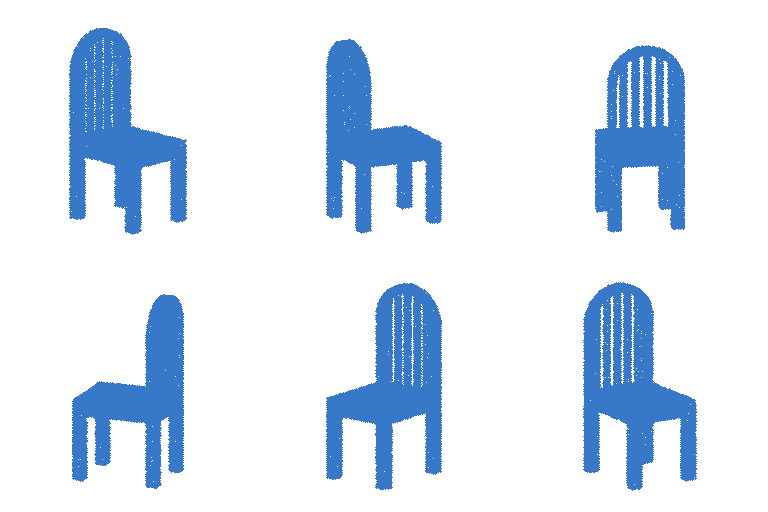
Chair 406 is a folding chair shown in its folded state and is predicted as a lamp; folded configurations are
likely underrepresented in the training data, so the model may rely on the separated seat and back of an
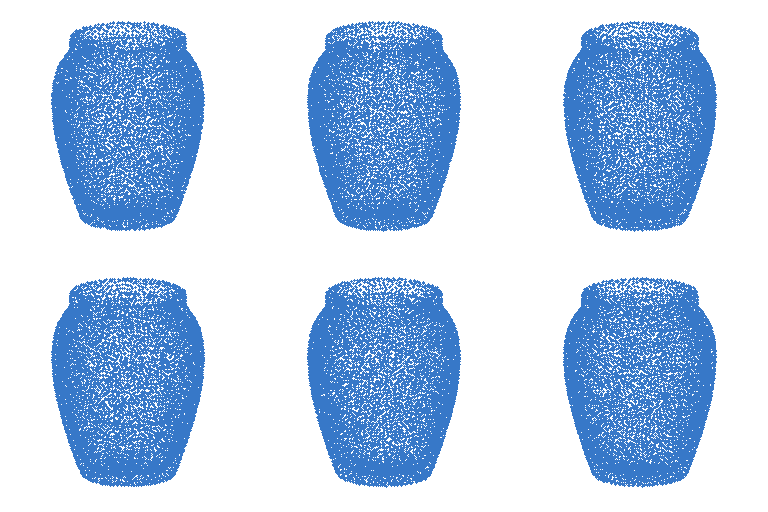
open chair. Vase 650 appears to consist of two parts: a tall box topped by a rotationally symmetric object.
Together they resemble a lamp, making this an understandable mistake even for a human. Lamp 777 is a
chandelier whose central vessel and surrounding curved arms resemble a decorated vase; these errors suggest
that global shape cues can dominate the finer arrangement of parts.
2. Segmentation Model
PointNet achieves 90.15% test point accuracy across 617 chairs by combining each point's
features with a pooled global feature.
Other/unassigned
Headrest
Backrest
Armrests
Base and legs
Seat
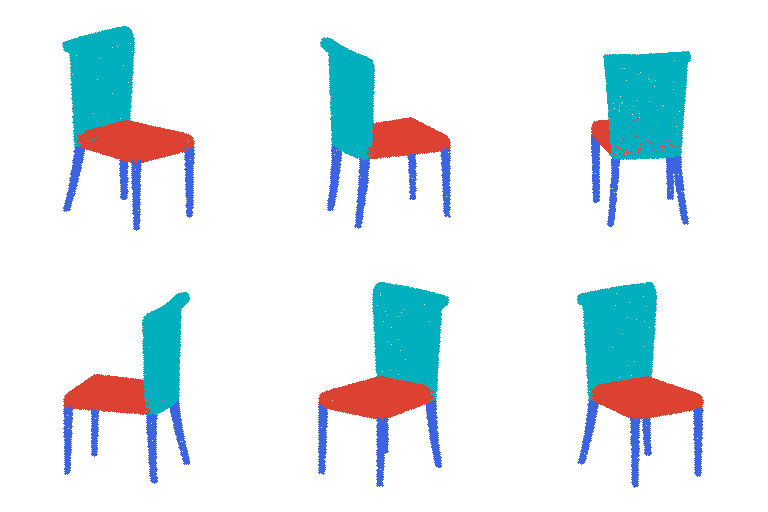
Object 53: 93.54% accuracy (near-median example)
Ground truthPointNet prediction
Object 357: 93.55% accuracy (near-median example)
Ground truthPointNet prediction
Object 477: 93.56% accuracy (near-median example)
Ground truthPointNet prediction
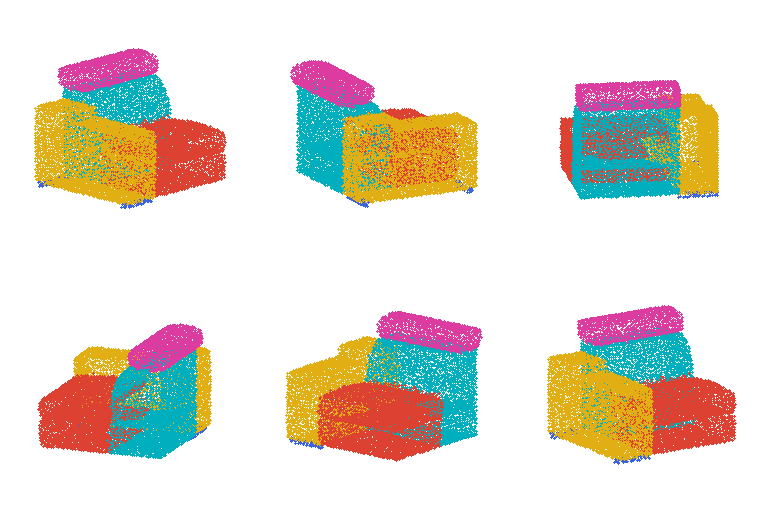
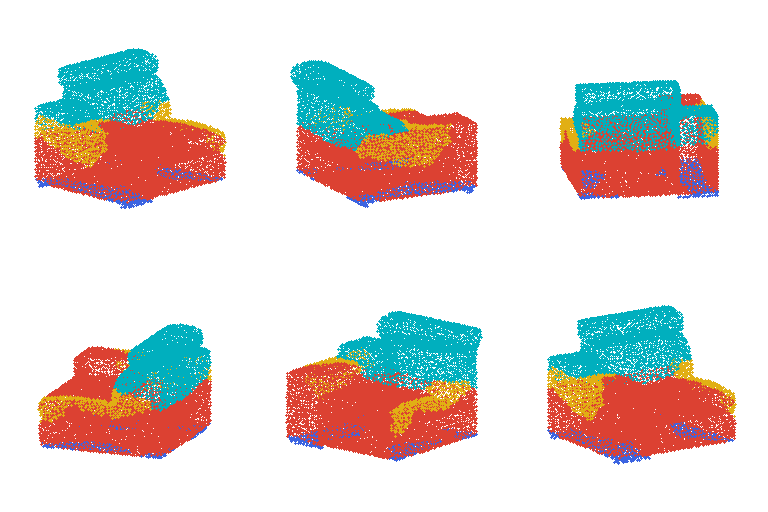
Object 26: 42.04% accuracy (poor prediction)
Ground truthPointNet prediction
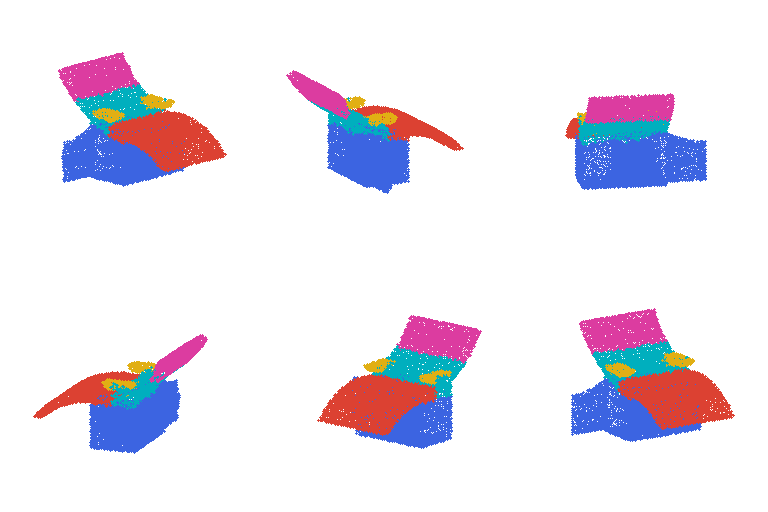
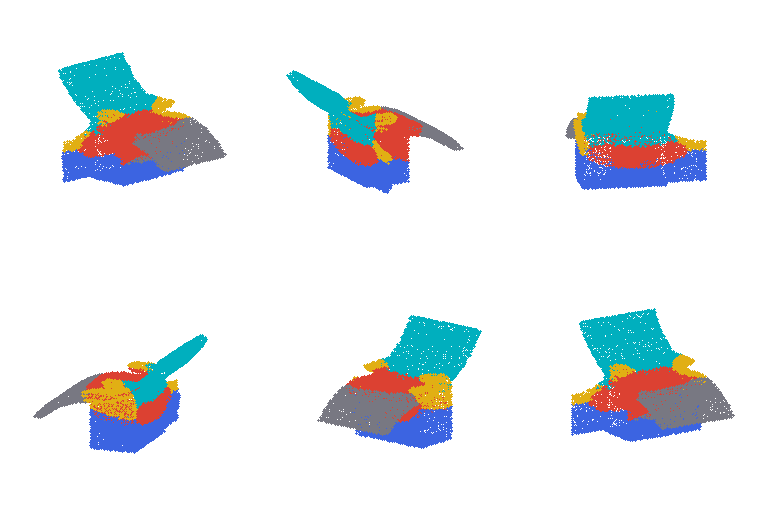
Object 238: 43.66% accuracy (poor prediction)
Ground truthPointNet prediction
Objects 53, 357, and 477 preserve the main back, seat, and support structure; most remaining mistakes lie around part
junctions.
Object 26 is a sofa with a single armrest on the left and a headrest on top. The model mislabels the headrest as backrest and fails to recover the armrest correctly. The model instead assigns points on the right
side to the armrest class. After visually inspecting the training inputs, my
impression is that this unusual, asymmetric configuration is underrepresented. Since chairs commonly have
armrests on both sides, the misplaced predictions suggest reliance
on a familiar global shape rather than the actual local geometry.
Object 238 is an unusual type of chair. Its backrest is curved, and it has two armrests and a floating legrest section. The
model correctly identifies both armrests, but particularly struggles
with the floating legrest, classifying it as Other/unassigned. A
solid base underneath supports the chair. My visual inspection of the
training inputs also suggests that this unconventional design is underrepresented, which could make its part
arrangement harder for the model to recognize.
3. Robustness Analysis
Both experiments use the frozen Q1/Q2 checkpoints and evaluate the entire test split; labels stay attached to
their points.
3.1. Rotation
I rotate every point cloud around its vertical Y axis by 0, 30, 60, 90, or 180 degrees, without retraining.
At 90 degrees, classification falls from 98.01% to 38.93% and segmentation from 90.15% to 58.60%. Chairs 119
and 233 become a lamp and a vase, respectively. On the chairs rotated by 90 degrees, the armrest predictions visibly shift from the sides to the back and
front: the model attempts to label the backrest and front portions of the chair
as armrests. These models do not include transformation blocks. The
effect is not monotonic in angle; segmentation accuracy is 63.51% at 180 degrees, so this is not the
worst-performing angle.
3.2. Number of points
I take nested subsets from one seeded random ordering, retaining 10,000, 2,048, 1,024, 256, or 64 points per
object; segmentation is scored on those retained points.
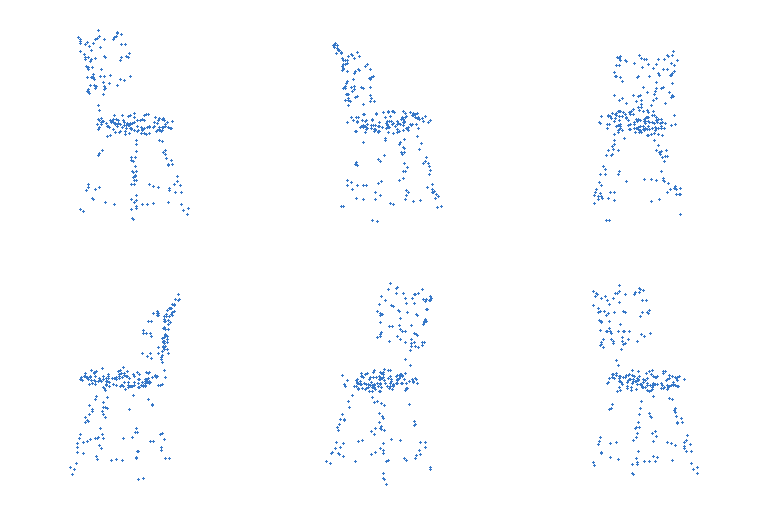
At 256 points, classification retains 97.06% accuracy and segmentation retains 87.28%; the displayed objects
still preserve their broad shape and main part layout. At 64 points, accuracy falls to 88.98% and 79.22%,
respectively. Global max pooling can preserve important feature responses under moderate subsampling, but
very sparse inputs lose evidence for thin structures and part boundaries. The small improvement at 2,048
points matches the training point count and should not be read as a reliable gain from a single sampled
subset.
4. Bonus: Locality
The PointNet++-inspired model uses 2,048 support points, 128 centers, and 32 neighbors per center. Shared
MLPs and max pooling extract local and global features for classification; segmentation predicts all 10,000
points using their coordinates, global features, and local features interpolated from the three nearest
centers.
The neighborhood model achieves higher overall accuracy on both tasks, but does not improve every object. The
locality model correctly classifies two of the three PointNet failure cases: chair 406 and lamp 777. This is
a clear improvement on these examples, although vase 650 is still predicted as a lamp. In segmentation,
object 53 shows better predictions at the junctions between chair parts. Object 357 also improves, while
object 477 becomes slightly worse; neighborhood features help with some part boundaries, but do not resolve
all ambiguities.
Object 238's seat portion is classified more accurately, although its headrest remains classified as backrest.
A larger portion of object 26's left armrest is correctly identified, but at
the cost of misclassifying more of the right side of its seat as armrest. Its headrest also remains classified as backrest.
Persistent headrest errors suggest that distinguishing it from the backrest may require better global context, rather than local
geometry alone.