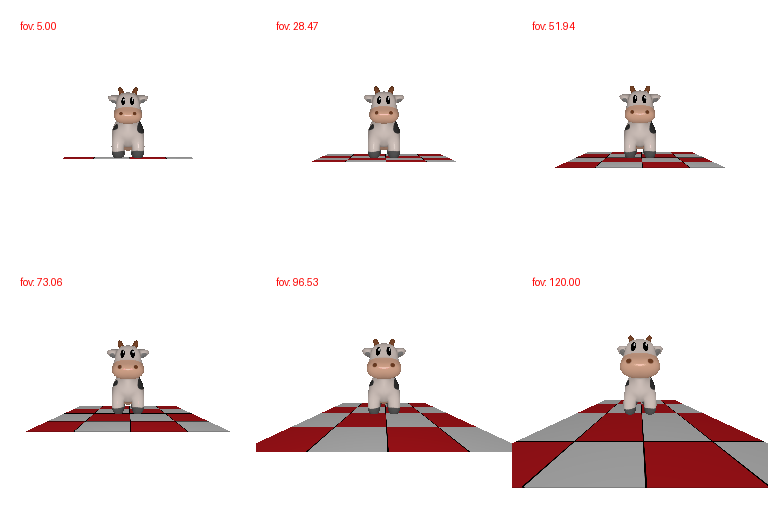
1.1. 360-degree Renders (5 points)


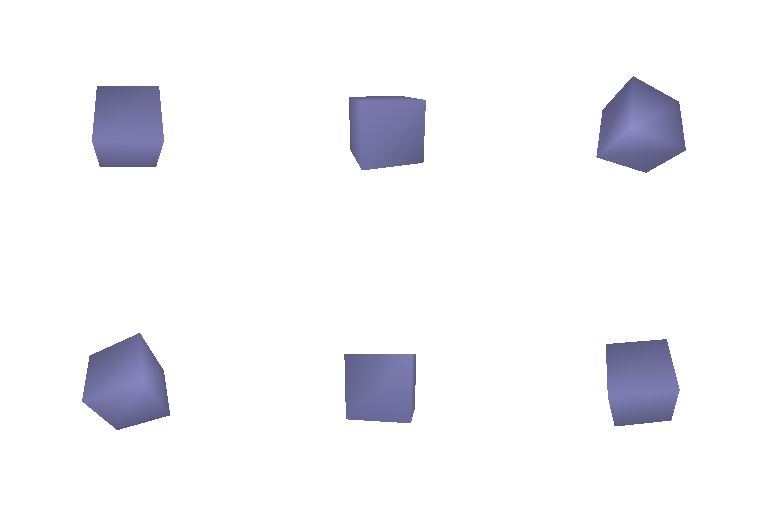

             ⎡ 0  1  0 ⎤                ⎡ 0 ⎤
R_relative = ⎢-1  0  0 ⎥   T_relative = ⎢ 0 ⎥
             ⎣ 0  0  1 ⎦                ⎣ 0 ⎦

R_relative rotates the camera 90 degrees around the z-axis while T_relative leaves its position unchanged.
             ⎡ 1  0  0 ⎤                ⎡  0  ⎤
R_relative = ⎢ 0  1  0 ⎥   T_relative = ⎢  0  ⎥
             ⎣ 0  0  1 ⎦                ⎣ 1.5 ⎦

R_relative keeps the camera orientation unchanged while T_relative moves the camera from world z = -3 to -4.5.
             ⎡ 1  0  0 ⎤                ⎡ 0.5 ⎤
R_relative = ⎢ 0  1  0 ⎥   T_relative = ⎢-0.5 ⎥
             ⎣ 0  0  1 ⎦                ⎣  0  ⎦

R_relative keeps the camera orientation unchanged while T_relative shifts the view by 0.5 in x and -0.5 in y.
             ⎡ 0  0  1 ⎤                ⎡-3 ⎤
R_relative = ⎢ 0  1  0 ⎥   T_relative = ⎢ 0 ⎥
             ⎣-1  0  0 ⎦                ⎣ 3 ⎦

R_relative rotates the camera 90 degrees around the y-axis while T_relative repositions it to keep the cow in view.


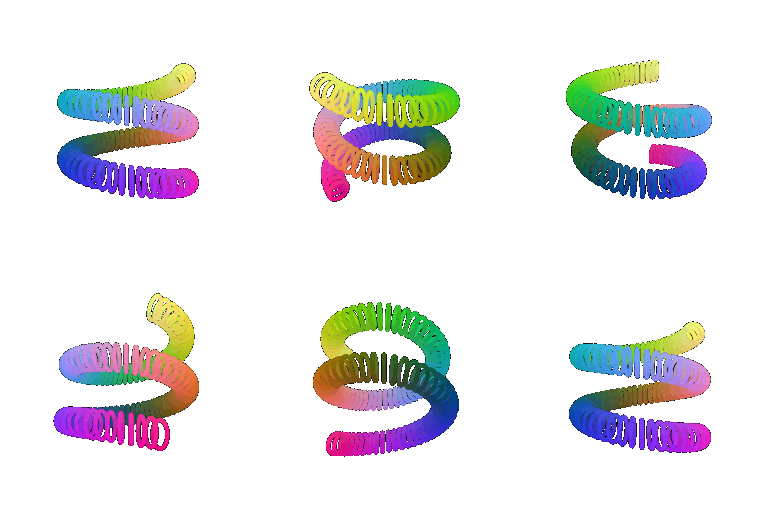
A torus and a spring



Meshes usually give better visual quality than sparse point clouds, with continuous surfaces and smooth lighting. Point clouds are simpler; speed and memory depend on triangle/point counts, while implicit extraction requires a voxel grid.
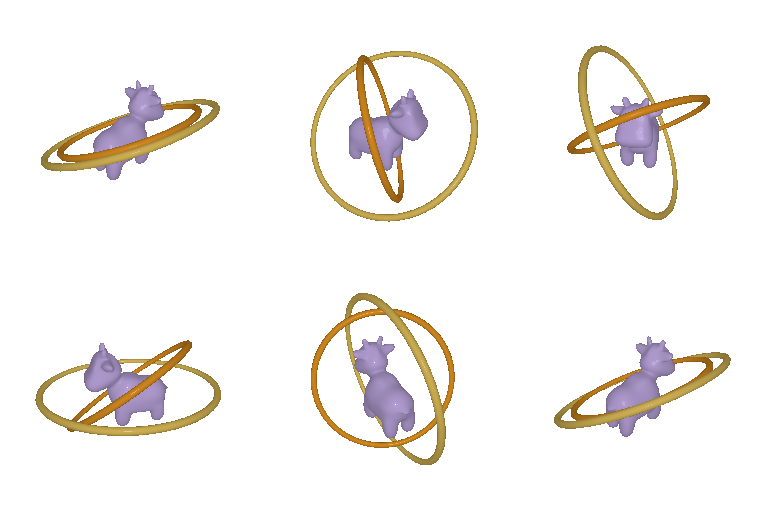
Cow being orbited by 2 rings.
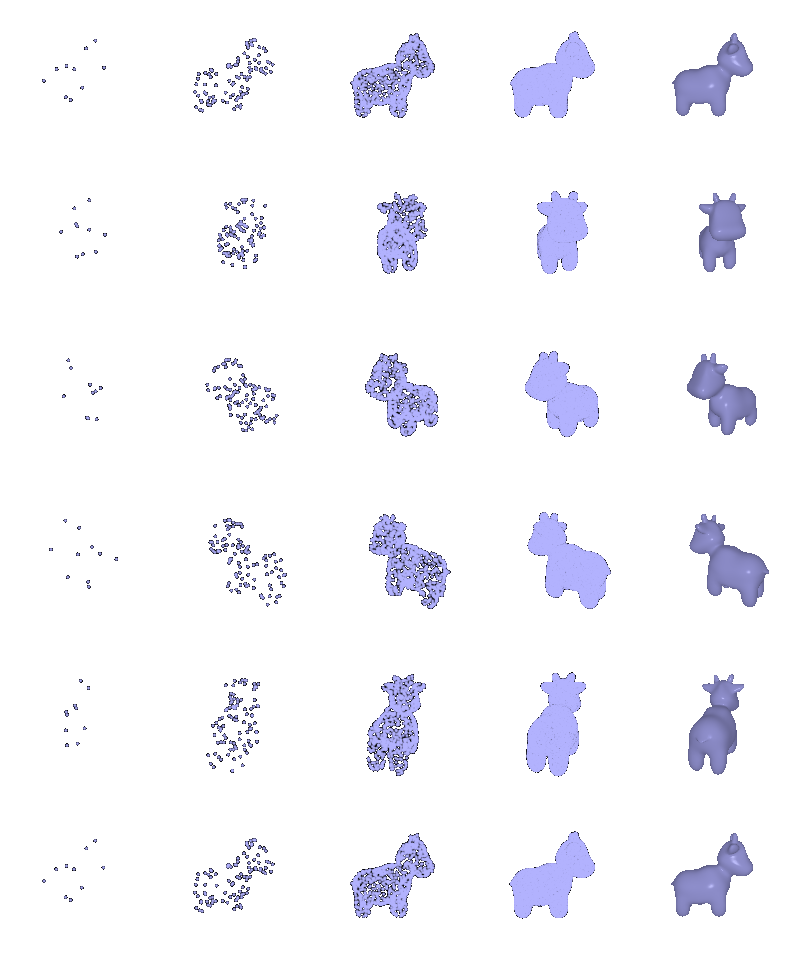
Left to right: 10, 100, 1,000, 10,000 points, and the original mesh.