16-825 Assignment 1: Rendering Basics with PyTorch3D
Name: Wen Wu
Andrew ID: wengleiw
1. Practicing with Cameras
1.1 360-degree Render

1.2 Dolly Zoom

2. Practicing with Meshes
2.1 Tetrahedron

- Number of vertices: 4
- Number of triangular faces: 4
2.2 Cube

- Number of vertices: 8
- Number of triangular faces: 12
3. Re-texturing a Mesh

- color1: Green ([0.0, 1.0, 0.0])
- color2: Magenta ([1.0, 0.0, 1.0])

- R_relative defines a camera rotation of -90 degree along the z-axis. T_relative defines no translation of camera.

- R_relative defines no rotation of camera. T_relative defines a camera translation of 3 units along the z-axis.

- R_relative defines a camera rotation of 5 degree along the y-axis. T_relative defines a camera translation of 0.2 units along the x-axis, and -0.5 units along the y-axis.

- R_relative defines a camera rotation of 90 degree along the y-axis. T_relative defines a camera translation of -3 units along the x-axis, and 3 units along the z-axis.
5. Rendering Generic 3D Representations
5.1 Point Clouds from RGB-D Images
| First RGB-D image |
Second RGB-D image |
Union |
 |
 |
 |
5.2 Parametric Functions
Torus
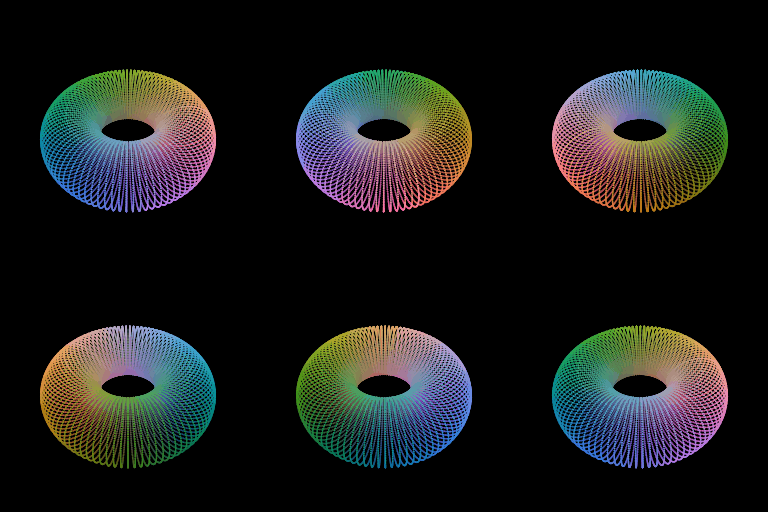
Additional object: Möbius strip

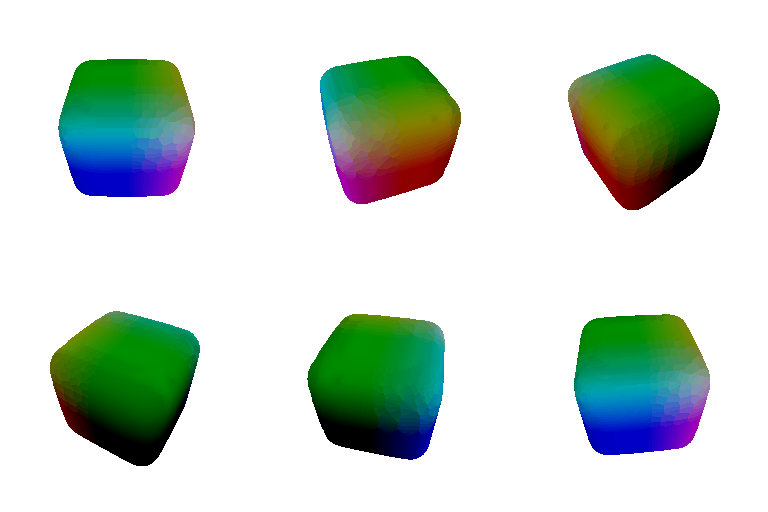
5.3 Implicit Surfaces
Torus
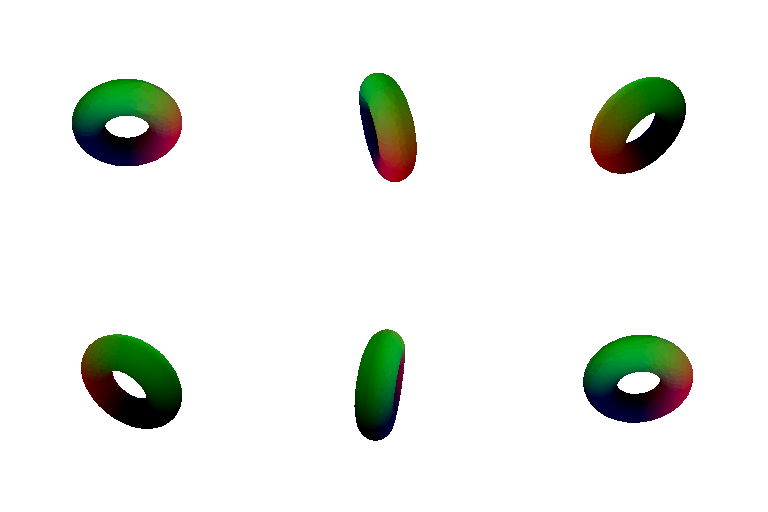
Additional object: rounded cube
Mesh versus point-cloud tradeoffs
- For rendering speed, rendering point cloud can be faster because we don't need to render the edges and faces.
- For rendering quality, rendering mesh have better visual quality since mesh faces are continuous, while point cloud have gaps unless sufficiently dense.
- For ease of use, point cloud is easier because we don't need to deal with faces and connectivity.
- For memory usage, for the same number of vertices or points, mesh rendering uses more momory because we need to also store faces. Dense point cloud can also consume more memory.

- Imagine there is a cow toy production line. A machine is deployed to filter out defective cow (abnormal size). I resued the implicit rounded cube created in 5.3 as a detection machine. If a normal item is scanned, the machine will turn green. If a defective item is detected, the machine will turn red. Vertices in or out of the machine are determined by the implicit function of the rounded cube, where less than 0 means inside. More than half vertices inside the machine implies the cow is in machine.
| Number of samples |
Mesh and point-cloud comparison |
| 10 |
 |
| 100 |
 |
| 1000 |
 |
| 10000 |
 |