


Center: (0.25, 0.25, 0.00). Side lengths: (2.01, 1.50, 1.50). Final sampled RGB MSE: 9.63e-7.


| Without view dependence | With view dependence |
|---|---|
 |
 |
Allowing color to depend on viewing direction helps represent highlights and reflections. A more expressive directional branch can fit training images more closely, but may memorize view-specific appearance and generalize poorly to unseen cameras. I keep density dependent only on position and limit the direction input to a small color branch with two harmonic frequencies. This preserves shared geometry while limiting appearance flexibility, at the cost of potentially blurring sharp reflections.
Compared with uniform sampling, coarse/fine 64 + 64 improves PSNR from 24.75 to 25.03 dB, but increases rendering time from 278.1 to 424.2 ms per image (about 53% slower). Coarse/fine 32 + 32 reduces rendering time to 214.6 ms per image (about 23% faster than uniform sampling), but PSNR drops to 23.94 dB.
| Sampling | Network queries per ray | PSNR | Render time per image |
|---|---|---|---|
| Uniform control | 128 | 24.75 dB | 278.1 ms |
| Coarse/fine: 64 + 64 | 192 | 25.03 dB | 424.2 ms |
| Coarse/fine: 32 + 32 | 96 | 23.94 dB | 214.6 ms |
| Uniform control | Coarse/fine: 64 + 64 | Coarse/fine: 32 + 32 |
|---|---|---|
 |
 |
 |

| Parameter | Learning rate |
|---|---|
| means | 0.00016 |
| scales | 0.005 |
| colours | 0.0025 |
| opacities | 0.05 |
Iterations: 1,000
PSNR: 29.349 dB · SSIM: 0.9388
Training progress
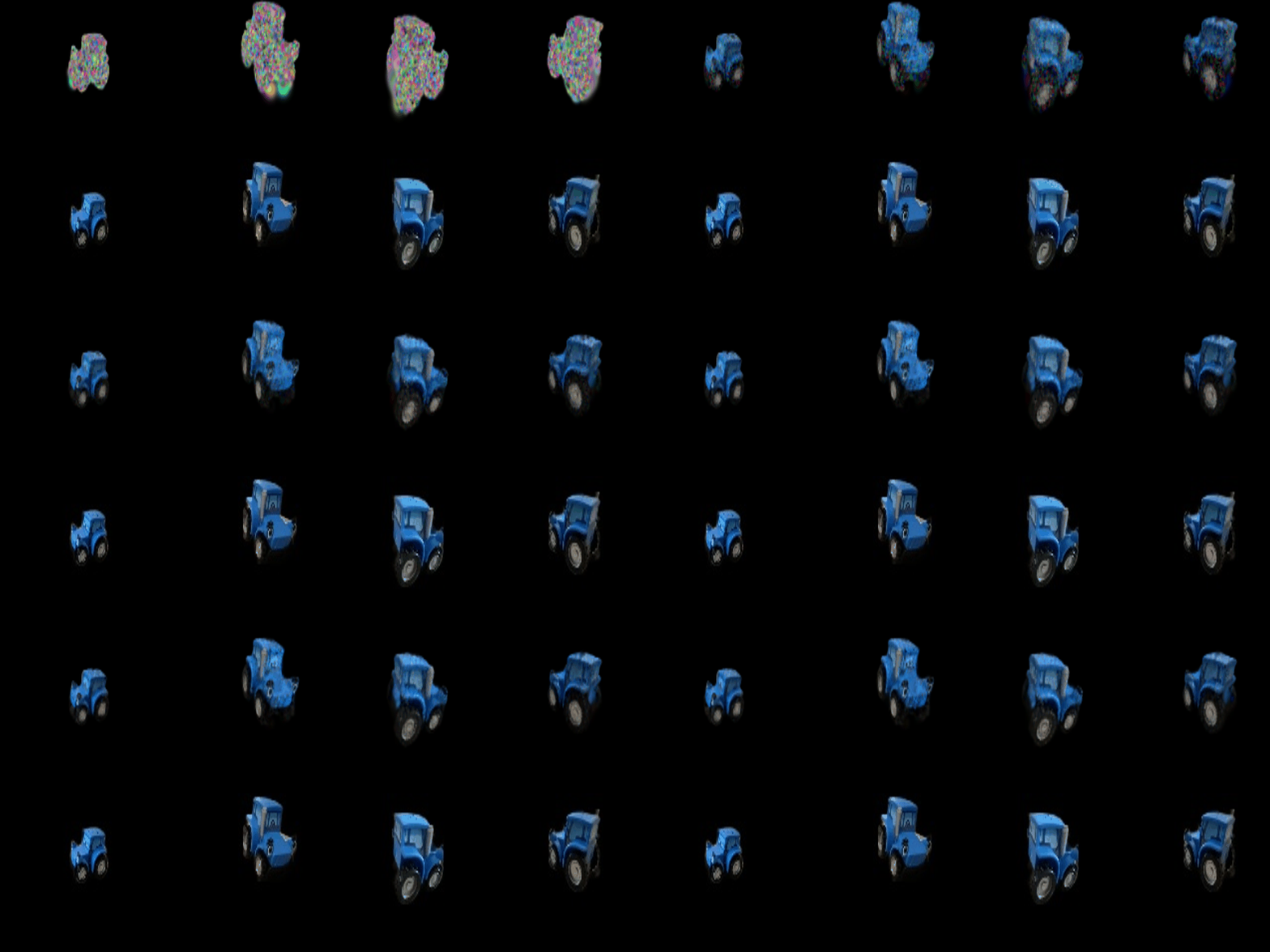
Final renders

| Without spherical harmonics (DC-only) | With spherical harmonics |
|---|---|
|
 |
Frame 0 — Left: DC-only · Right: Full SH

Frame 0: The chair with full spherical harmonics has stronger contrast between the green and gold colors, and the shading transitions appear smoother. The gold pattern is more distinct, so the upholstery details appear better preserved.
Frame 8 — Left: DC-only · Right: Full SH

Frame 8: With full spherical harmonics, the green upholstery looks darker and the gold pattern stands out more clearly. The stronger contrast makes the fabric details easier to see, although streaks around the thin supports remain.
Frame 20 — Left: DC-only · Right: Full SH

Frame 20: The green and gold trim has stronger contrast with full spherical harmonics, making its pattern easier to see. The beige back panel looks similar in both images, and the streaks around the thin supports remain.