


PointNet classification and segmentation results, robustness experiments, and a Point Transformer bonus model.
97.59% (930 / 953 test objects)


Chair failure: The chair has a tall, narrow structure, so its legs and back produce a silhouette resembling a lamp stand. PointNet's global max-pooled feature appears to emphasize this overall vertical shape more than the spatial relationship between the seat and back.
Vase failure: The vase's narrow neck and wider body resemble the stem-and-shade proportions of a lamp. This suggests that the classifier relies strongly on coarse proportions when the local surface structure is ambiguous.
Lamp failure: The lamp has a rounded body or base connected to a narrow section, which resembles a vase profile. Sparse or thin lamp components contribute fewer prominent features, allowing the smoother vase-like regions to dominate the global representation.
89.89% (5,546,210 / 6,170,000 test points)


Interpretation: The model performs well when chair parts have clear spatial separation. The worst examples contain ambiguous boundaries and structures, causing large connected regions to receive the wrong part label.
Procedure: Evaluate both trained models with 10,000, 5,000, 1,000, and 100 sampled points per object. Smaller point sets are subsets of the larger sets.
| Points | Classification accuracy | Segmentation accuracy |
|---|---|---|
| 10,000 | 97.59% | 89.89% |
| 5,000 | 97.38% | 89.91% |
| 1,000 | 96.96% | 89.02% |
| 100 | 94.44% | 79.79% |
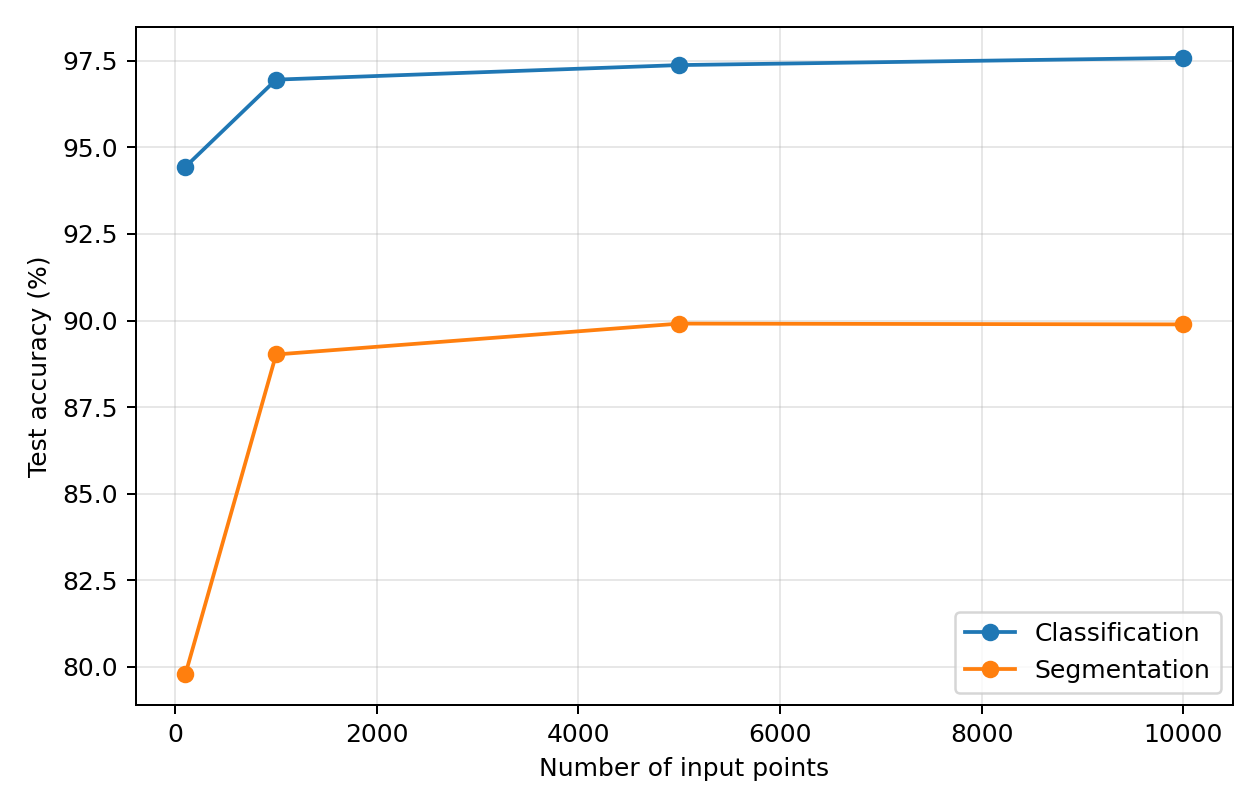


Interpretation: Both models remain stable through 1,000 points. At 100 points, classification falls by 3.15 percentage points and segmentation by 10.10 points. Dense segmentation depends more strongly on sufficient spatial coverage.
Procedure: Rotate each input around the y-axis by 0°, 45°, 90°, 135°, and 180° without retraining. Segmentation labels remain attached to their points.
| Rotation | Classification accuracy | Segmentation accuracy |
|---|---|---|
| 0° | 97.59% | 89.89% |
| 45° | 77.54% | 71.50% |
| 90° | 77.33% | 51.34% |
| 135° | 27.39% | 32.11% |
| 180° | 32.84% | 39.75% |


Interpretation: Rotation causes a much larger drop than point removal. The models learn orientation-dependent coordinate patterns rather than rotation invariance. Segmentation is especially sensitive because rotation changes the coordinate patterns used to identify individual parts.
Our compact Point Transformer selects 1,024 anchors with farthest-point sampling and applies vector attention over each point's K = 16 nearest neighbors. For segmentation, anchor features are interpolated back to all 10,000 points.
| Task | PointNet | Point Transformer | Difference |
|---|---|---|---|
| Classification | 97.59% | 96.96% | −0.63 |
| Segmentation | 89.89% | 91.13% | +1.24 |


The Point Transformer improves segmentation by 1.24 percentage points and labels 76,564 additional test points correctly. Classification is 0.63 points below PointNet.
| Points | Classification accuracy | Segmentation accuracy |
|---|---|---|
| 10,000 | 96.96% | 91.13% |
| 5,000 | 97.17% | 91.16% |
| 1,000 | 96.54% | 90.71% |
| 100 | 41.76% | 83.47% |


Interpretation: Transformer segmentation remains comparatively robust at 100 points, dropping 7.66 percentage points. Classification falls by 55.20 points. The classifier was trained using up to 1,024 attention anchors and does not generalize well to an extremely sparse 100-point input. In comparison, PointNet classification still reaches 94.44% with 100 points.
| Rotation | Classification accuracy | Segmentation accuracy |
|---|---|---|
| 0° | 96.96% | 91.13% |
| 45° | 80.27% | 82.77% |
| 90° | 77.02% | 63.83% |
| 135° | 30.01% | 55.79% |
| 180° | 35.05% | 62.88% |


Interpretation: Point Transformer classification has approximately the same rotation sensitivity as PointNet. Transformer segmentation is more rotation robust: at 90° it reaches 63.83% versus PointNet's 51.34%, and at 180° it reaches 62.88% versus 39.75%.