Differentiable Volume Rendering
1.3 Ray Sampling


1.4 Point Sampling

1.5 Volume Rendering


Optimizing a Basic Implicit Volume
2.3 Visualization


Box center: (0.25, 0.25, 0.00)
Box side lengths: (2.00, 1.50, 1.50)
Optimizing a Neural Radiance Field
Visual Results

NeRF Extras
4.1 View Dependence


Adding view dependence produces subtle appearance changes in the Lego scene while preserving similar overall geometry. View dependence is particularly relevant to the materials scene, where reflections and highlights vary with viewing direction. However, greater directional flexibility can overfit the training views and reduce consistency at unseen angles. Limiting this flexibility helps balance realistic appearance with generalization to novel views.
3D Gaussian Rasterization
5.5 Perform Splatting

Training 3D Gaussian Representations
6.2 Forward Pass, Loss, and Training Results
I used Adam with learning rates of 0.0002 for means (positions), 0.005 for scales, 0.05
for opacities, and 0.0025 for colors. The model was configured to train for 1,000
iterations.
PSNR (dB): 29.493
SSIM: 0.940


Gaussian Splatting Extensions
7.1 Rendering Using Spherical Harmonics
GIF Comparison:

Matched View 1:


In the DC-only rendering, the upper half of the chair cushion is noticeably bright. With SH, the entire cushion appears darker and more shaded, including the upper-right corner.
Matched View 2:


In the DC-only rendering, the cushion remains noticeably bright. From this viewpoint, the cushion in the SH rendering becomes brighter overall, including the upper-right corner.
Matched View 3:


In the DC-only rendering, the upper half of the cushion remains noticeably bright. From this viewpoint, the SH rendering shows uneven brightness across the cushion: the upper-right corner is darker, while the other areas are relatively bright.
Across all three comparisons, the chair’s texture also appears clearer in the SH renderings.
7.2 Training on a Harder Scene
Baseline Results:


Improved Results:
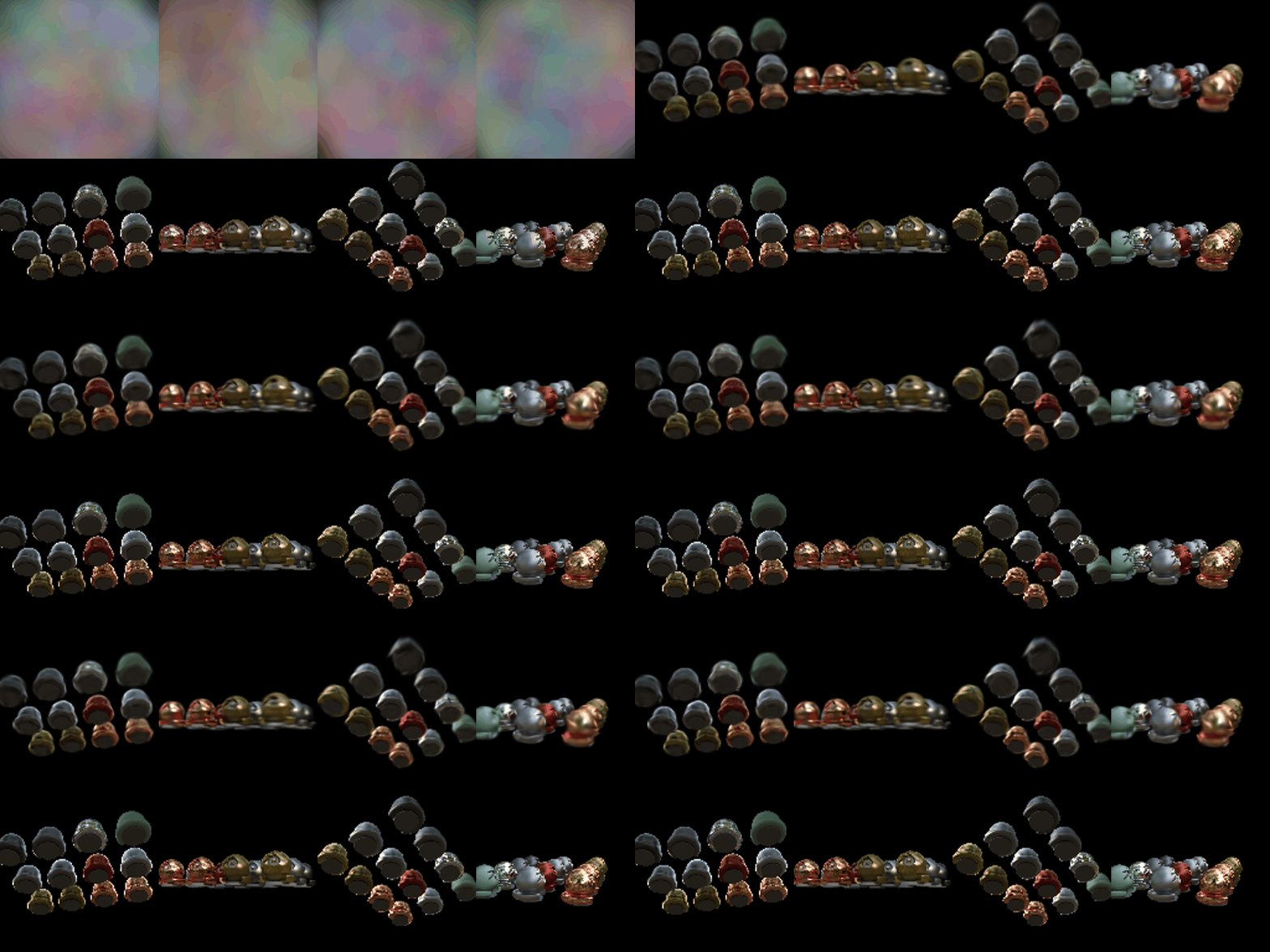
Since both the baseline and improved models were trained for 30,000 iterations, their training progress GIFs are large, so we uniformly sample 100 frames from each.

Baseline:
PSNR: 17.737 dB
SSIM: 0.674
Improved:
PSNR: 24.933 dB
SSIM: 0.903
Improved Settings:
Compared with the baseline, I made the following modifications:
Training duration and learning-rate scheduling:
Both the baseline and improved models were trained for 30,000 iterations, compared
with 1,000 iterations for the toy-truck experiment. For the improved model, the position
learning rate decays exponentially from 0.0005 to 0.000005 over 30,000 steps,
allowing larger updates early
and finer adjustments later. The learning rates for opacities and scales remain 0.05 and
0.005.
Anisotropic Gaussians:
I replaced isotropic Gaussians with anisotropic Gaussians, optimizing three scales and a
rotation for each Gaussian to better fit scene geometry. The rotation learning rate is
0.001.
View-dependent appearance:
I added trainable spherical harmonics to model appearance changes across viewing
directions. The DC coefficients use a learning rate of 0.0025, while higher-order
coefficients use 0.000125.
Combined reconstruction loss:
I replaced the L1-only loss with 0.8 × L1 + 0.2 × (1 − SSIM) to
encourage both pixel accuracy and structural similarity.
Improved initialization:
Relative to the original initialization, I increased the standard deviation of random
positions from 0.2 to 0.5, initialized opacity to 0.1 instead of nearly 1, and
initialized scales using the root mean squared distance to each point's three nearest
neighbors. These changes provide broader initial coverage, reduce excessive occlusion,
and adapt Gaussian sizes to local point spacing.
Comparison With NeRF:

The improved Gaussian representation captures surface cracks and holes, with more pronounced gloss and view-dependent color changes. Visually, it reconstructs these details more clearly than my NeRF result.