1. Classification Model
I implemented a PointNet based classification model, and training and evaluation codes. I trained the model and evaluated the best checkpoint on the test set. The test accuracy is as follows.
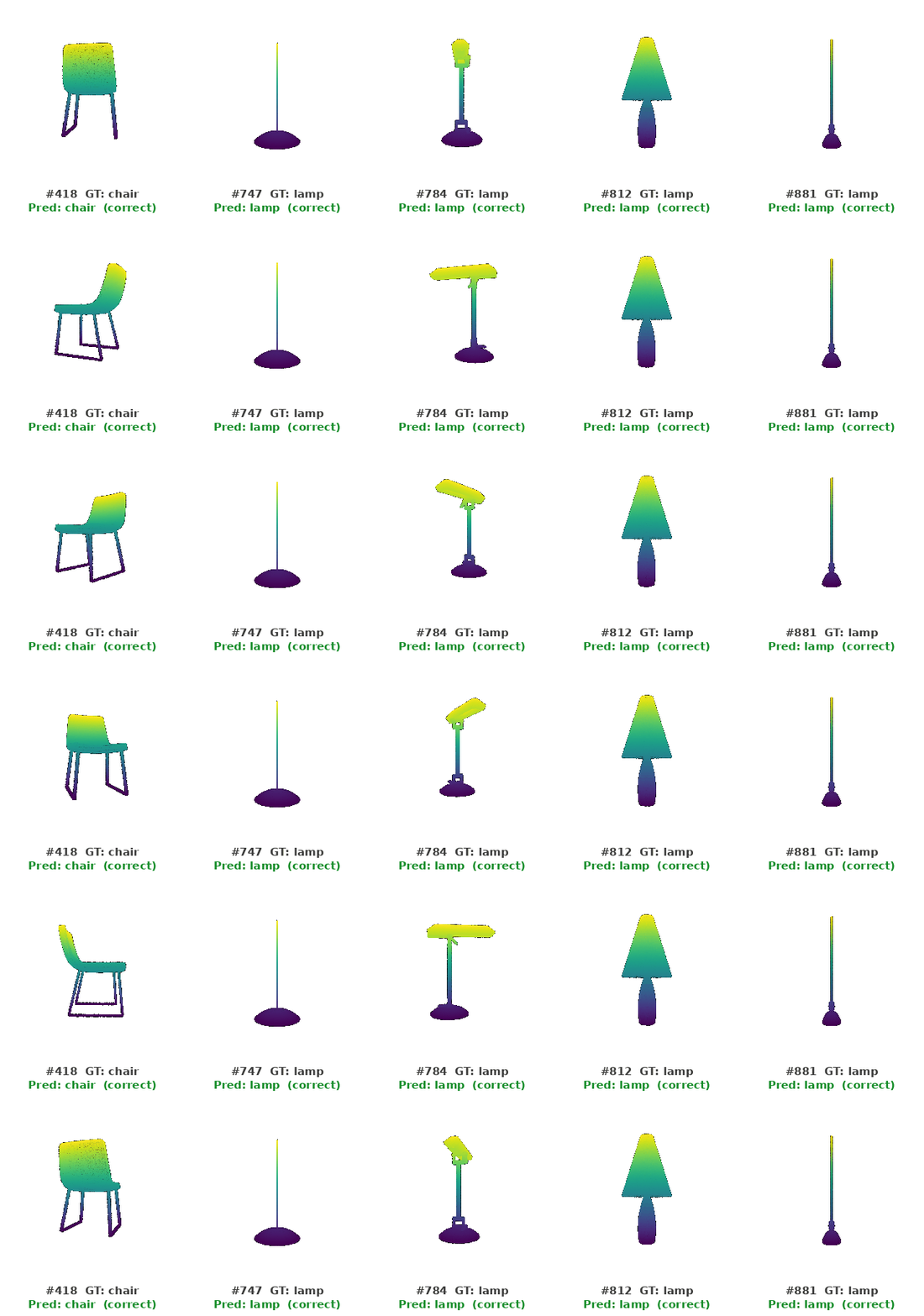
I randomly sampled five test samples from the test set, and visualized the point clouds and the predicted class (Fig. 1).
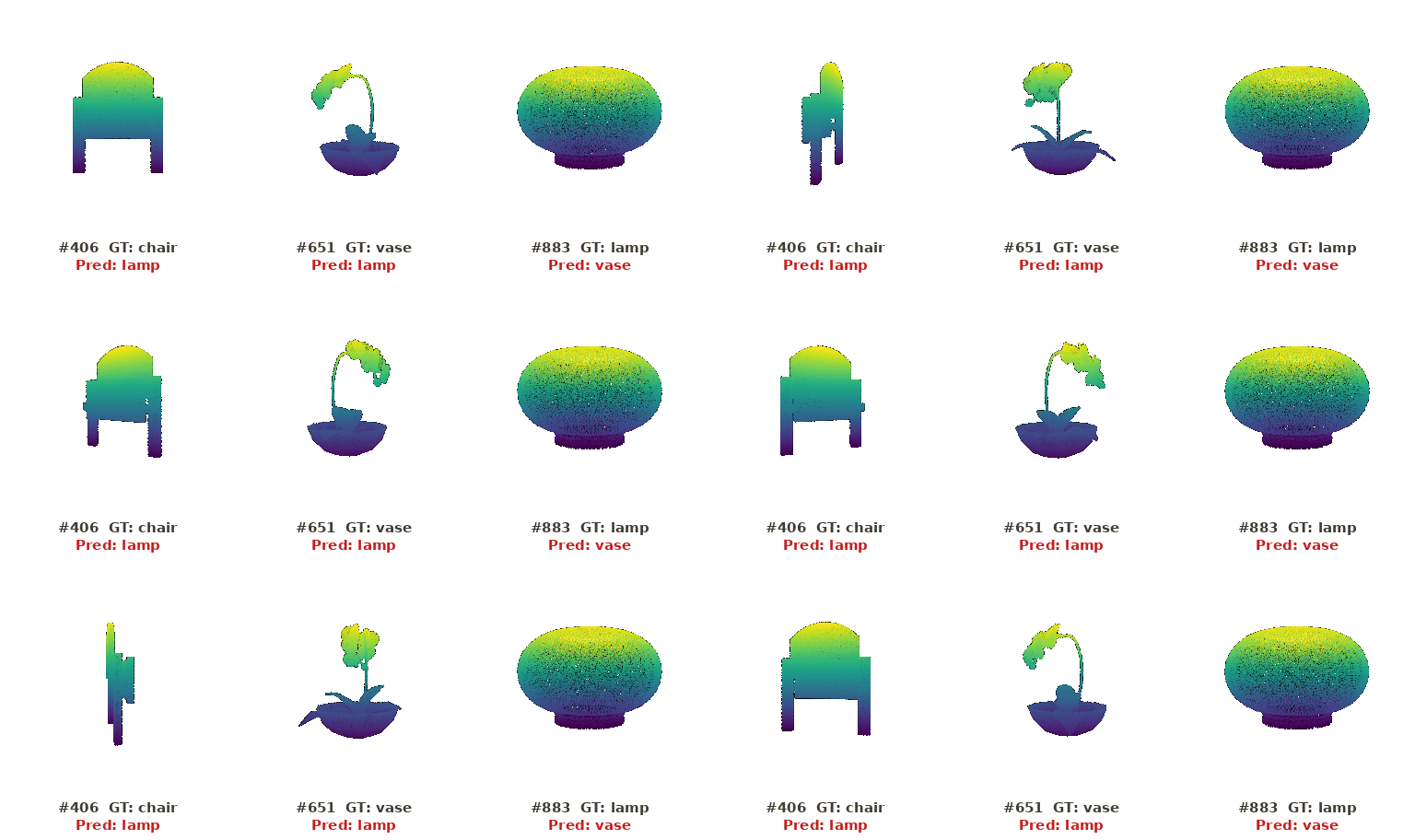
I sampled one failure case for each class, and visualized the point clouds, the ground truth and the predicted class (Fig. 2)
Interpretation:
The chair (#406) is a wide, upright armchair whose seat is folded in and rounded back dominates the shape. Its symmetric outline with a dome-shaped top looks similar to the lamp shapes in the training set (for example, # 883), so the model confuses it with a lamp. The vase (#651) is a flow with a long, thin stalk on a shallow bowl. This shape is similar to a lamp shape with a rounded base, a thin arm and a blob at the end, so the model confuses it with a lamp. The lamp (#883) is a squat, rounded shape with a small rim at the bottom and no visible pole or base. A wide, rotationally symmetric body that bulges in the middle confuses it with a vase.
2. Segmentation Model
I implemented a PointNet based segmentation model, and training and evaluation codes. I trained the model and evaluated the best checkpoint on the test set. The test accuracy is as follows.
I randomly sampled five test objects and visualized the segmentation results (Fig. 3). The results include two bad predictions where the accuracy is below 0.8.
| Object index | Per-object accuracy |
|---|---|
| 212 | 0.910 |
| 233 | 0.904 |
| 304 | 0.926 |
| 238 (bad) | 0.664 |
| 331 (bad) | 0.609 |

Interpretation:
On ordinary chairs (#212, #233, #304) the model predicted the correct segmentation in large parts though there are some errors on the boundaries between parts such as the armrests and the back. The chair (#238) is a reclining chair with a continuous curved surface for the seat and the back. The ground truth contains a headrest (green), which connects so seamlessly to the back that the model confuses most of the part with the back in the prediction. The chair (#331) is a box-shaped chair with a single cuboid-shaped leg (purple), a solid block for the seat (cyan) and thick wall-shaped armrests (orange). They are closely aligned in the point cloud, so the model confuses them with each other and failed to identify the boundaries among them.
3. Robustness Analysis
I conducted two experiments to analyze 1) How rotating the input point clouds affects the accuracy and 2) How varying the number of points affects the accuracy.
Experiment 1: Rotating the Input Point Clouds
Procedure: In each experiment, I rotate the input point clouds (10000 points per object) by fixed angles around y-axis (vertical axis) and z-axis (horizontal axis) and evaluate the accuracy on the test set using the same checkpoints as in Q1 and Q2.
Table 2 shows the test accuracy of classification and segmentation under each rotation angle.
| Rotation (deg) | Classification accuracy | Segmentation accuracy |
|---|---|---|
| 0 (Q1 / Q2) | 0.978 | 0.904 |
| 30 (y-axis) | 0.866 | 0.815 |
| 60 (y-axis) | 0.540 | 0.709 |
| 90 (y-axis) | 0.604 | 0.587 |
| 180 (y-axis) | 0.355 | 0.556 |
| 30 (z-axis) | 0.596 | 0.669 |
| 60 (z-axis) | 0.260 | 0.531 |
| 90 (z-axis) | 0.237 | 0.442 |
| 180 (z-axis) | 0.613 | 0.361 |
Figure 4 shows a chair, a vase and a lamp rotated by 0, 30, 60 and 90 degrees with the ground-truth and predicted class (green: correct, red: wrong).


Figure 5 shows chair #212 rotated by the same angles, with the per-object accuracy under each prediction.


Interpretation:
For classification, the accuracy drops sharply with rotation especially around z-axis. This is because the training set is canonically aligned and PointNet without T-Net is not trained in the rotation-invariant way. The chair (#418) rotated around z-axis (top right in Fig. 4) has unrealistic poses which may not exist in the training set and in fact is wrongly recognized as a vase and a lamp, which might be more similar to the rotated chair than the original chair. For segmentation, the accuracy drops more gradually with rotation, but still decreases significantly. Fig. 5 shows that the model segments the points by their position in the canonical frame. Rotating around y-axis (vertical axis) keeps every point at its original height, so the labels stay mostly correct till 30 degrees. Rotating the chair around z-axis moves the seat and back down to the leg's height, which causes the model to mistake the regions of the seat and the back under the leg height as leg (purple) and a seat strip (cyan) appears right above it.
Experiment 2: Varying the Number of Points
Procedure: In each experiment, I randomly sampled a fixed number of points from each test object and evaluated the accuracy on the test set using the same checkpoints as in Q1 and Q2 for classification and segmentation.
Table 3 shows the test accuracy of classification and segmentation for each number of points per object. Both accuracies drop as the number of points decreases. However, the drop is modest and the models predict the correct class and segmentation with comparable accuracy even at 100 points by which the shape of the object is barely visible.
| Points per object | Classification accuracy | Segmentation accuracy |
|---|---|---|
| 10000 (Q1 / Q2) | 0.978 | 0.904 |
| 5000 | 0.978 | 0.903 |
| 1000 | 0.977 | 0.895 |
| 500 | 0.974 | 0.876 |
| 100 | 0.900 | 0.793 |
| 50 | 0.778 | 0.760 |
| 10 | 0.404 | 0.693 |
Figure 6 shows the sampled point clouds and the predictions.


Interpretation: Both models are very robust to subsampling. Down to 1000 points (10% of the default), the accuracy is unchanged within noise, and even at 500 points the classification model loses only 0.4 point and the segmentation model loses only 2.8 points. This might be because the max-pooled global feature is determined by a small set of points that achieves the channel-wise maxima, therefore, as long as the subset covers the extremes of the shape, the feature and the prediction are barely affected by the subsampling.
With 10 points, the silhouette is gone and the max pooling could no longer capture the overall shape of the object, so the classifier wrongly predicts "lamp" for the vase (#636) and the segmentation model wrongly segments the points of the chair (#212).
4. Bonus: Locality
I implemented PointNet++ and trained it with the same settings as PointNet. Instead of one global max-pool, PointNet++ applies small PointNets to local regions hierarchically. A set abstraction layer picks centroids by farthest point sampling, groups neighbors around each centroid, and max-pools a shared MLP over each group, so each centroid summarizes its neighborhood. For segmentation, feature propagation layers interpolate the coarse features back to all points with skip connections.
I evaluated the PointNet++ model on the test set and compared the accuracy with PointNet (Table 4). The results show that PointNet++ improves both classification and per-object segmentation accuracy.
| Model | Classification accuracy | Segmentation accuracy |
|---|---|---|
| PointNet (Q1 / Q2) | 0.978 | 0.904 |
| PointNet++ | 0.992 | 0.920 |
PointNet++ also fixes all three failure cases in Q1 (Fig. 7). Those objects were misclassified by their global shape but PointNet++ can successfully classify them by the local features (the seat and legs of the chair, the thin stalk of the flower and the hollow rim of the shade). In segmentation (Fig. 8), PointNet++ gives sharper part boundaries on chairs (#233, #304) and recovers the armrests of the boxy chair (#331) from their local shape rather than their height. However, it hallucinates armrests on the back of chair (#212) and fragments the curved recliner(#238).


Locality also makes the model more robust to rotation (Table 5). A 30-degree tilt around the z-axis costs PointNet 38 points in classification accuracy but PointNet++ only 4 because relative coordinates inside a small ball barely change. On the other hand, the locality makes the model more sensitive to point density. The ball radius was turned for 10000 points, so with 1000 points each ball holds 10 times fewer points and the accuracy degrades significantly whereas PointNet's global max pooling only needs a few critical points.
| Perturbation | PointNet cls | PointNet++ cls | PointNet seg | PointNet++ seg |
|---|---|---|---|---|
| none | 0.978 | 0.992 | 0.904 | 0.920 |
| 30 deg about y | 0.866 | 0.952 | 0.815 | 0.876 |
| 30 deg about z | 0.596 | 0.954 | 0.669 | 0.862 |
| 1000 points | 0.977 | 0.571 | 0.895 | 0.633 |
| 100 points | 0.900 | 0.215 | 0.793 | 0.434 |