16-825 Assignment 1: Rendering Basics

1. Practicing with Cameras

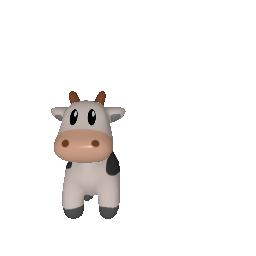
360 degree cow render
1.1 Cow turntable
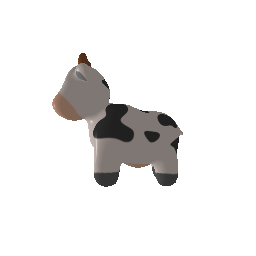
Cow dolly zoom
1.2 Dolly zoom

2. Practicing with Meshes

The tetrahedron has 4 vertices and 4 triangular faces. The cube has 8 vertices and 12 triangular faces, since each of its six square sides uses two triangles.

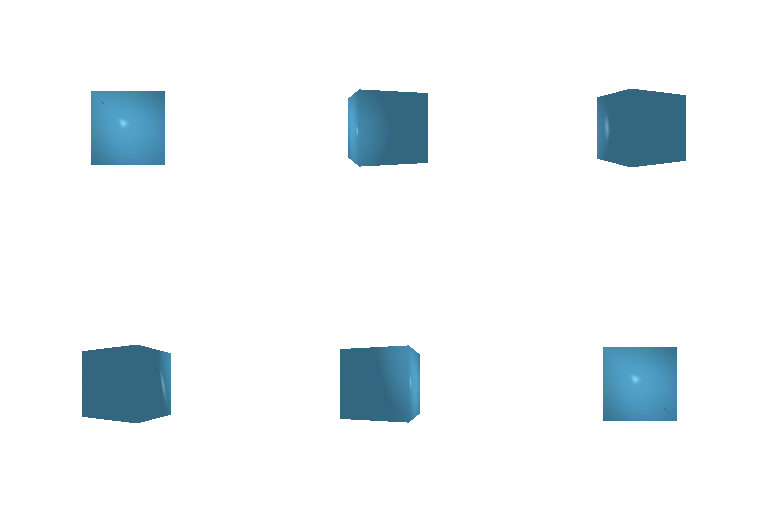
Tetrahedron turntable
2.1 Tetrahedron
Cube turntable
2.2 Cube

3. Re-texturing a Mesh

I chose dark blue color1 = [0, 0, 0.1] for the front and warm brown color2 = [0.8, 0.5, 0.3] for the back. Linear interpolation along each vertex's z-coordinate creates the smooth transition.

Retextured cow turntable
Front-to-back color interpolation

4. Camera Transformations

The starting camera has R0=I and T0=(0,0,3). I read each target as a change in orientation, size, or image position, chose the desired final camera translation, and solved Trel = Tdesired − Rrel·T0. Using the standard axis-rotation formulas with cos(90°)=0 and sin(90°)=1 gives Rz(−90°)=[[0,1,0],[−1,0,0],[0,0,1]] and Ry(90°)=[[0,0,1],[0,1,0],[−1,0,0]]. The small 0.5 and 0.3 offsets were tuned visually to match the pictures.
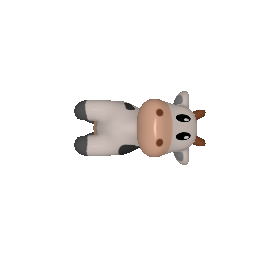
Rolled cow
Target 1. The picture is a 90° clockwise roll, so Rrel=Rz(−90°) and Trel=(0,0,0); rotation about z leaves T0 unchanged.
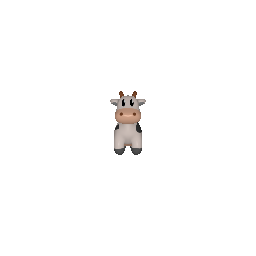
Cow farther away
Target 3. Only the scale changes, so Rrel=I. Doubling the final depth from 3 to 6 gives Trel=(0,0,6)−T0=(0,0,3).
Shifted cow
Target 4. Orientation and size stay fixed, so Rrel=I. A left/down image shift gives final T=(0.5,−0.5,3), hence Trel=(0.5,−0.5,0).
Side view of cow
Target 2. The side view uses Rrel=Ry(90°). Since Rrel·T0=(3,0,0), the desired T≈(0.3,0,3) gives Trel=(−2.7,0,3).

5. Rendering Generic 3D Representations

5.1 Point Clouds from RGB-D Images

First RGB-D point cloud
First view
Second RGB-D point cloud
Second view
Union of RGB-D point clouds
Union of both views

5.2 Parametric Functions

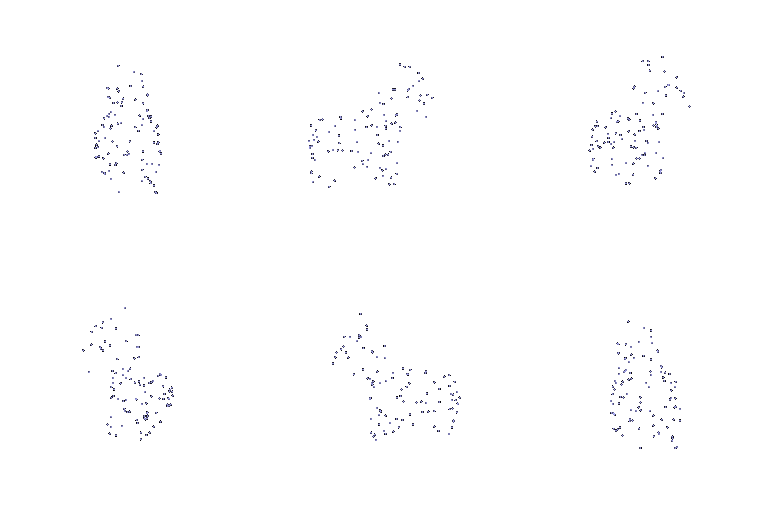
Parametric torus point cloud
Parametric torus
Parametric cone point cloud
New object: parametric cone

5.3 Implicit Surfaces

Meshes store connectivity, so they produce continuous surfaces, clean silhouettes, and reliable lighting with relatively few vertices, but extracting and maintaining good topology is more involved. Point clouds are easy to sample, combine, and obtain from sensors, but they can show holes and need many points (plus careful point-radius choices) for a dense-looking surface. Their memory and rendering cost therefore rise quickly with visual quality.

Implicit torus mesh
Implicit torus
Implicit cone mesh
New object: implicit cone

6. Extra Credit: Something Fun

Point-cloud snowman
A snowman assembled from parametric point-cloud primitives

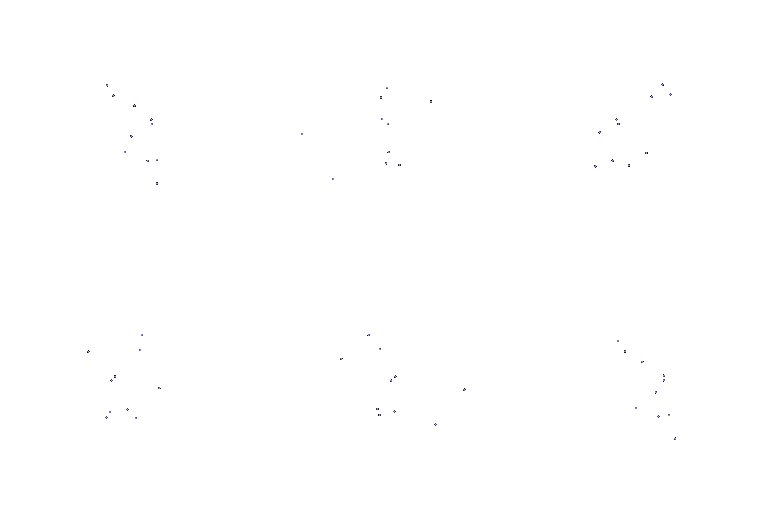
7. Extra Credit: Sampling Points on Meshes

Faces are sampled in proportion to their area, followed by a uniform barycentric sample within the selected triangle.
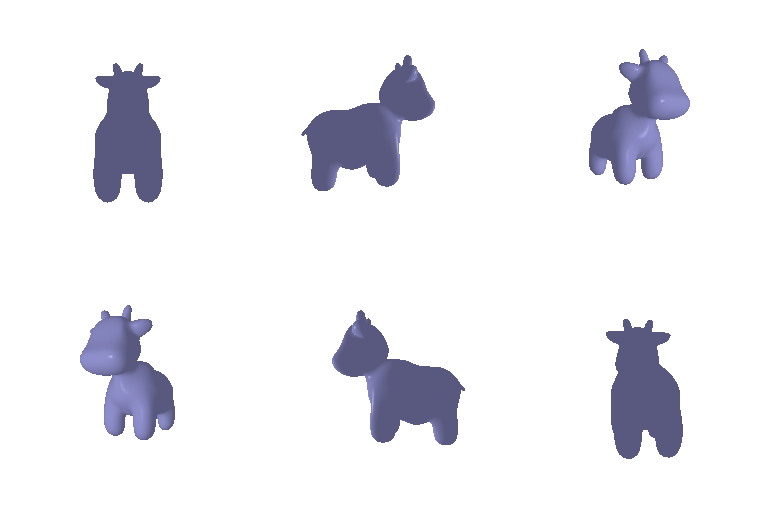
Original cow mesh
Original mesh
Cow sampled with 10 points
10 points
Cow sampled with 100 points
100 points
Cow sampled with 1000 points
1,000 points
Cow sampled with 10000 points
10,000 points