1.3. Ray sampling (5 points)


1.4. Point sampling (5 points)

1.5. Volume rendering (20 points)


3. Optimizing a Neural Radiance Field (NeRF) (20 points)

4.1 View Dependence (10 bonus points)
The benefits of View Dependence is to predict the highlights or the reflections from metals as we seen in the materials dataset. But if the network relies too heavily on the view dependence, it suffers shape ambiguity and overfitting.


4.2 Coarse/Fine Sampling (10 bonus points)
Using Coarse/Fine sampling cost more time at sampling, because it requires more computation. In hypothesis, the coarse sampling will improve the quality of th rendering; however, in this test, it doesn't show the significant improvement.

4.3 VolSDF (10 bonus points)
beta=0.2


beta(default)=0.05


beta=0.01


Alpha: density scaling factor, this controls how solid is the object.
Beta: surface boundary transition, it controls how quickly space transitions from completely empty outside the object to solid inside.
- How does high beta bias your learned SDF? What about low beta?
High beta bias causes smooth edges and the image show blur. Low beta bias causes clear edges.
- Would an SDF be easier to train with volume rendering and low beta or high beta? Why?
SDF is easier to train with volume rendering and low beta or high beta, because the density gradient is not zero.
- Would you be more likely to learn an accurate surface with high beta or low beta? Why?
To learn an accurate surface with low beta, because low beta means that there is no transition around the boundary.
5. 3D Gaussian Rasterization (35 points)

6 Training 3D Gaussian Representations (15 points)
parameters = [
    {'params': [gaussians.pre_act_opacities], 'lr': 0.05, "name": "opacities"},
    {'params': [gaussians.pre_act_scales], 'lr': 0.05, "name": "scales"},
    {'params': [gaussians.colours], 'lr': 0.05, "name": "colours"},
    {'params': [gaussians.means], 'lr': 0.05, "name": "means"},
]
[*] Evaluation --- Mean PSNR: 25.330
[*] Evaluation --- Mean SSIM: 0.868

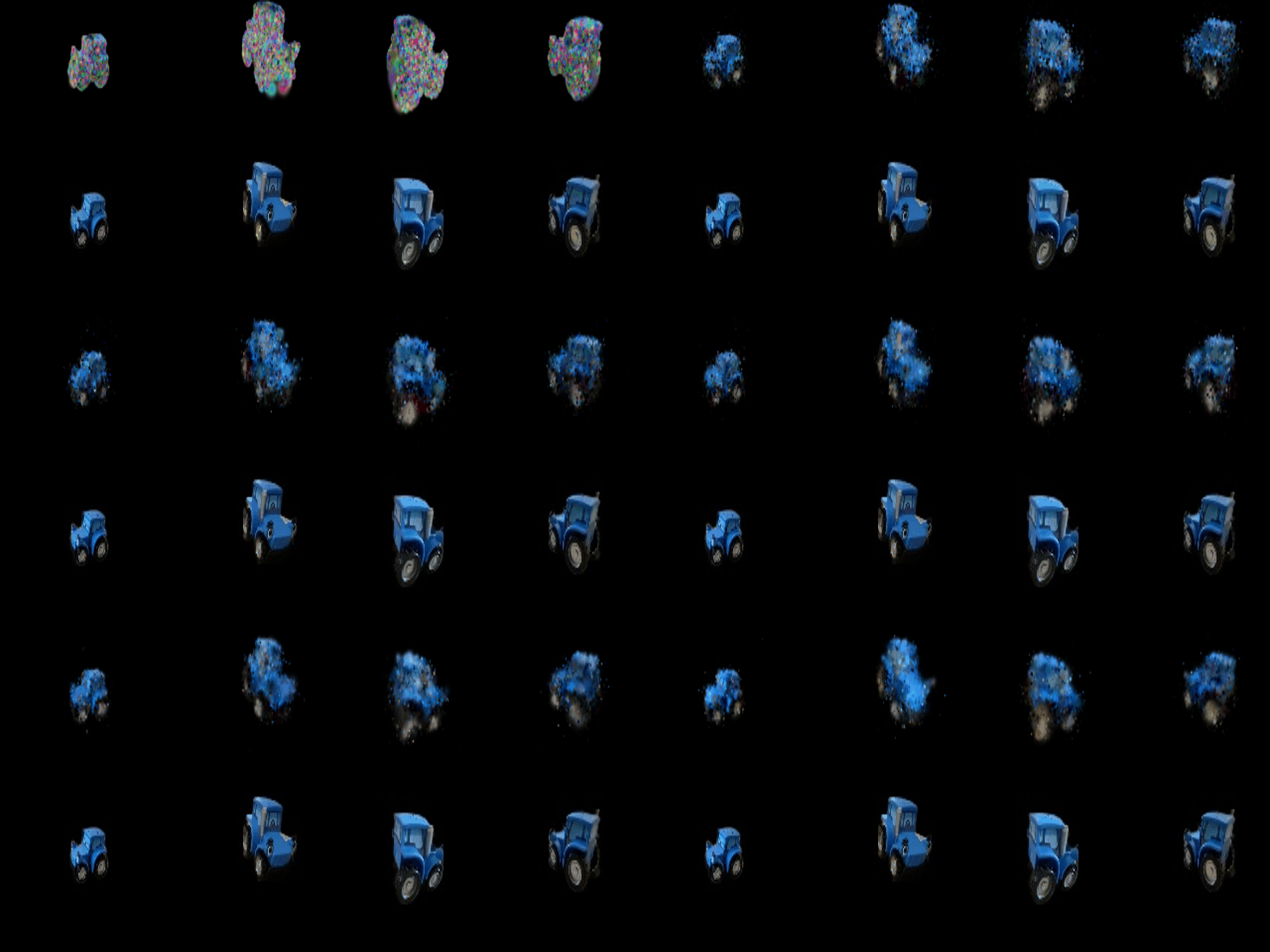
parameters = [
    {'params': [gaussians.pre_act_opacities], 'lr': 0.05, "name": "opacities"},
    {'params': [gaussians.pre_act_scales], 'lr': 0.05, "name": "scales"},
    {'params': [gaussians.colours], 'lr': 0.05, "name": "colours"},
    {'params': [gaussians.means], 'lr': 0.001, "name": "means"},
]
[*] Evaluation --- Mean PSNR: 29.399
[*] Evaluation --- Mean SSIM: 0.935


parameters = [
        {'params': [gaussians.pre_act_opacities], 'lr': 0.005, "name": "opacities"},
        {'params': [gaussians.pre_act_scales], 'lr': 0.05, "name": "scales"},
        {'params': [gaussians.colours], 'lr': 0.05, "name": "colours"},
        {'params': [gaussians.means], 'lr': 0.001, "name": "means"},
    ]
[*] Evaluation --- Mean PSNR: 28.606
[*] Evaluation --- Mean SSIM: 0.932


parameters = [
    {'params': [gaussians.pre_act_opacities], 'lr': 0.05, "name": "opacities"},
    {'params': [gaussians.pre_act_scales], 'lr': 0.05, "name": "scales"},
    {'params': [gaussians.colours], 'lr': 0.005, "name": "colours"},
    {'params': [gaussians.means], 'lr': 0.001, "name": "means"},
]
[*] Evaluation --- Mean PSNR: 30.054
[*] Evaluation --- Mean SSIM: 0.946


7.1 Rendering Using Spherical Harmonics (10 points)
5.5 (older question):
questions 7.1:
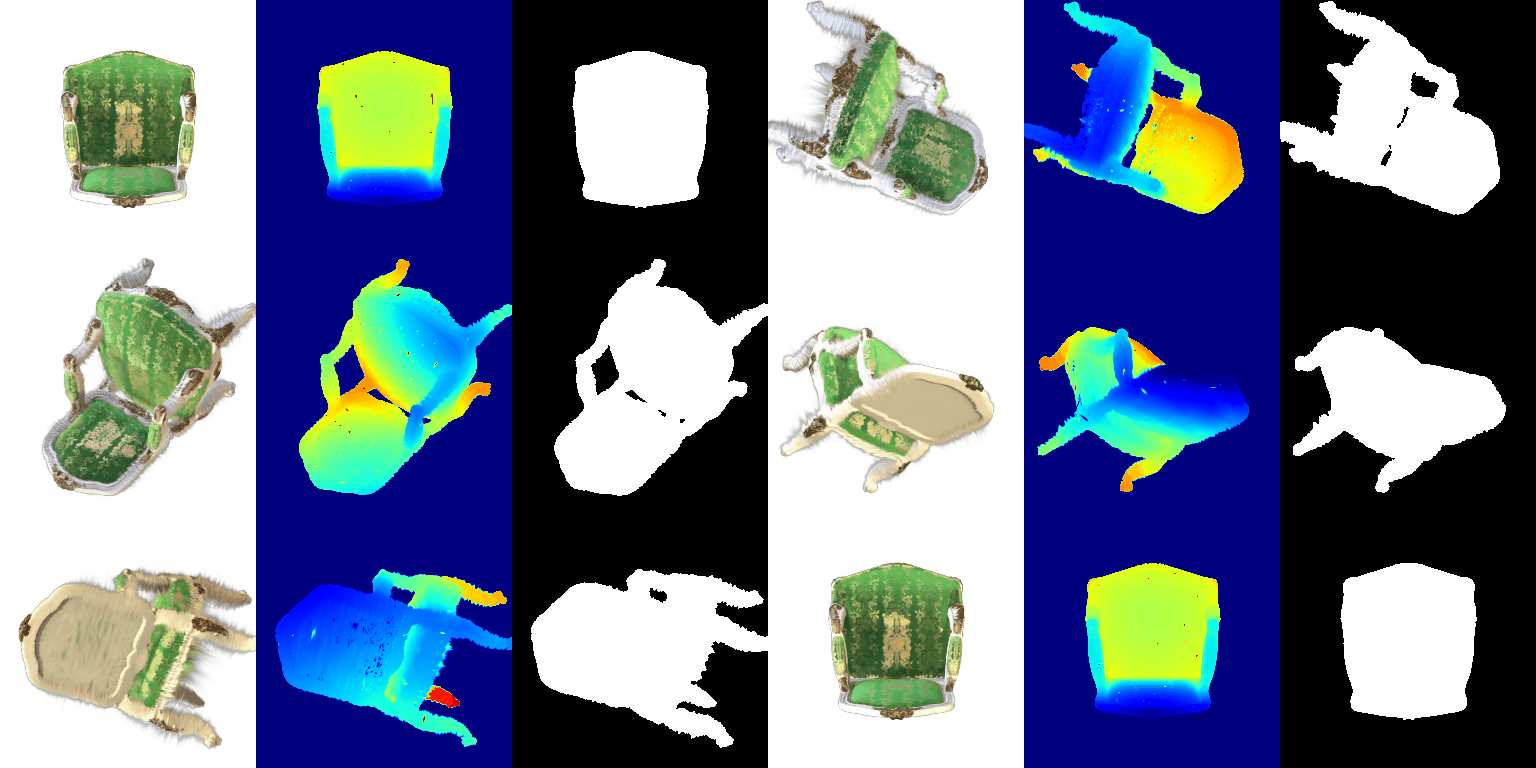
Comparision: When we use all spherical harmonic components to render, the color constract is obvious than the one we used only the DC spherical harmonic component. The color brown is more dark.


Use all spherical harmonic components to render, the highlight details appear much more natural, while the light and shadow transitions on the chair surface are more realistic.

