Assignment 5
Point Cloud Classification and Segmentation
Contents
1. Classification Model
1. Classification
30 pointsTest accuracy: 98.01%
Random test samples


Failure cases


All three just look like the other class. The chair is basically a flat panel, the vase sits on a tall pedestal like a floor lamp, and the lamp is a plain cylinder with no shade. Vases fail the most since there are few of them in training and they share the tall, round shape with lamps.
2. Segmentation Model
2. Segmentation
30 pointsTest accuracy: 90.29%
Ground truth (left) vs. prediction (right)

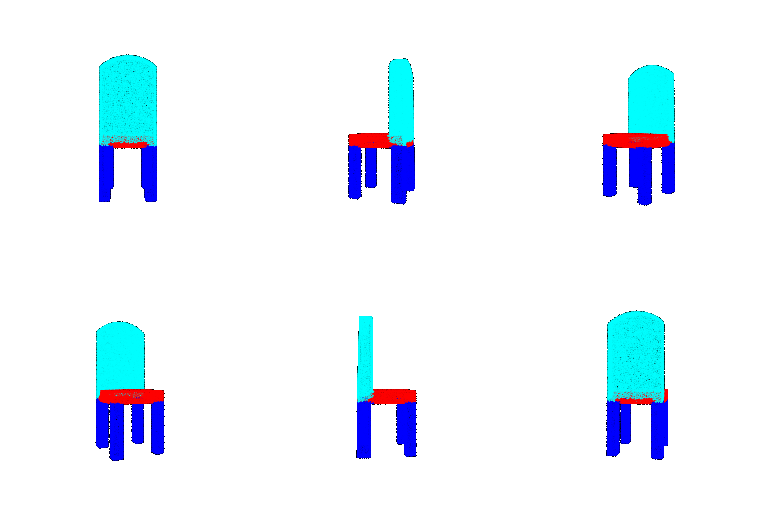


Normal chairs are mostly right, with errors only along part boundaries (e.g. the seat edge). The two bad ones are odd chairs: #235 is a boxy sofa where seat, back and arms blend together, and #605 has a sled-like base that gets labeled as seat/arms instead of legs. The model seems to lean on height to pick the part.
3. Robustness Analysis
3.1 Rotation
10 pointsProcedure. Rotate the test point clouds around the vertical axis by different angles and evaluate the Q1/Q2 models.
| Angle | Classification | Segmentation |
|---|---|---|
| 0° (Q1/Q2) | 98.01% | 90.29% |
| 15° | 96.96% | 86.27% |
| 30° | 80.59% | 79.11% |
| 45° | 64.74% | 72.97% |
| 60° | 58.45% | 66.67% |
| 90° | 57.19% | 58.37% |
Classification


Segmentation


Not robust to rotation. All training shapes face the same way and PointNet uses raw xyz with no T-Net or augmentation, so a rotated chair looks like a new shape. Segmentation drops a bit slower since rotating around the vertical axis keeps each point's height.
3.2 Number of Points
10 pointsProcedure. Randomly sample fewer points per object at test time (--num_points) and evaluate the Q1/Q2 models.
| Points | Classification | Segmentation |
|---|---|---|
| 10000 (Q1/Q2) | 98.01% | 90.29% |
| 5000 | 97.90% | 90.32% |
| 1000 | 97.06% | 89.42% |
| 500 | 96.85% | 87.85% |
| 100 | 92.86% | 79.65% |
Classification


Segmentation


Pretty robust. Max pooling only depends on a few key points, and a few hundred random points still cover the shape. At 100 points segmentation suffers more because thin parts like legs end up with just a few points.
4. Bonus: Locality
4. DGCNN
Bonus · 20 pointsModel. DGCNN with EdgeConv layers (k = 20). Each layer finds the k nearest neighbors in feature space, uses [xi, xj − xi] as edge features, applies an MLP and max-pools over neighbors. Trained and tested with 1024 points (k-NN memory is O(N²)), so PointNet is also tested at 1024 points below.
| Model | Classification | Segmentation |
|---|---|---|
| PointNet (Q1/Q2, 10000 pts) | 98.01% | 90.29% |
| PointNet (Q1/Q2, 1024 pts) | 97.27% | 89.51% |
| DGCNN (1024 pts) | 98.01% | 91.21% |
GT / PointNet / DGCNN


DGCNN fixes two of the three Q1 failures (#406, #650); the cylinder lamp #803 is still called a vase.