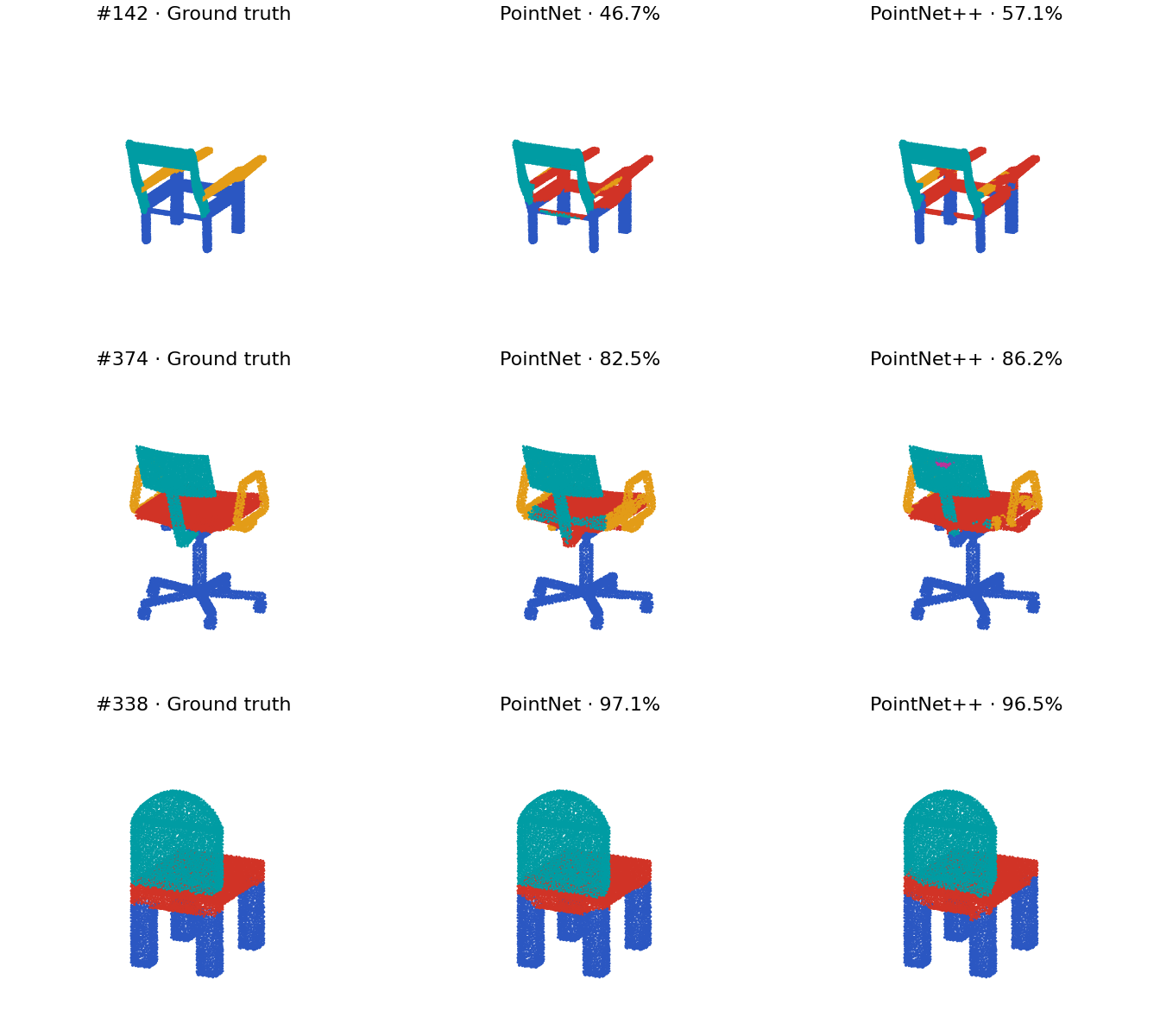
Chair #142 · 46.72%


The model identifies much of the back and legs. It assigns the thin armrests and several nearby rails to the seat class, accounting for much of the visible error.
16-825 · Learning for 3D Vision
A shared pointwise MLP encodes the XYZ coordinates. Global max pooling gives one descriptor per object, and a classification head predicts chair, vase, or lamp. The model trained for 30 epochs with 2,048 randomly sampled points per object. Validation accuracy selected the checkpoint, and the official test used all 10,000 points per object.
Test accuracy: 95.28% (908 / 953 objects)
| True class | Correct | Test objects | Accuracy |
|---|---|---|---|
| Chair | 614 | 617 | 99.51% |
| Vase | 89 | 102 | 87.25% |
| Lamp | 205 | 234 | 87.61% |
One object was sampled at random from each true class.


The segmentation model concatenates each point's local feature with a global max-pooled descriptor and predicts one of six part labels per point. It trained for 30 epochs with 2,048 sampled points per object. The best validation checkpoint was evaluated on all 10,000 points of each of the 617 test chairs.
Test point accuracy: 89.44% (5,518,677 / 6,170,000 points)
Colors indicate the same part labels throughout. Objects #142 and #351 have the two lowest test accuracies.
The model identifies much of the back and legs. It assigns the thin armrests and several nearby rails to the seat class, accounting for much of the visible error.


The compact, curved shell has no clearly separated legs. The model predicts a broad band of support labels around the lower shell, where the ground-truth part labels continue down from the upper surfaces.


The model captures the wheeled base and most of the backrest. Errors cluster around the seat and the lower armrest attachments, where several parts meet.


The four legs, crossbars, seat, and backrest are largely intact. A few support labels spill into the seat edge around the joints.


The model separates the seat, legs, and rounded backrest cleanly. The remaining visible errors are concentrated near the seam between the backrest and seat.
Both experiments use the trained PointNet checkpoints from Q1 and Q2. Classification accuracy is measured over all 953 test objects. Segmentation accuracy is measured over the evaluated points from all 617 test chairs. The original 10,000-point inputs reproduce the Q1 and Q2 baselines.
Rotate every test cloud by 30°, 60°, or 90° about the Y axis through the origin. Each input keeps all 10,000 points. Each segmentation label stays attached to its corresponding point during rotation.
| Rotation | Classification | Change (pp) | Segmentation | Change (pp) |
|---|---|---|---|---|
| 0° (baseline) | 95.28% | 0.00 | 89.44% | 0.00 |
| 30° | 85.20% | −10.07 | 75.13% | −14.31 |
| 60° | 69.05% | −26.23 | 64.14% | −25.30 |
| 90° | 65.27% | −30.01 | 55.70% | −33.74 |
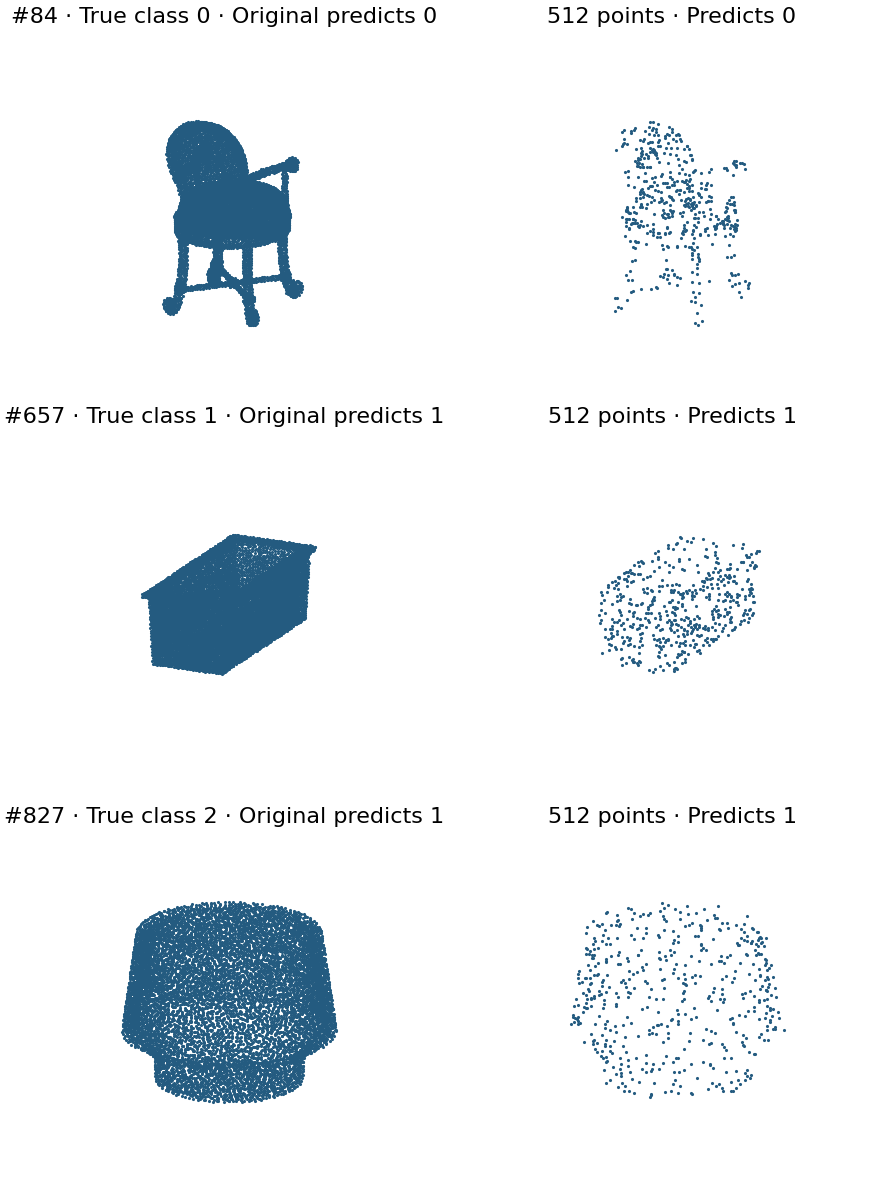
Accuracy decreased as the tested angle increased for both tasks. The classifier changed chair #84 from class 0 to class 1 after a 90° rotation. For chair #338, segmentation dropped from 97.1% to 62.2%, with errors across the backrest and seat. The models were trained in the dataset's original orientations, and the pointwise features depend directly on the XYZ coordinates. The results show sensitivity to orientation despite max pooling across points.


Use a fixed random permutation of point indices (seed 825) to select nested subsets of 4,096, 2,048, and 512 points without replacement. Keep the original orientation and score the segmentation predictions on the retained points.
| Input points | Classification | Change (pp) | Segmentation | Change (pp) |
|---|---|---|---|---|
| 10,000 (baseline) | 95.28% | 0.00 | 89.44% | 0.00 |
| 4,096 | 95.07% | −0.21 | 89.41% | −0.03 |
| 2,048 | 95.17% | −0.10 | 89.38% | −0.07 |
| 512 | 94.86% | −0.42 | 88.57% | −0.87 |
With 512 points, classification lost 0.42 percentage points and segmentation lost 0.87 points relative to the full-cloud baselines. Scoring the full-input segmentation predictions on the same 512 retained points gave 89.40%, a 0.83-point gap from the sparse-input prediction. The retained points still capture the overall shape in the examples. Chair #338 retains its main part boundaries, and the armrest errors on chair #142 are visible at both densities. These results describe one fixed random subsample at each size.

I implemented a PointNet++ variant with two levels of set abstraction. The first level uses farthest-point sampling to select 128 centers and groups 24 nearest input points around each center. The second selects 32 of those centers and groups 16 neighbors. A shared MLP encodes relative XYZ coordinates and any features from the previous level, then max pooling summarizes each neighborhood. A final global max-pooling layer gives the classifier an object descriptor.
For segmentation, the decoder interpolates features from the three nearest coarse centers with inverse squared distance weights. It combines the interpolated features with first-level features and the global descriptor, interpolates again to the original points, and predicts a part label at each point. The hierarchy follows the set-abstraction and feature-propagation design of PointNet++.
Both models trained for 30 epochs using 2,048 randomly sampled points per object. The best checkpoint from that stage then received six more epochs of fine-tuning on full 10,000-point clouds at a learning rate of 0.0003. Checkpoint selection used the same held-out splits as Q1 and Q2. All reported test scores use the full 10,000 points per object.
| Model | Classification accuracy | Segmentation point accuracy |
|---|---|---|
| PointNet (Q1 and Q2) | 95.28% (908 / 953) | 89.44% (5,518,677 / 6,170,000) |
| PointNet++ after 2,048-point training | 94.54% (901 / 953) | 88.18% (5,440,486 / 6,170,000) |
| PointNet++ after full-cloud fine-tuning | 98.01% (934 / 953) | 90.01% (5,553,625 / 6,170,000) |
The selected model improves classification by 2.73 percentage points and segmentation by 0.57 points. The local model also received extra full-cloud training, so the comparison measures the combined effect of the architecture and training schedule.
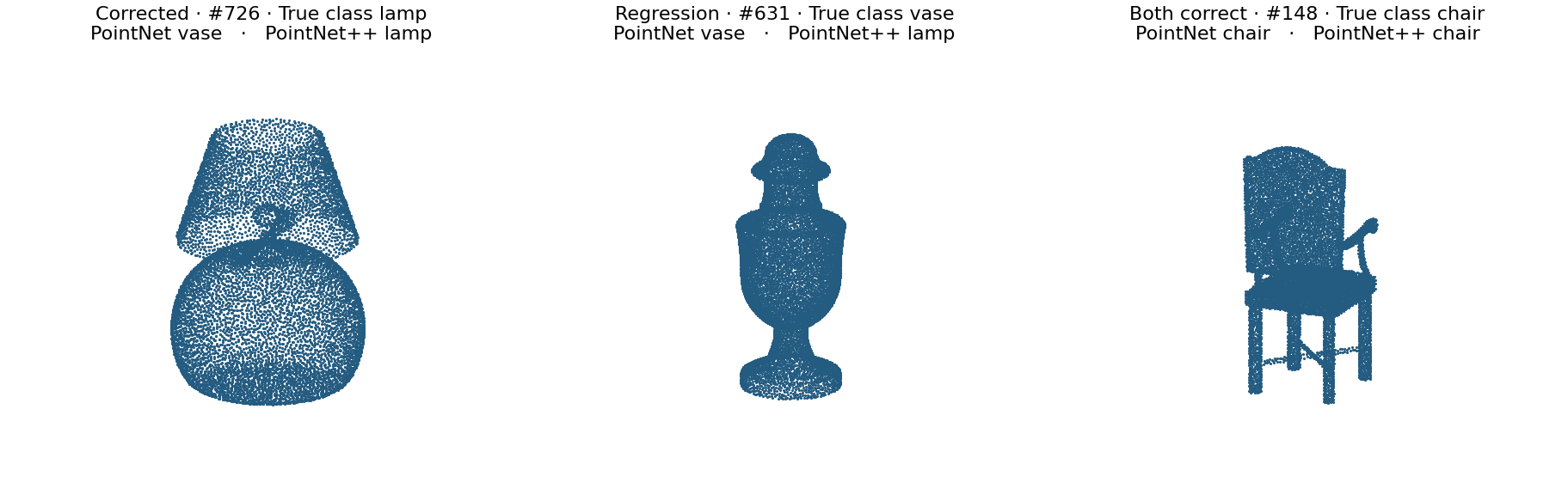
The selected model corrected 34 of the baseline's errors and introduced 8 new errors. It correctly recognized the lamp in #726, which PointNet labeled as a vase. It predicted a lamp for vase #631, whose narrow stem and wide base resemble a lamp stand.
On chair #142, the local model recovers parts of the armrests, raising accuracy from 46.72% to 57.10%. It labels more of the seat correctly on #374, which improves from 82.55% to 86.19%. Both models capture the main parts of #338, with accuracy changing from 97.06% to 96.47%.