1.1 360-Degree Renders

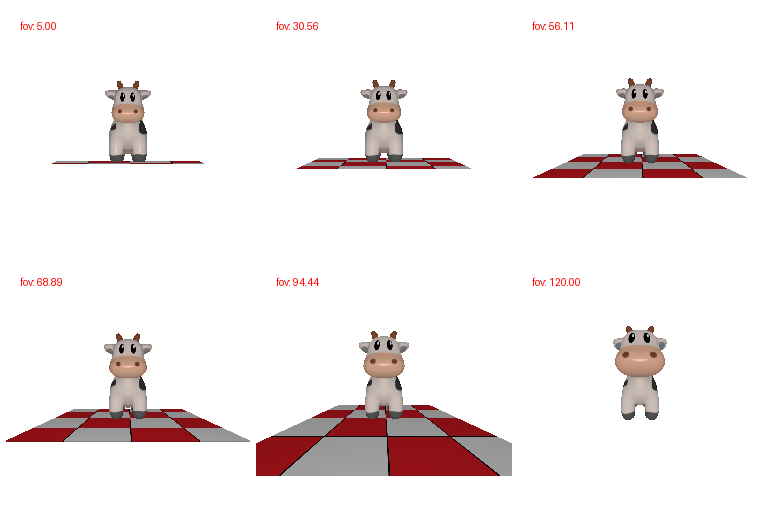
1.2 the Dolly Zoom
2.1 Constructing a Tetrahedron
A tetrahedron with 4 vertices and 4 triangular faces

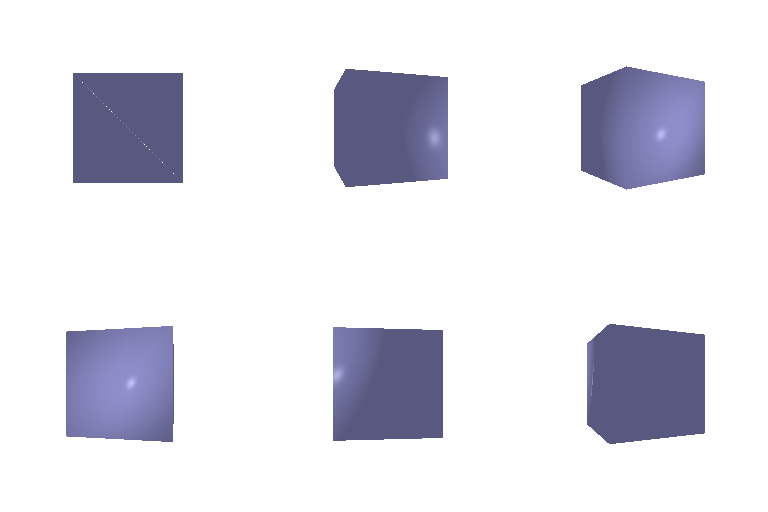
2.2 Constructing a Cube
This cube has 8 vertices, with 12 triangles in total.
3. Re-texturing a Mesh
color1 = [0, 0, 1] (blue): front of the cow; color2 = [0, 1, 0] (green): back of the cow.

4. Camera Transformations
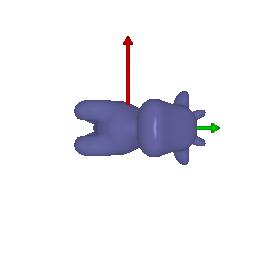
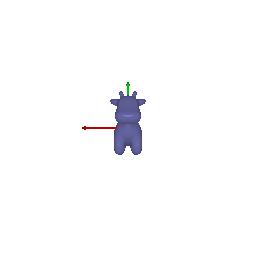
For each target view, a relative rotation/translation $(R_{\text{relative}}, T_{\text{relative}})$ is applied on top of the reference extrinsics, giving $R = R_{\text{relative}} \, R_0$ and $T = R_{\text{relative}} \, T_0 + T_{\text{relative}}$.
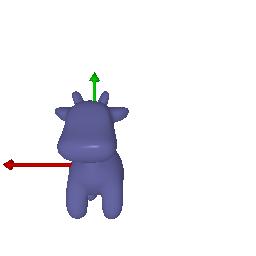
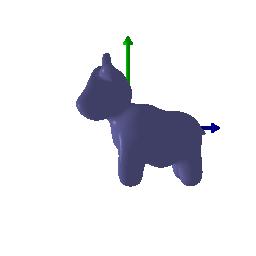
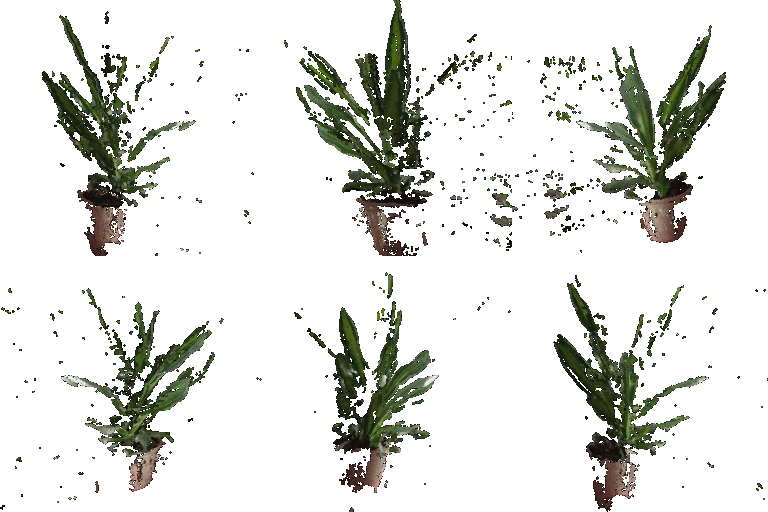
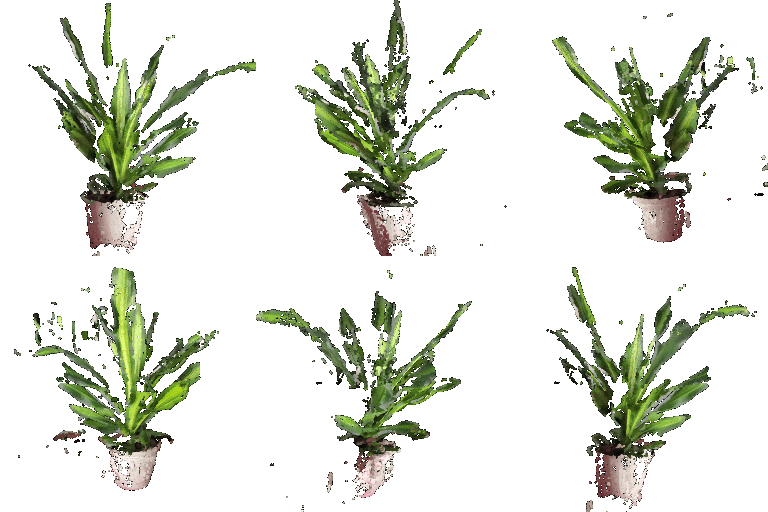
5.1 Rendering Point Clouds from RGB-D Images
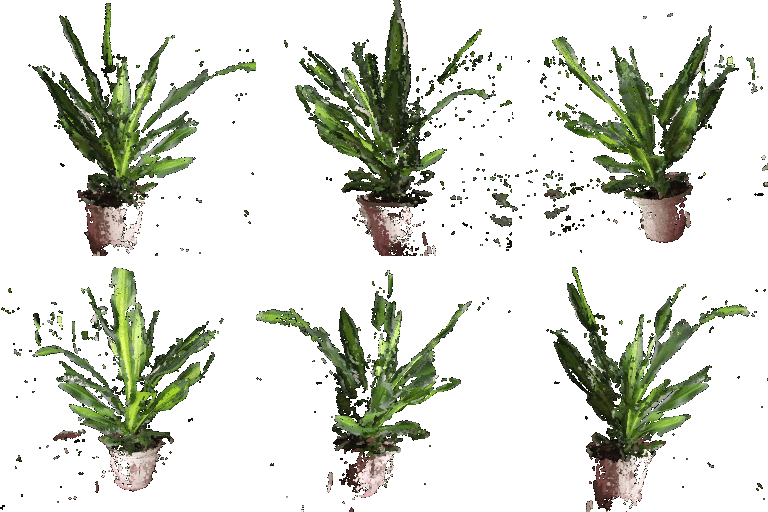
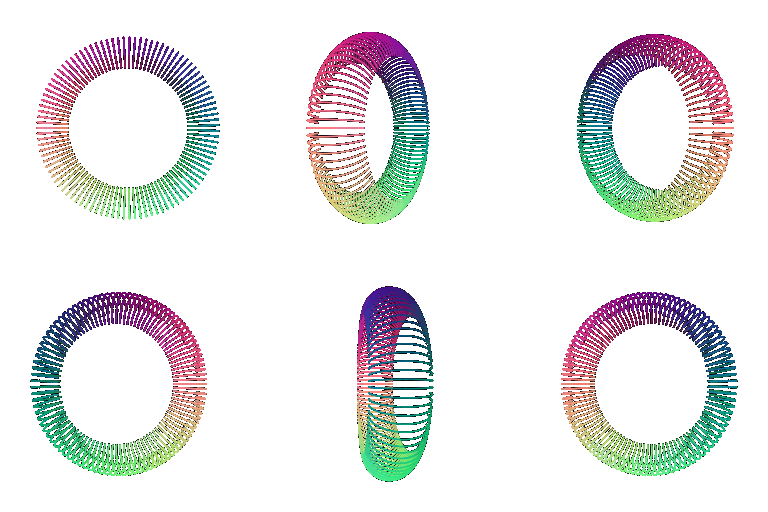
5.2 Parametric Functions
Torus
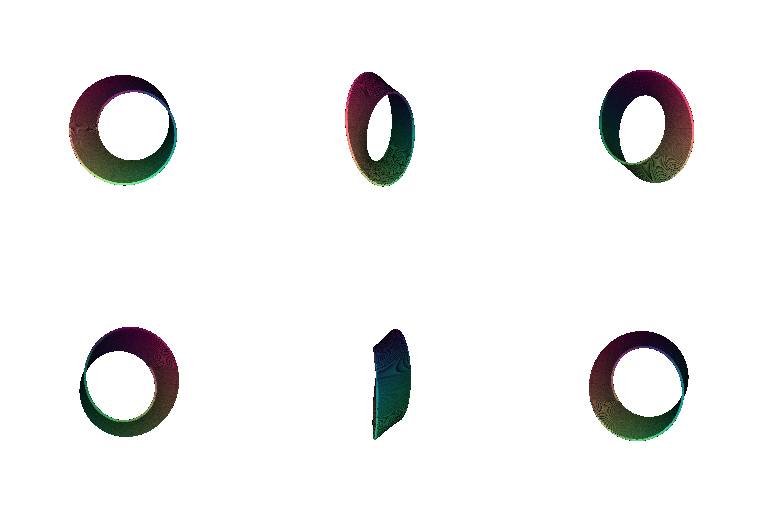
Extra object: Möbius strip
A Möbius strip parameterized over u ∈ [0, 2π], v ∈ [-0.6, 0.6].
5.3 Implicit Surfaces
Torus mesh

Mesh vs. point cloud tradeoffs
Meshes: rendering is fast (rasterization), shading looks smooth, and the representation is memory-efficient
for low-curvature geometry. Building a mesh from an implicit function requires
discretizing a 3D voxel grid and running marching cubes, whose resolution directly limits geometric quality
and can introduce topological artifacts.
Point clouds: any function that produces 3D samples can be visualized immediately. However, point clouds have no real surface,
so achieving same render quality requires more samples, memory usage and rendering time than an equivalent mesh.
Extra object: superquadric

(Extra Credit) 6. Do Something Fun
A yellow duck. Credit: https://free3d.com/3d-model/rubber-duck-v1--250409.html

(Extra Credit) 7. Sampling Points on Meshes


