1. Practicing With Cameras
1.1 360-Degree Renders

1.2 Dolly Zoom

2. Practicing with Meshes
2.1 Constructing a Tetrahedron
The mesh has 4 vertices and 4 faces.

The mesh has 8 vertices and 12 faces.

3. Retexturing a Mesh
I decided to switch the colors from red and blue to green and pink. I used a color slider to choose the RGB values and converted them to a 0-1 scale to display them here.

4. Camera Transformations
The first transformation is a 90-degree rotation around the z-axis. This is represented by:
$$R_{relative} = \begin{bmatrix} cos(\theta) & -sin(\theta) & 0 \\ sin(\theta) & cos(\theta) & 0 \\ 0 & 0 & 1 \\ \end{bmatrix}$$
Where $\theta = -\frac{\pi}{2}$.

The second transformation is a translation along the z-axis. This is represented by:
$$T_{relative} = \begin{bmatrix} 0 & 0 & 2 \\ \end{bmatrix}$$

The third transformation is a translation in the x and y axes. This is represented by:
$$T_{relative} = \begin{bmatrix} 0.5 & -0.5 & 0 \\ \end{bmatrix}$$

The fourth transformation is a 90-degree rotation around the y-axis combined with a translation in the x and z axes. This is represented by:
$$R_{relative} = \begin{bmatrix} cos(\theta) & 0 & sin(\theta) \\ 0 & 1 & 0 \\ -sin(\theta) & 0 & cos(\theta) \\ \end{bmatrix}$$
$$T_{relative} = \begin{bmatrix} -\pi & 0 & \pi \\ \end{bmatrix}$$
Where $\theta = \frac{\pi}{2}$.

5. Rendering Generic 3D Representations
5.1 Rendering Point Clouds from RGB-D Images


5.2 Parametric Functions

New object: Helix

5.3 Implicit Surfaces
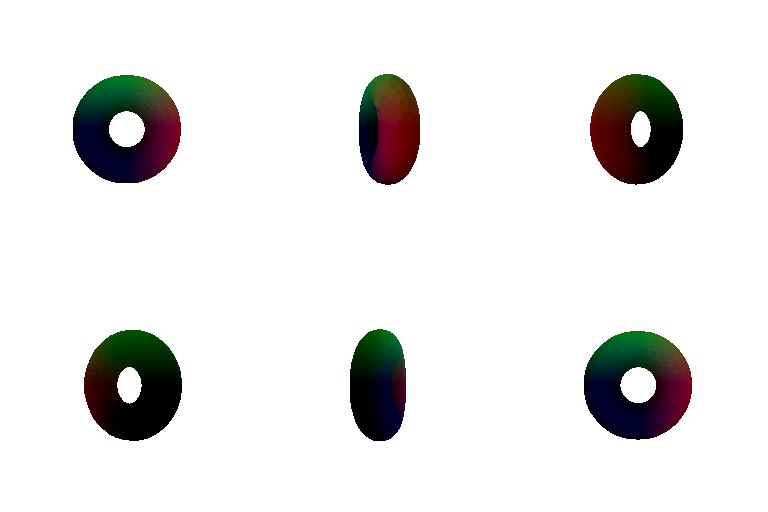
New object: Genus
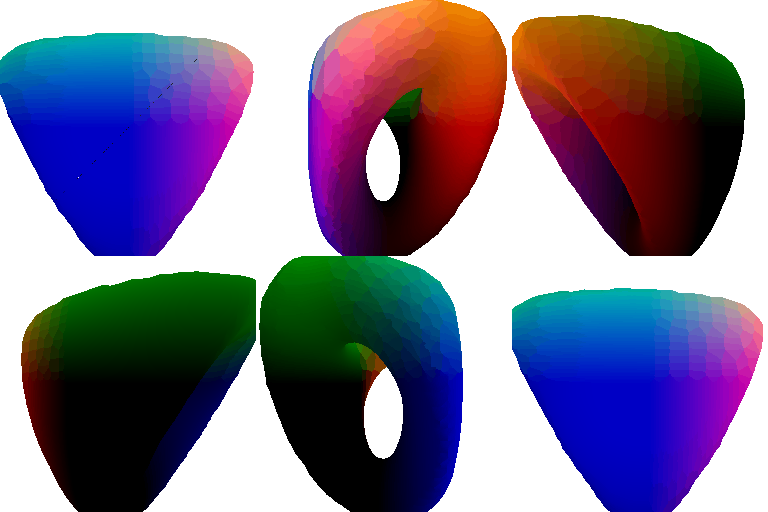
Rendering as a mesh is useful for computing surface information and defining the boundaries of shapes, especially for purposes such as ray-triangle interactions or texturing. Meshes can be of varying quality, though higher-quality meshes become inefficient and difficult to work with as they have to store and work with increasing amounts of vertices and faces. It can also be difficult to transform or infer due to the necessity of connectivity between vertices.
Point clouds, on the other hand, have no such connectivity requirement, making them versatile and easy to use. However, it is difficult to determine any sort of surface or boundary information due to the lack of connectivity or ordering. Rendering quality is similarly variable, where higher-quality imagery requires storing more vertices, but they store less information overall. However, the tradeoff is that any necessary connectivity information needs to be computed at runtime, unlike a mesh which already has it available.
6. Something Fun!
This is a figurine I modeled and 3D-printed a couple of years ago based on Amazon's Project Kuiper. It features a communications dish pointing up at a satellite, mounted on a solid base. I decided to render and texture it with some slight modifications. I thought it might be interesting to try sampling random points to color white, thinking it might create a pinprick effect, but due to the way color is assigned over the surface, it created this streak effect instead. While not the desired output, it is still interesting.
