Vertices: 4. Faces: 4.

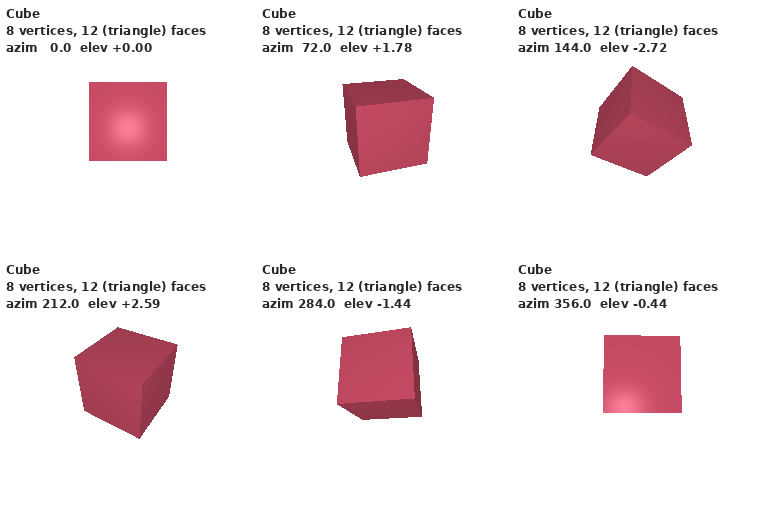
Vertices: 8. Faces: 12.
color1 = (0, 0.71, 1) (Cyber Blue). color2 = (1, 0, 1) (Hot Magenta)

Baseline camera:
R0 =            T0 =
[ 1  0  0 ]     [ 0 ]
[ 0  1  0 ]     [ 0 ]
[ 0  0  1 ]     [ 3 ]

Transform 1: Roll the camera 90 degrees about its viewing (Z) axis
R_relative =        T_relative =
[  0  1  0 ]        [ 0 ]
[ -1  0  0 ]        [ 0 ]
[  0  0  1 ]        [ 0 ]
| Original | Mine |
|---|---|
|
|
Transform 2: Yaw the camera 90 degrees about the world Y axis and move it to the opposite side of the cow
R_relative =        T_relative =
[  0  0  1 ]        [ -3 ]
[  0  1  0 ]        [  0 ]
[ -1  0  0 ]        [  3 ]
| Original | Mine |
|---|---|
 |
 |
Transform 3: Keep orientation fixed and push the camera straight back along its own Z axis.
R_relative =        T_relative =
[ 1  0  0 ]         [ 0.0 ]
[ 0  1  0 ]         [ 0.0 ]
[ 0  0  1 ]         [ 1.5 ]
| Original | Mine |
|---|---|
 |
 |
Transform 4: Slide the camera sideways along its own X axis.
R_relative =        T_relative =
[ 1  0  0 ]         [  0.5 ]
[ 0  1  0 ]         [ -0.5 ]
[ 0  0  1 ]         [  0.0 ]
| Original | Mine |
|---|---|
 |
 |
Point cloud 1, point cloud 2, and their union, each shown as a 12-frame turntable at distance 6:
| Image 1 | Image 2 | Union |
|---|---|---|
 |
 |
 |
Torus point cloud, 360-degree gif, hole visible:

Extra object (own choice): a helical coil, same tube parameterization as the torus with phi sweeping several turns and a linear rise in z:

Torus mesh via marching cubes, 360-degree gif, hole visible:

Extra object (own choice): two merged Gaussian fields, producing one blob with a pinched waist where the fields overlap:

Mesh vs. point cloud tradeoffs: Meshes look good because they give you connected surfaces with proper normals for lighting but the tradeoff is you need to evaluate a full voxel grid upfront and you're locked into whatever resolution you extracted at.
On the other hand, point clouds are quick and easy to generate since there's not connectivity to generate, but it doesen't look great without a surface without many points, and memory scales with point count not necessarily of surface area.
Banking drone flyby using the tetrahedron and cube from Section 2:


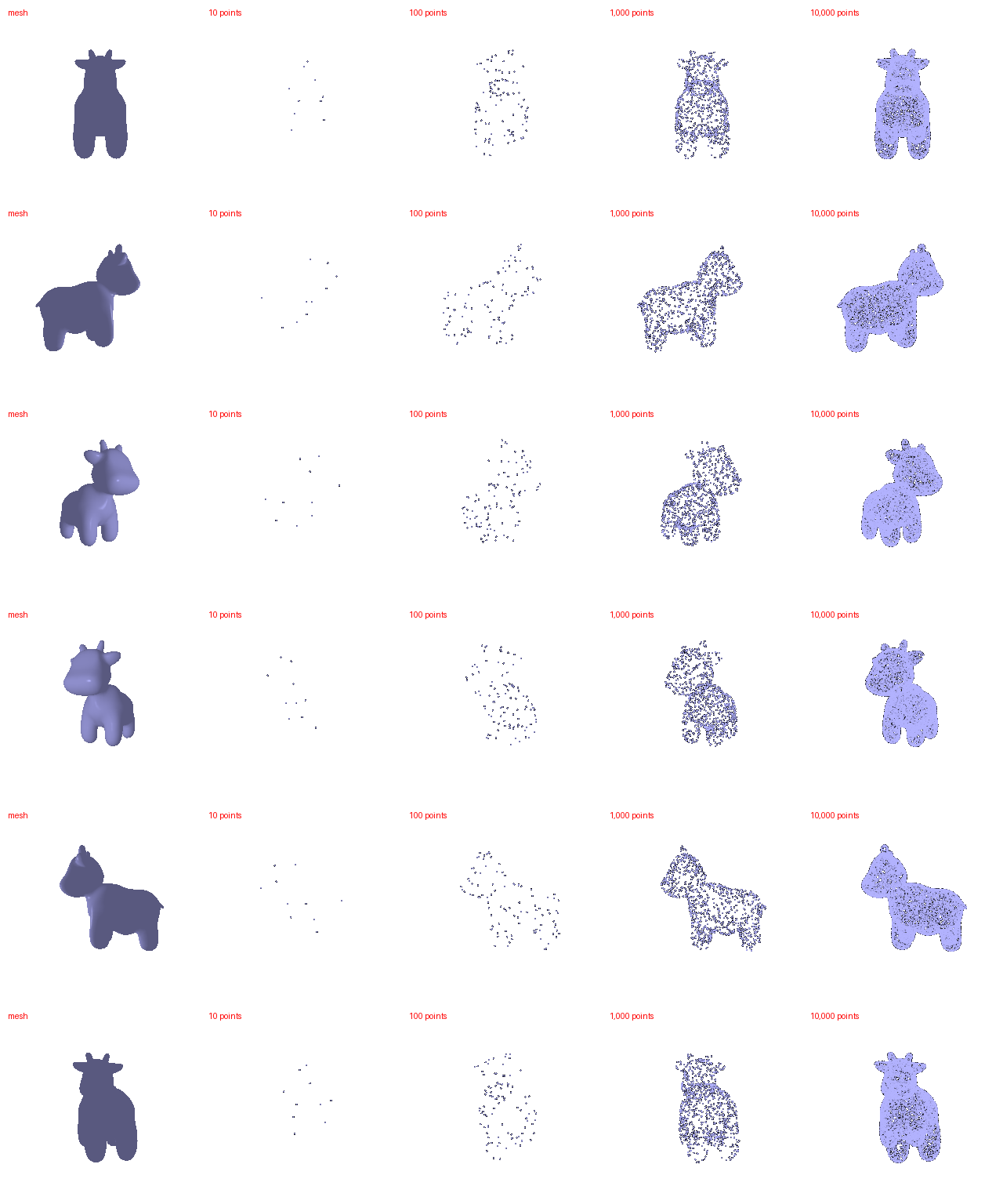
Faces sampled proportional to area, barycentric coordinates sampled uniformly via a sqrt-transform. 10, 100, 1000, and 10000 sampled points shown alongside the original cow mesh: